

Why I Erased 10,000 Notes, 7 Years of Ideas, and Every Thought I Tried to Save
Meet Pebble Index 01 - External Memory For Your Brain
Catch your best ideas before they slip through your fingers Do you ever have flashes of insight or an idea worth remembering? This happens to me 5 10 times e...

Tinkered Thinking
Daily, snackable writings to spur changes in thinking.Building a blueprint for a better brain by tinkering with the code.
Do not give up your brain
It's tempting to just let tools think for you, but you still need to be able to think for yourself and stay sharp.

mymind is the extension for your mind.
A private place to save your most precious notes, images, quotes and highlights. Enhanced with AI to help you remember without wasting time on categorizing & organizing.
Vox on Twitter / X
stop just hoarding notes.you save more every week and find less every month. a thousand notes, none of them talking to each other. a better notes app won't fix that. nobody maintains the brain you built.Karpathy's 𝗟𝗟𝗠 𝗪𝗶𝗸𝗶 fixes that: don't have AI search your notes,…— Vox (@Voxyz_ai) June 29, 2026
The Cognitive Debt of Digging Through Preprints
Your Brain on MIT Media Lab

The Second Brain That Grows Smarter and Lives on your Computer
How a spark from Andrej Karpathy, app called Obsidian, and “The Curator”, the app I built are changing the way I think.
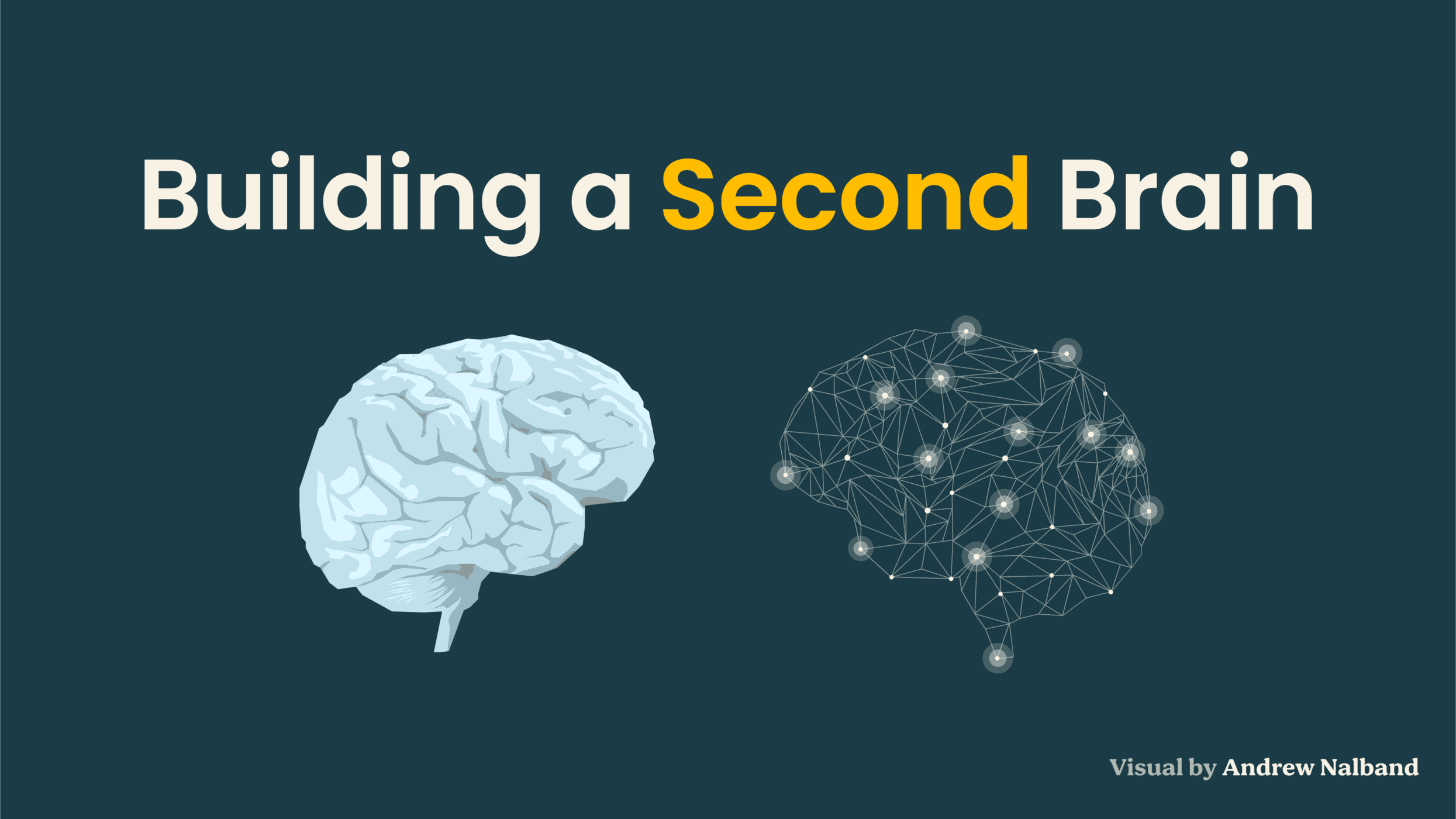
Building a Second Brain: The Definitive Introductory Guide
This is an introduction to Building a Second Brain, the proven method to organize your digital life and unlock your creative potential
Basic Memory
AI conversations that actually remember. Never re-explain your project to your AI again. Join our Discord: https://discord.gg/tyvKNccgqN

Your Brain Can Only Take So Much Focus
Research has shed light on the power of focus and its role as a hidden driver of success. Yet as helpful as focus can be, research also shows there’s a downside to it: excessive focus exhausts the focus circuits in your brain. It can drain your energy, make you lose self-control, impair your decision-making, and make you less collaborative. The brain operates optimally when it toggles between focus and unfocus. When you unfocus, you engage a brain circuit called the default mode network (DMN). The DMN activates old memories, goes back and forth between the past, present, and future, and recombines different ideas. Using this new and previously inaccessible data, you can imagine creative solutions or predict the future, and more. There are many simple and effective ways to activate this circuit in the course of a day, such as positive constructive daydreaming, napping, and consciously thinking from another person’s perspective.

Note-ifying all the things (with Boris Mann)
Conversation about note-taking, the overwhelm of tools, and future possibilities. (shortlink:…

Imagining your future projects is holding you back.
There is no book. There is only Idea Debt.

Your Brain on ChatGPT: Accumulation of Cognitive Debt when Using an AI Assistant for Essay Writing Task
This study explores the neural and behavioral consequences of LLM-assisted essay writing. Participants were divided into three groups: LLM, Search Engine, and Brain-only (no tools). Each completed three sessions under the same condition. In a fourth session, LLM users were reassigned to Brain-only group (LLM-to-Brain), and Brain-only users were reassigned to LLM condition (Brain-to-LLM). A total of 54 participants took part in Sessions 1-3, with 18 completing session 4. We used electroencephalography (EEG) to assess cognitive load during essay writing, and analyzed essays using NLP, as well as scoring essays with the help from human teachers and an AI judge. Across groups, NERs, n-gram patterns, and topic ontology showed within-group homogeneity. EEG revealed significant differences in brain connectivity: Brain-only participants exhibited the strongest, most distributed networks; Search Engine users showed moderate engagement; and LLM users displayed the weakest connectivity. Cognitive activity scaled down in relation to external tool use. In session 4, LLM-to-Brain participants showed reduced alpha and beta connectivity, indicating under-engagement. Brain-to-LLM users exhibited higher memory recall and activation of occipito-parietal and prefrontal areas, similar to Search Engine users. Self-reported ownership of essays was the lowest in the LLM group and the highest in the Brain-only group. LLM users also struggled to accurately quote their own work. While LLMs offer immediate convenience, our findings highlight potential cognitive costs. Over four months, LLM users consistently underperformed at neural, linguistic, and behavioral levels. These results raise concerns about the long-term educational implications of LLM reliance and underscore the need for deeper inquiry into AI's role in learning.

Your Brain on ChatGPT: Accumulation of Cognitive Debt when Using an AI Assistant for Essay Writing Task
This study explores the neural and behavioral consequences of LLM-assisted essay writing. Participants were divided into three groups: LLM, Search Engine, and Brain-only (no tools). Each completed three sessions under the same condition. In a fourth session, LLM users were reassigned to Brain-only group (LLM-to-Brain), and Brain-only users were reassigned to LLM condition (Brain-to-LLM). A total of 54 participants took part in Sessions 1-3, with 18 completing session 4. We used electroencephalography (EEG) to assess cognitive load during essay writing, and analyzed essays using NLP, as well as scoring essays with the help from human teachers and an AI judge. Across groups, NERs, n-gram patterns, and topic ontology showed within-group homogeneity. EEG revealed significant differences in brain connectivity: Brain-only participants exhibited the strongest, most distributed networks; Search Engine users showed moderate engagement; and LLM users displayed the weakest connectivity. Cognitive activity scaled down in relation to external tool use. In session 4, LLM-to-Brain participants showed reduced alpha and beta connectivity, indicating under-engagement. Brain-to-LLM users exhibited higher memory recall and activation of occipito-parietal and prefrontal areas, similar to Search Engine users. Self-reported ownership of essays was the lowest in the LLM group and the highest in the Brain-only group. LLM users also struggled to accurately quote their own work. While LLMs offer immediate convenience, our findings highlight potential cognitive costs. Over four months, LLM users consistently underperformed at neural, linguistic, and behavioral levels. These results raise concerns about the long-term educational implications of LLM reliance and underscore the need for deeper inquiry into AI's role in learning.
I accidentally wrote a whole post thinking back on the last year of Roomy development.

Learning To Write Software… Is Hard - Zicklag's Leaflets
zicklag.leaflet.pub