


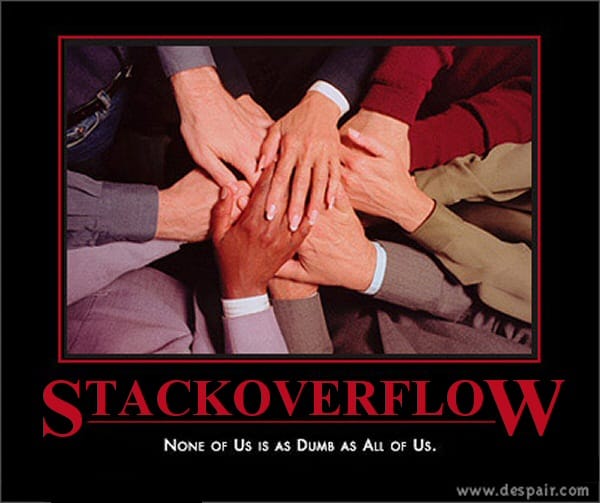
I had to think for a minute to realize that Stack Overflow has “gamification” too. Not a ton. Maybe a dusting of gamification, most of it around reputation.
Play is doing its work even if we’re not keeping score | Aeon Essays
We are most human when we play freely, imaginatively, pointlessly. Gamification risks atrophying that most precious capacity

Integrity games: an online teaching tool on academic integrity for undergraduate students
In this paper, we introduce Integrity Games (https://integgame.eu/) – a freely available, gamified online teaching tool on academic integrity. In addition, we present results from a randomized controlled experiment measuring the learning outcomes from playing Integrity Games.

What does Stack Overflow want to be when it grows up?
I sometimes get asked by regular people in the actual real world what it is that I do for a living, and here’s my 15 second answer: We built a sort of Wikipedia website for computer programmers to post questions and answers. It’s called Stack Overflow. As of
High score, low pay: why the gig economy loves gamification
The long read: Using ratings, competitions and bonuses to incentivise workers isn’t new – but as I found when I became a Lyft driver, the gig economy is taking it to another level

A lexicon for game activity sharing
I think that discussion landed on atmosphere.games, no? I think it’d be cool to get this lexicon out there soon.
From Pill Mills to Prop Bets: Prediction Markets and Mobile Sports Betting Apps Are Fueling America’s Next Addiction Crisis
Against the gamblification of the world.

Opinion | Video Games Are Destroying the People Who Make Them (Published 2017)
The industry’s infamous “crunch” culture is taking a serious toll on workers.

How League of Legends could make the internet a better place
An online game could just be the start of a happier, healthier online community

The rise of Whatever
This was originally titled “I miss when computers were fun”. But in the course of writing it, I discovered that there is a reason computers became less fun, a dark thread woven through a number of events in recent history. Let me back up a bit.

Game design is simple, actually
So, let’s just walk through the whole thing, end to end. Here’s a twelve-step program for understanding game design. One: Fun There are a lot of things people call “fun.” But most of them are not u…

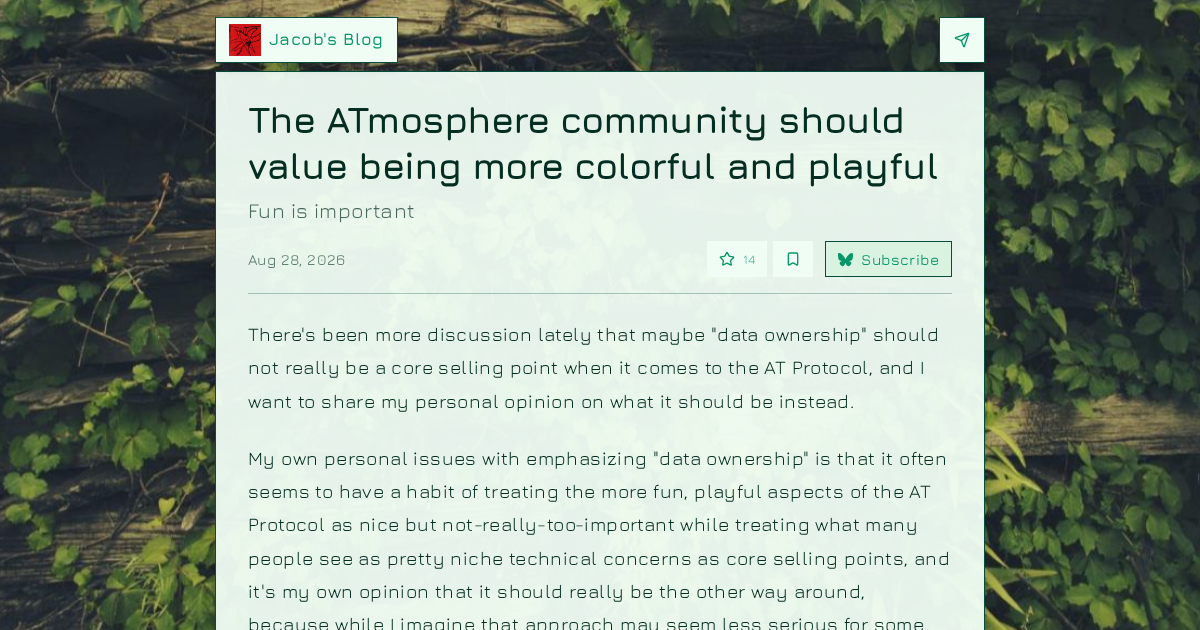
The ATmosphere community should value being more colorful and playful - Jacob's Blog
Fun is important

The ATmosphere community should value being more colorful and playful - Jacob's Blog
Fun is important
Actionable Gamification Book: 8 Core Drives Behind Behavior
Read Yu-kai Chou's Actionable Gamification: the 8 Core Drives behind every product people come back to. Used by LEGO, Microsoft, Porsche, and MrBeast.

Consequences of Information Feed Integration on User Engagement and Contribution: A Natural Experiment in an Online Knowledge-Sharing Community
Many online communities that rely on effortful, voluntary content contributions offer additional content curation tools to facilitate social interactions and encourage user contributions. Any platform that offers two or more heterogeneous content types (e.g., expert knowledge and social posts) faces a choice about the presentation format: whether to display the content types separately or in an integrated information feed. We leverage a natural experiment on Zhihu, a Q&A platform that offers a social-interaction-oriented functionality called Ideas. Zhihu initially presented answers (expert knowledge content) and ideas (social posts) in two different information feeds, but the platform integrated ideas into the same information feed as answers in June 2019. We find that information feed integration significantly decreased user engagement with and contribution of both ideas and answers. We hypothesize that users decreased their engagement because the juxtaposition of incongruous types of content increased mindset switching and cognitive strain. This hypothesis is supported by an additional laboratory experiment. We also present evidence showing that contributions decreased both because of the decrease in engagement (weaker social recognition incentives) and because integration heightened concerns that posting ideas would dilute the contributor’s professional image. Our findings have important theoretical and practical implications for any platform that hosts heterogeneous content. History: Xiaoquan (Michael) Zhang served as the senior editor and Yili (Kevin) Hong served as associate editor for this article. Funding: Z. Cao acknowledges this research was funded by National Natural Science Foundation of China [Grants 72201238, 72192823]. G. Li acknowledges this research was funded by National Natural Science Foundation of China [Grant 72102047] and Shanghai Pujiang Program [Grant 21PJC006]. Supplemental Material: The e-companion is available at https://doi.org/10.1287/isre.2022.0043.
Erlend Sogge Heggen (@erlend.sh)
1. solitude: single-player game loop 2. bottomlessness: infinite scroll 3. speed: instant delivery/gratification 4. teasing: generally satisfactory, never perfect; “maybe the next one is exactly what I want” ↘️ quoting NPR (@npr.org): Taken together, these four features can create a trancelike state that can keep us stuck on social media apps or video games for hours. Children are particularly vulnerable. n.pr/4mH6i6s