

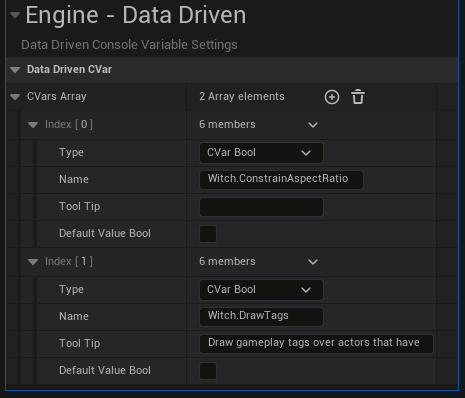
If you use UE5, you might have noticed there’s a new-ish feature called Data-Driven Console Variables, and you might also have noticed that nothing comes up when you Google this. There’s not much to it, but in the interests of having something come up when you Google this, here’s what I’ve figured out about data-driven cvars.
Varv: Reprogrammable Interactive Software as a Declarative Data Structure
This summary was generated using automated tools and was not authored or reviewed by the article's author(s). It is provided to support discovery, help readers assess relevance, and assist readers from adjacent research areas in understanding the work. It is intended to complement the author-supplied abstract, which remains the primary summary of the paper. The full article remains the authoritative version of record. Click here to learn more.

Datacurve | The data engine for frontier AI
Custom data for long-horizon reasoning, software engineering, and data science.

Kyle Mathews on Twitter / X
D2TS enables really powerful streaming joins, aggregations, etc. and will be powering a lot of Electric features in the future!This is an early preview but very cool tech. First Typescript implementation of Differential Dataflow afaik. https://t.co/i4qSJnVZWV— Kyle Mathews (@kylemathews) February 28, 2025
Coeffects: a calculus of context-dependent computation
The notion of context in functional languages no longer refers just to variables in scope. Context can capture additional properties of variables (usage patterns in linear logics; caching requirements in dataflow languages) as well as additional resources or properties of the execution environment (rebindable resources; platform version in a cross-platform application). The recently introduced notion of coeffects captures the latter, whole-context properties, but it failed to capture fine-grained per-variable properties.We remedy this by developing a generalized coeffect system with annotations indexed by a coeffect shape. By instantiating a concrete shape, our system captures previously studied flat (whole-context) coeffects, but also structural (per-variable) coeffects, making coeffect analyses more useful. We show that the structural system enjoys desirable syntactic properties and we give a categorical semantics using extended notions of indexed comonad.The examples presented in this paper are based on analysis of established language features (liveness, linear logics, dataflow, dynamic scoping) and we argue that such context-aware properties will also be useful for future development of languages for increasingly heterogeneous and distributed platforms.

Dremel: interactive analysis of web-scale datasets: Proceedings of the VLDB Endowment: Vol 3, No 1-2
Dremel is a scalable, interactive ad-hoc query system for analysis of read-only nested data. By combining multi-level execution trees and columnar data layout, it is capable of running aggregation queries over trillion-row tables in seconds. The system ...

DASL — Data-Addressed Structures & Links
A small set of simple, standard primitives to work on content-addressed data.

DASL — Data-Addressed Structures & Links
A small set of simple, standard primitives to work on content-addressed data.
A High-Level Grammar of Interactive Graphics
Vega-Lite - a high-level grammar for statistical graphics. Vega-Lite provides a higher-level grammar for visual analysis, comparable to ggplot or Tableau, that generates complete Vega specifications. Vega-Lite specifications consist of simple mappings of variables in a data set to visual encoding channels such as x, y, color, and size. These mappings are then translated into detailed visualization specifications in the form of Vega specification language. Vega-Lite produces default values for visualization components (e.g., scales, axes, and legends) in the output Vega specification using a rule-based approach, but users can explicit specify these properties to override default values.

Dynamic Data Science
<p>Use our Common Online Data Analysis Platform (CODAP) to explore dynamic data science activities and gain fluency in data moves to examine large datasets.</p>

Structured Outputs with Will Kurt and Cameron Pfiffer - Weaviate Podcast #119!
I/O systems for level scripting – joe wintergreen internet zone
This week I built a Source Engine style input/output (I/O) system for level scripting in Sleight of Hand, and if you don’t know what that is or means, you have that in common with most game developers. It’s an astonishingly useful thing to have on any game with level scripting (it’s how Valve’s games do it all the way from Half-Life to Half-Life Alyx). It’s empowering to level designers, and the time and work it stands to save you is unquantifiable but immense. It’s also simple and easy! I’m gonna jot down here how mine (in Unreal) works, but also make a case for the feature in the first place, because like all the most impactful good ideas, most people don’t see the point right away. Alas, I fear I will have to use headings.

NVD - cve-2019-5736
This CVE record has been updated after NVD enrichment efforts were completed. Enrichment data supplied by the NVD may require amendment due to these changes.
Build Reproducible Analytical Pipelines with Nix
Streamlines the creation of reproducible analytical pipelines using default.nix expressions generated via the rix package for reproducibility. Define derivations in R, Python or Julia, chain them into a composition of pure functions and build the resulting pipeline using Nix as the underlying end-to-end build tool. Functions to plot the pipeline as a directed acyclic graph are included, as well as functions to load and inspect intermediary results for interactive analysis. User experience heavily inspired by the targets package.

DASL: DRISL — Deterministic Representation for Interoperable Structures & Links
DRISL is a serialization format that is deterministic (so that the same data will have the same CID) and that features native support for using CIDs as links. It is based on CBOR, using a narrow profile of CBOR's "Core" featureset called "[[cborc-42]]", specified formally in this IETF document.

The control layer for AI
The industry spent two years teaching LLMs to speak JSON. That work mattered: free-form text was unusable in production. Today, every serious inference provider uses some implementation (often open-source) of structured output. Structured output has become essential infrastructure that the team at .txt is proud to have spearheaded. Even as the ecosystem evolves, and open-source alternatives emerged, our engine remains the state of the art.