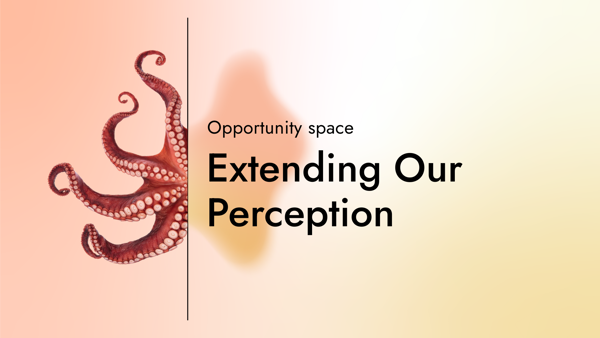
Sensory Transducers • Grace Kind
Humans have a limited set of senses. There are the five major senses (sight, hearing, smell, taste, and touch) as well as a few lesser-known ones (e.g. balance, proprioception).

Sensors, not just bookmarks [Patterns of Sensemaking #1] - Cosmik Labs
First of a new series on sensemaking patterns we're observing on Semble
Sensors, not just bookmarks [Patterns of Sensemaking #1] - Cosmik Labs
First of a new series on sensemaking patterns we're observing on Semble
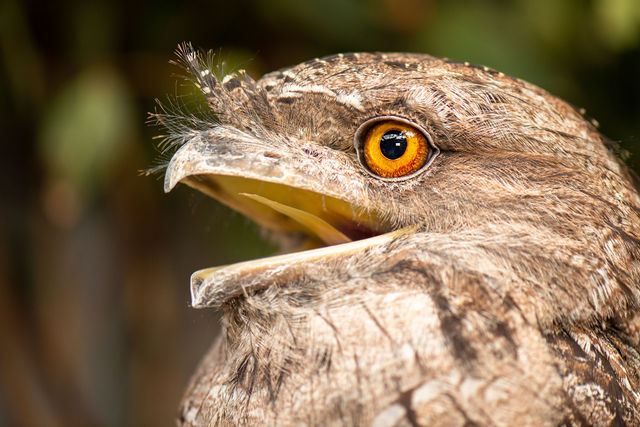
Antenna (zoology)
An antenna is one of a pair of appendages used for sensing in arthropods. Antennae are sometimes referred to as feelers.

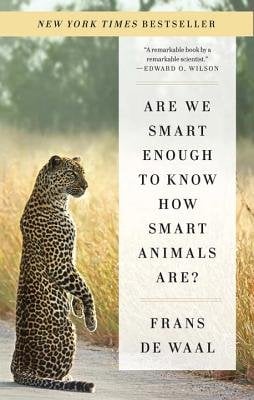
Are We Smart Enough to Know How Smart Animals Are?
Check out Are We Smart Enough to Know How Smart Animals Are? - Hailed as a classic, Are We Smart Enough to Know How Smart Animals Are? explores the oddities and complexities of animal cognition--in crows, dolphins, parrots, sheep, wasps, bats, chimpanzees, and bonobos--to reveal how smart animals really are, and how we've underestimated their abilities for too long. Did you know that octopuses use coconut shells as tools, that elephants classify humans by gender and language, and that there is a young male chimpanzee at Kyoto University whose flash memory puts that of humans to shame? Fascinating, entertaining, and deeply informed, de Waal's landmark work will convince you to rethink everything you thought you knew about animal--and human--intelligence. by Dr Frans de Waal on Bookshop.org US!
Foundation Model Predicts Brain Responses to Visual and Auditory Stimuli | Elisa Cascardi posted on the topic | LinkedIn
Thrilled to share this work with the world! Today, we're releasing a foundation model that predicts how the human brain responds to almost any sight or sound -- and replace the need for human scans to significantly fast-track neuroscience and clinical research. 🧠 With this model, we can simulate brain responses to advance our understanding of the brain -- without the need for costly human brain scans 🌐 By using improved understanding of how efficient our brains perceive the world around us, we can guide the development of more advanced AI systems 👩⚕️ With computer-simulated experimentation, we can now speedup clinical research to diagnose neurological diseases and find treatments faster We've open sourced the model and code for researchers to use and build on, and an interactive demo for you to learn more -- see below! 📄 Paper: https://lnkd.in/e7cbunJp 💻 Code: https://lnkd.in/ebwBVuJp ▶️ Demo: https://lnkd.in/eEUVxP4S 🤗 Model: https://lnkd.in/e2T8nPJP So thrilled to be a part of this team with Stéphane d'Ascoli Jean-Rémi King Jérémy RAPIN Yohann Benchetrit Teon Brooks Katelyn Begany Joséphine Raugel Hubert Banville and for the great teamwork with Diego Marcos Dominic Giardini bringing this research to life! #neuroscience #AI #aiforscience #opensource #neuroAI
Radar Esquerdista
Agenda de atos e manifestações: data, horário, local, confirmados, ideias e sugestões.
Juice
I need to push some updates to the remote sensing instruments, which are there to measure the surface and definitely not do anything else.



Frank — Hotdog detector
Take a camera snapshot or upload a photo or video for a hotdog classification with Clef.
Vote 1 for Wildlife
Subscribe to Wildlife Victoria. Stay up to date with our latest news.
A Sheaf Theoretical Approach to Uncertainty Quantification of Heterogeneous Geolocation Information
Integration of multiple, heterogeneous sensors is a challenging problem across a range of applications. Prominent among these are multi-target tracking, where one must combine observations from different sensor types in a meaningful and efficient way to track multiple targets. Because different sensors have differing error models, we seek a theoretically justified quantification of the agreement among ensembles of sensors, both overall for a sensor collection, and also at a fine-grained level specifying pairwise and multi-way interactions among sensors. We demonstrate that the theory of mathematical sheaves provides a unified answer to this need, supporting both quantitative and qualitative data. Furthermore, the theory provides algorithms to globalize data across the network of deployed sensors, and to diagnose issues when the data do not globalize cleanly. We demonstrate and illustrate the utility of sheaf-based tracking models based on experimental data of a wild population of black bears in Asheville, North Carolina. A measurement model involving four sensors deployed among the bears and the team of scientists charged with tracking their location is deployed. This provides a sheaf-based integration model which is small enough to fully interpret, but of sufficient complexity to demonstrate the sheaf's ability to recover a holistic picture of the locations and behaviors of both individual bears and the bear-human tracking system. A statistical approach was developed in parallel for comparison, a dynamic linear model which was estimated using a Kalman filter. This approach also recovered bear and human locations and sensor accuracies. When the observations are normalized into a common coordinate system, the structure of the dynamic linear observation model recapitulates the structure of the sheaf model, demonstrating the canonicity of the sheaf-based approach. However, when the observations are not so normalized, the sheaf model still remains valid.

Extending Our Perception
The world is rich with information hidden from human senses and not captured by our algorithms. The next era of AI will require Hypersensory Intelligence — AI and novel sensors engineered together to perceive reality in fundamentally new ways, catalysing breakthroughs across disciplines.