


Upgrade OpenClaw's memory search from basic SQLite to QMD — a local hybrid search engine combining BM25, vector search, and LLM re-ranking for better AI memory.
project-you-apps/vector-plus-studio
Semantic search via 16M-neuron CUDA lattice. Content-addressable memory with noise tolerance.
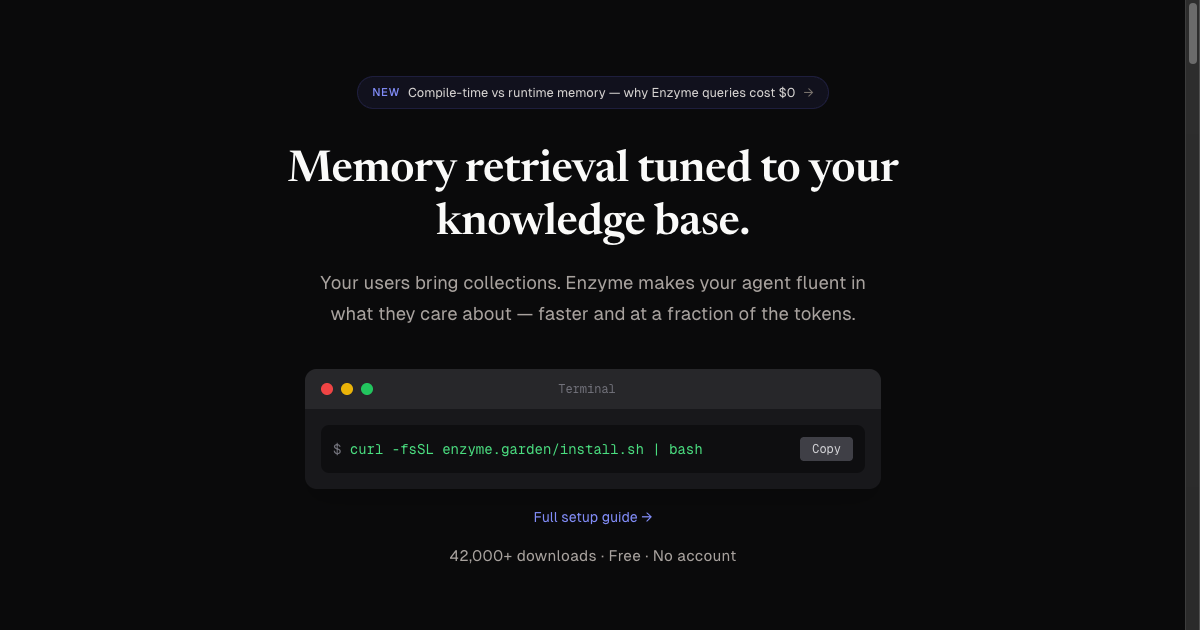
Memory retrieval tuned to your knowledge base | Enzyme
Your users bring content. Enzyme gives your agent their conceptual landscape from the first import. 42,000+ installs. Local CLI and hosted memory workflows.
Introducing the OpenMemory Chrome Extension
AI memory Chrome extension for LLM memory and retrieval augmented generation. OpenMemory enables persistent AI agent memory across web browsing sessions.

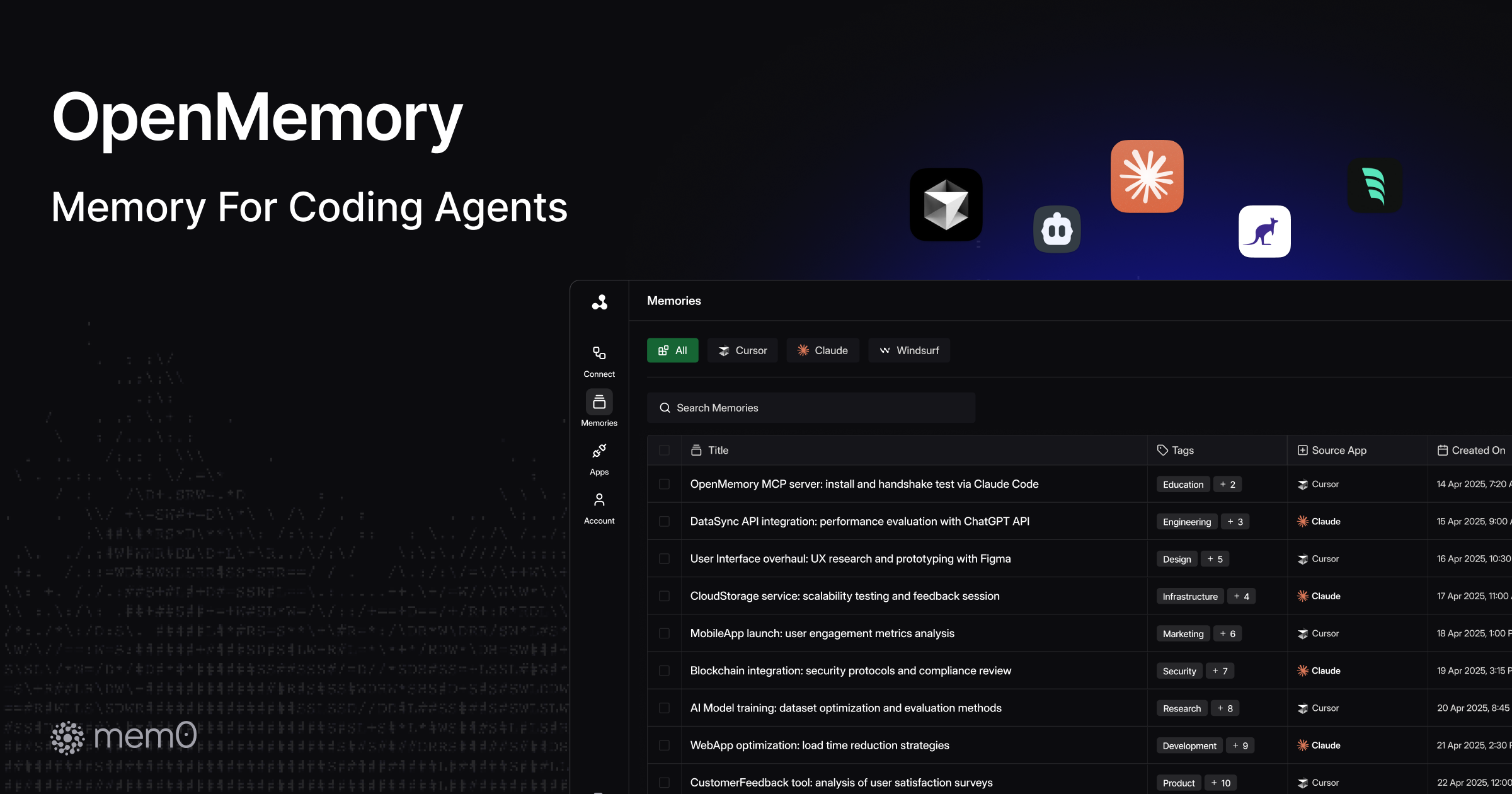
OpenMemory - AI Memory MCP Server for Coding Agents | Mem0
With OpenMemory, add persistent, project-aware memory to Cursor, Windsurf, and VS Code agents. Store preferences, patterns, and context that get retrieved automatically.
OpenAI Developers on Twitter / X
Last week, we released a preview of memories in Codex.Today, we’re expanding the experiment with Chronicle, which improves memories using recent screen context.Now, Codex can help with what you’ve been working on without you restating context. pic.twitter.com/b3p8I5eXOy— OpenAI Developers (@OpenAIDevs) April 20, 2026

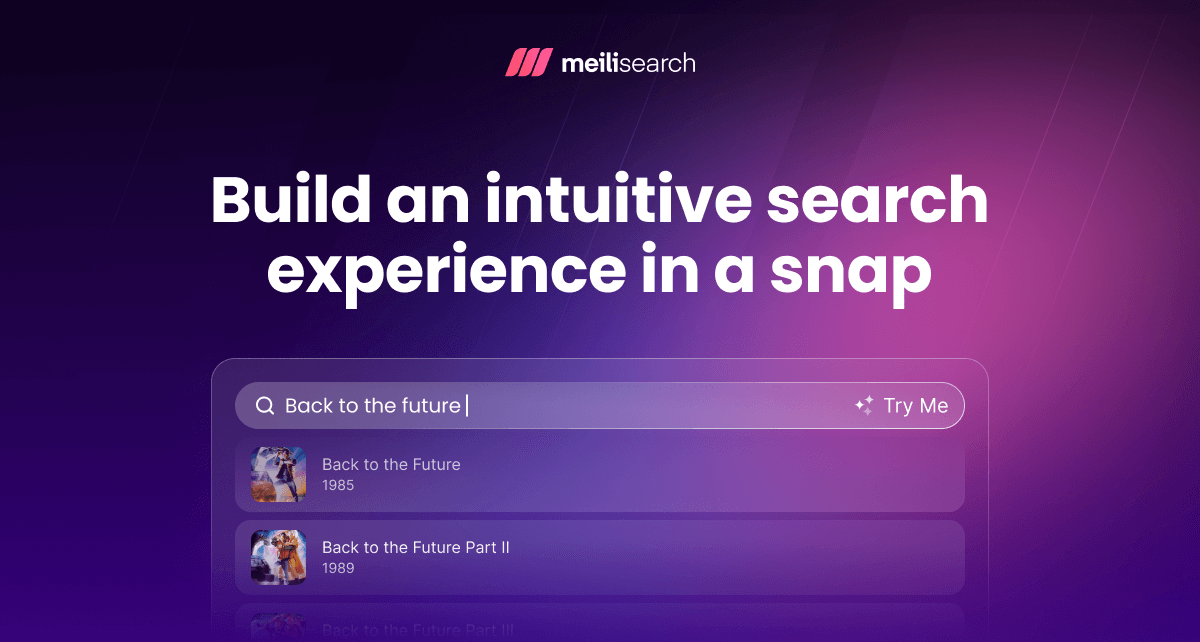
Meilisearch: Unified Search & AI Retrieval Platform
Build lightning-fast search and AI retrieval with Meilisearch. Open-source, developer-friendly search engine trusted by 20,000+ teams worldwide.
turbopuffer: fast search on object storage
Inaugural blog post about the development of turbopuffer, a search engine that uses object storage and SSD caching for cost-effective, low latency search. This post describes into the motivation behind its creation, its unique architecture, and how it significantly reduces costs for large-scale vector searches. Discover how turbopuffer is transforming search infrastructure for companies like Cursor and Suno, offering a scalable and reliable solution.

How to forget
Most agent frameworks optimize for recall. Open-strix optimizes for forgetting — and that turns out to be the whole trick.

Introduction
A complete search engine and RAG pipeline in your browser, server or edge network with support for full-text, vector, and hybrid search in less than 2kb.
Letting an AI remember tripled its puzzle score - Sensemaker
OpenAI changed two conversation settings, not the model. The result shows why long-running AI tests depend on their memory setup.
I Benchmarked OpenAI Memory vs LangMem vs Letta (MemGPT) vs Mem0 for Long-Term Memory: Here’s How They Stacked Up
145 votes, 53 comments. Lately, I’ve been testing memory systems to handle long conversations in agent setups, optimizing for: Factual consistency…
Why AI Coding Agents Forget — And How ArcticMem Fixes It
Explore ArcticMem, Snowflake’s persistent semantic memory system for AI coding agents. See how dual-tier memory improves benchmark pass rates to 73%.

Learning to Continually Learn via Meta-learning Agentic Memory Designs
The statelessness of foundation models bottlenecks agentic systems' ability to continually learn, a core capability for long-horizon reasoning and adaptation. To address this limitation, agentic systems commonly incorporate memory modules to retain and reuse past experience, aiming for continual learning during test time. However, most existing memory designs are human-crafted and fixed, which limits their ability to adapt to the diversity and non-stationarity of real-world tasks. In this paper, we introduce ALMA (Automated meta-Learning of Memory designs for Agentic systems), a framework that meta-learns memory designs to replace hand-engineered memory designs, therefore minimizing human effort and enabling agentic systems to be continual learners across diverse domains. Our approach employs a Meta Agent that searches over memory designs expressed as executable code in an open-ended manner, theoretically allowing the discovery of arbitrary memory designs, including database schemas as well as their retrieval and update mechanisms. Extensive experiments across four sequential decision-making domains demonstrate that the learned memory designs enable more effective and efficient learning from experience than state-of-the-art human-crafted memory designs on all benchmarks. When developed and deployed safely, ALMA represents a step toward self-improving AI systems that learn to be adaptive, continual learners.

milla-jovovich/mempalace
The highest-scoring AI memory system ever benchmarked. And it's free.
ChatGPT will now use its 'memory' to personalize web searches | TechCrunch
ChatGPT will now use its 'memory' to personalize web searches, thanks to a new feature called Memory with Search.

OpenClaw is a local-first, open-source AI agent that runs 24/7 on your own machine, connecting AI models to your files, messaging apps… »...
20 OpenClaw Use Cases for a Personal AI Assistant in 2026
clawbeat.co