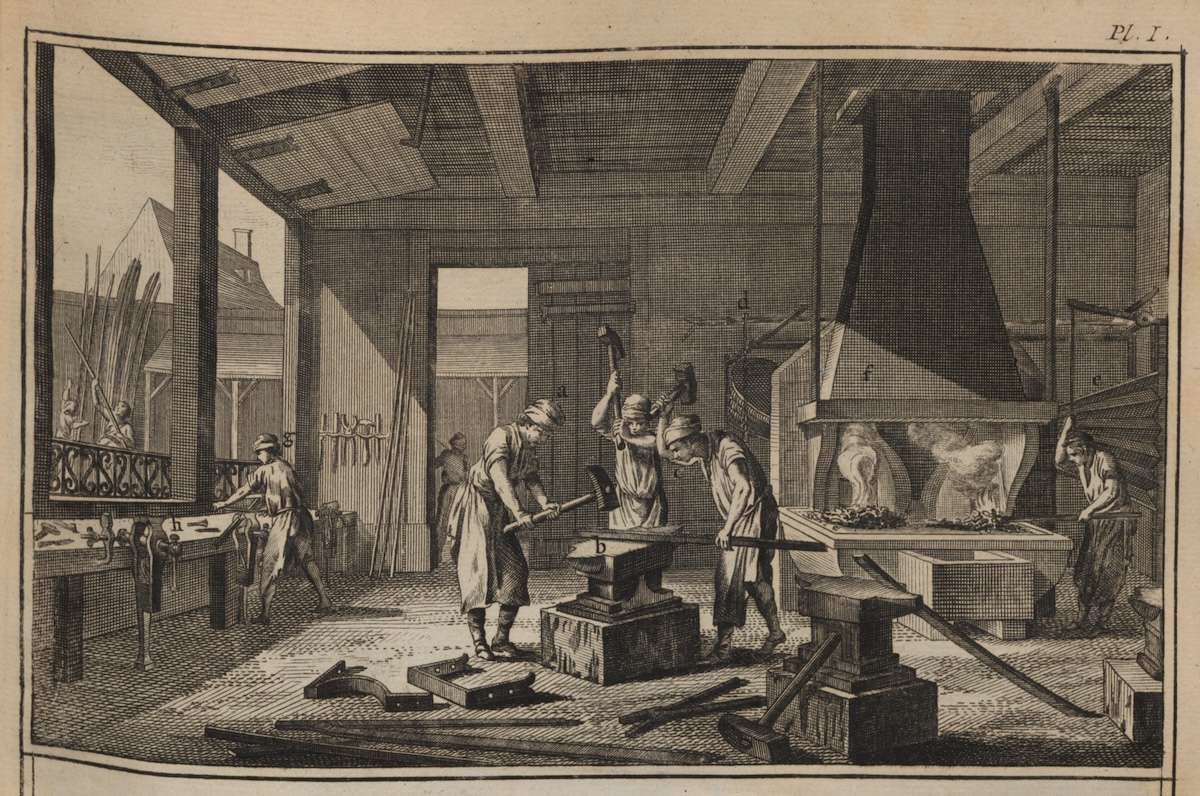


Hampton Smith Sometime in the spring of 1800, enslaved tobacco cutters in Henrico County, Virginia, brought their scythes to one of Brookfield plantation’s blacksmiths, Solomon Prosser, for sharpening.

Between Threat and Reality: The National Association for the Advancement of Colored People and the Emergence of Armed Self-Defense in Clarksdale and Natchez, Mississippi, 1960-1965
Annelieke Dirks, Between Threat and Reality: The National Association for the Advancement of Colored People and the Emergence of Armed Self-Defense in Clarksdale and Natchez, Mississippi, 1960-1965, Journal for the Study of Radicalism, Vol. 1, No. 1 (Spring 2007), pp. 71-98
Battle of Blair Mountain
The Battle of Blair Mountain was the largest labor uprising in United States history and is the largest armed uprising since the American Civil War. The conflict occurred in Logan County, West Virginia, as part of the Coal Wars, a series of early-20th-century labor disputes in Appalachia.

The Counter-Revolution of 1776: Slave Resistance and th…
Illuminates how the preservation of slavery was a moti…


John Brown, abolitionist : the man who killed slavery, sparked the Civil War, and seeded civil rights : Reynolds, David S., 1948-
Includes bibliographical references and index

The Rebel: An Essay on Man in Revolt | Philopedia
Overview of Albert Camus’s The Rebel, exploring metaphysical and historical rebellion, nihilism, revolution, and the limits of political violence.

Origin Stories: Plantations, Computers, and Industrial Control
The proto-Taylorist methods of worker control Charles Babbage encoded into his calculating engines have origins in plantation management.

Anarchism and The Black Revolution and Other Essays
An analysis of white supremacy vs the black struggle an…

We Will Shoot Back: Armed Resistance in the Mississippi…
"Ranging from Reconstruction to the Black Power period,…

Waging a good war: a military history of the civil rights movement, 1954-1968
"A new history of the Civil Rights Movement with an emphasis on its nonviolent use of military tactics and strategy"--

The Chesapeake Slave Trade:Regional Patterns, African Origins, and Some Implications | History Cooperative
THE movement of peoples from the Old World to the New and the resulting transfers or transformations of homeland cultures in new physical and social environments has been a central theme of early American history. Overwhelmingly, historians have written on the transfers of peoples from sixteenth- through eighteenth-century Europe and sub-Saharan Africa to various American destinations in isolation from one another. When these two contemporary migration flows are considered together, sheer numbers demonstrate that, up to 1776, the majority of men, women, and children transported from the Old World to British North America were, to varying degrees, unfree. And increasingly throughout most of the eighteenth century, those migrants came from Africa and were permanently enslaved.
The Water’s Edge: Empire, Race, and the Global History of Oakland, California, 1848-1980
Author(s): Klein, Andrew Nelson Carver | Advisor(s): Kelley, Robin D.G. | Abstract: This dissertation explores historical intersections between capitalism, race-making, environmental change, and U.S. foreign relations from the vantage of Oakland’s waterfront. It tracks the evolution of this geostrategic coastline since it emerged as a coal-powered nexus of railroads, steamships, and military installations during American colonization. Revising the story of Oakland’s development from a global perspective, my project documents how local boosters, businessmen, and bureaucrats forged intimate ties with far-flung territories administered by U.S. troops and landowners. Combining social and environmental history with methods from Black studies, I map the transformation of Oakland’s fertile estuary into an infilled hub of postindustrial commerce, a vital node of military logistics, and a focal point for racialized labor migration. Simultaneously, this dissertation reveals how, over the long twentieth century, Black, Indigenous, Chinese, and other working-class Oaklanders found footholds on the harbor, often repurposing its imperial routes for dramatically different ends. Drawing on archives and oral histories in Cuba, Hawai‘i, and across the continental United States, I trace Oakland’s tradition of radical internationalism, most visible in the antiwar and Black Power movements of the sixties, to multi-generational struggles over the governance of coastal land. I argue that Oakland’s waterfront both bridged the continental and overseas expansion of an ascendant world power and came to serve as a proving ground for alternative forms of globalization. “The Water’s Edge” therefore offers a critical reappraisal of the generally place-bound history of North American urbanism and far-reaching lessons for building just cities in a present defined by global environmental crises.

The Chesapeake: Making Race
When the Chesapeake region began taking shape, race and class were ill-defined. But Africans quickly became enslaved for life.

"We Will Shoot Back": The Natchez Model and Paramilitary Organization in the Mississippi Freedom Movement
Between 1965 and 1979, economic boycotts were a principal form of insurgency for Black activists in Mississippi. After 1964, in several communities, the boycott of White-owned commerce became the primary tactic utilized by human rights forces to disrupt the system of segregation. These boycotts relied upon paramilitary organization to protect the activities and leadership of the Mississippi freedom movement and the Black community in general and to sanction anyone in the Black community who wished to violate the boycott. This paradigm of economic boycotts supported by paramilitary organization was first utilized in 1965 in Natchez. Natchez is a commercial center in southwest Mississippi. The combination of economic boycott with armed resistance posed an effective coercive campaign to pressure the local White power structure for concessions demanded by the movement. The insurgent model of Natchez was replicated throughout the state, particularly in Black communities of southwest Mississippi.