


The increasing availability of data derived from linked consumer financial accounts has the potential to dramatically expand the potential for research. Examining the most comprehensive existing set of linked-account data, consisting of transaction and balance sheet data for millions of Americans, I demonstrate the power and versatility of such sources. I discuss advantages and concerns arising from this type of data and match a range of distributional moments to external sources. As one application, I test consumption elasticities across households with varying levels, and types, of debt. I find that heterogeneity in consumption elasticity can be explained entirely by credit and liquidity.
Asymmetric Consumption Smoothing
Analyzing account-level data from an account aggregator, we find that households increase consumption when they receive expected tax refunds, as if they face liquidity constraints. However, these same households smooth consumption when making payments in other years, primarily by transferring funds among liquid accounts. Even households carrying credit card debt smooth consumption when making payments, and even highly liquid households spend out of refunds. This behavior is inconsistent with pure liquidity constraints or hand-to-mouth behavior and is most consistent with a mental accounting life-cycle model.
Household Financial Transaction Data
The growth of the availability and use of detailed household financial transaction micro data has dramatically expanded the ability of researchers to understand both household decision making and aggregate economic fluctuations across a wide range of fields. This class of transaction data is derived from a myriad of sources, including financial institutions, FinTech apps, and payment intermediaries. We review how these detailed data have been utilized in finance and economics research and analyze both their benefits and limitations as compared to more traditional measures of income, spending, and wealth. Finally, we discuss the future potential of this flexible class of data in firm-focused research, real-time policy analysis, and macro statistics.

Household Need for Liquidity and the Credit Card Debt Puzzle
Abstract. In the 2001 U.S. Survey of Consumer Finances, 27% of households report simultaneously revolving significant credit card debt and holding sizeable
Household Debt: Facts, Puzzles, Theories, and Policies
Borrowing decisions affect most households, with large stakes and implications for research subfields as varied as macroeconomics and industrial organization. I review theoretical and empirical work on household debt: its prevalence, level, growth, and composition, as well as various measures of consumer choice and market (in)efficiency, elasticities, and prices, including new evidence on how borrowing heterogeneity affects the distribution of the opportunity cost of consumption. I also discuss opportunities and challenges in policy evaluation. A key takeaway is that puzzles abound, and I highlight numerous avenues for further research.
Consumption and Debt Response to Unanticipated Income Shocks: Evidence from a Natural Experiment in Singapore
This paper uses a unique panel dataset of consumer financial transactions to study how consumers respond to an exogenous unanticipated income shock. Consumption rose significantly after the fiscal policy announcement: during the ten subsequent months, for each $1 received, consumers on average spent $0.80. We find a strong announcement effect—19 percent of the response occurs during the first two-month announcement period via credit cards. Subsequently, consumers switched to debit cards after disbursement before finally increasing spending on credit cards in the later months. Consumers with low liquid assets or with low credit card limit experienced stronger consumption responses. (JEL D12, D14, E21)
The Coholding Puzzle: New Evidence from Transaction-Level Data
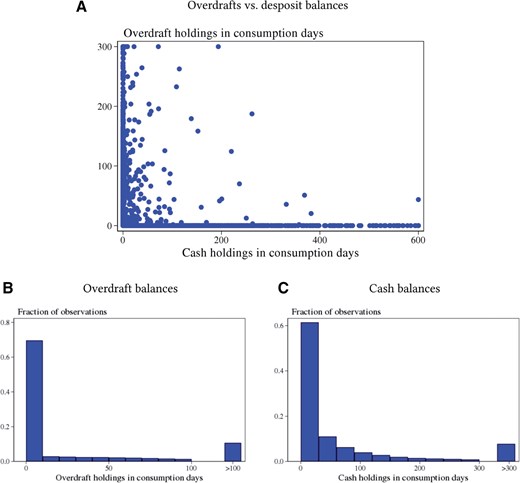
Abstract Why do individuals pay debt interest when they could use their savings to pay down the debt? We explore why individuals “cohold” debt and savings using detailed and highly disaggregated daily-level data on household finances. We find that coholding mostly occurs in short spells within the month and the level of coholding is typically modest. Periods of coholding are not associated with shocks at the individual level. We show that mental accounting has a role to play in explaining coholding, in particular how individuals allocate different categories of expenditure to accounts in credit and debit.
The Co-holding Puzzle: New Evidence from Transaction-Level Data
Using detailed and highly disaggregated data on household finances, we examine the<br>tendency of consumers to “co-hold” savings and debt simultaneously. The di

Liquidity versus Wealth in Household Debt Obligations: Evidence from Housing Policy in the Great Recession
We exploit variation in mortgage modifications to disentangle the impact of reducing long-term obligations with no change in short-term payments ("wealth"), and reducing short-term payments with no change in long-term obligations ("liquidity"). Using regression discontinuity and difference-in-differences research designs with administrative data measuring default and consumption, we find that principal reductions that increase wealth without affecting liquidity have no effect, while maturity extensions that increase only liquidity have large effects. This suggests that liquidity drives default and consumption decisions for borrowers in our sample and that distressed debt restructurings can be redesigned with substantial gains to borrowers, lenders, and taxpayers.
Credit card debt puzzle: liquid assets to pay household bills
Using transaction data from a US consumer payments diary, we revisit the credit card debt puzzle—a scenario in which households revolve credit card debt while also keeping liquid assets as bank account deposits. This scenario is very common: 42 percent of consumers in our sample were borrower-savers in 2019. We explain the puzzle by showing that consumers need their liquid assets to pay household bills and other necessary expenses, including mortgage or rent. More than 80 percent of bills by value were paid out of bank accounts and could not be charged to credit cards, so bank account balances were needed to cover those basic expenses. On average, borrower-savers’ credit card debt exceeded their liquid assets. The average borrower-saver carried almost $6,400 in unpaid credit card debt and had $5,400 in liquid assets. On average, the value of their liquid assets could cover only about 60 percent of their unpaid debt plus monthly bills. In almost every category of assets or debts, borrower-savers were worse off financially than savers. Thus, the differences between borrower-savers and savers are much broader than just their credit card debt and bank account balances; they extend to mortgage debt and home equity. Carrying a mortgage or other debt (such as auto or educational loans) is associated with a higher probability of revolving on a credit card, suggesting that various types of household debt might be complements rather than substitutes. We do not find evidence that either financial literacy scores or the “Big 5” personality traits predict whether a consumer is a borrower-saver. During the COVID-19 pandemic in 2020, bor-savs’ behavior was consistent with what we would expect under our explanation for the credit card puzzle. However, consumers’ unpaid credit card debt decreased, and their liquid assets increased, so the fraction of borrower-savers dropped to 35 percent of the sample.

Do Liquidity Constraints and Interest Rates Matter for Consumer Behavior? Evidence from Credit Card Data
Abstract. This paper utilizes a unique data set of credit card accounts to analyze how people respond to credit supply. Increases in credit limits generate
Intra-Household Frictions, Anchoring, and the Credit Card Debt Puzzle
Abstract I study how intra-household frictions and anchoring contribute to the credit card debt puzzle, the co-holding of high-cost debt, and low-yield liquid assets. First, I find couples co-hold 42% more as units than as individuals relative to income. Moreover, in a natural experiment, couples do not cooperate to reduce high-cost debt, suggesting that intra-household frictions contribute to co-holding. Second, I find individuals who regularly make credit card debt payments equal to or near the minimum account for 59% of individual co-holding. The evidence suggests anchoring to the minimum payment contributes to co-holding via these low payments.
Consumption Response to Credit Expansions: Evidence from Experimental Assignment of 45,307 Credit Lines
In a field experiment that constructs a randomized credit limit shock, participants borrow to spend 11 cents on the dollar in the first quarter and 28 cents by the third year. Effects extend to those far from the limit, those who had the new limits as available credit, and those with a liquid asset buffer. In the short-run, flexible and installment contracts are used in tandem, with unconstrained using installments more. Long-run borrowing is predominantly using installments. Near limits, participants borrow when credit expands but save out of constraints when limits are tight. Findings support a buffer-stock interpretation emphasizing precautionary saving.
Harnessing naturally occurring data to measure the response of spending to income
Balancing your incomings and outgoings Economic theory predicts that when someone receives money should have little effect on their spending patterns. Gelman et al. constructed a data set of 60 million transactions made by 75,000 people to test this theory. People do seem to go on a mini–spending spree after they get their paychecks or pensions. However, closer inspection reveals that that's mostly explained by the convenience of linking regular payments, such as rent and utilities, to regular income. Unsurprisingly, cash-strapped people are more likely to increase their spending in response to receiving income. Science , this issue p. 212 , How do theoretical predictions of individual fiscal behaviors match up against real-world, real-time data? , This paper presents a new data infrastructure for measuring economic activity. The infrastructure records transactions and account balances, yielding measurements with scope and accuracy that have little precedent in economics. The data are drawn from a diverse population that overrepresents males and younger adults but contains large numbers of underrepresented groups. The data infrastructure permits evaluation of a benchmark theory in economics that predicts that individuals should use a combination of cash management, saving, and borrowing to make the timing of income irrelevant for the timing of spending. As in previous studies and in contrast to the predictions of the theory, there is a response of spending to the arrival of anticipated income. The data also show, however, that this apparent excess sensitivity of spending results largely from the coincident timing of regular income and regular spending. The remaining excess sensitivity is concentrated among individuals with less liquidity.
The Co-Holding Puzzle: New Evidence from Transaction-Level Data
The tendency of consumers to hold low-yield liquid savings while simultaneously holding high-cost unsecured credit on revolving credit lines is a long standing
Cash versus Debit Card: The Role of Budget Control
Due to the financial crisis, an increasing number of households face financial problems. This may lead to an increasing need for monitoring spending and budgets. We demonstrate that both cash and the debit card are perceived as helpful in this respect. We show that, on average, consumers responsible for financial decision making within a household find cash and the debit card equally helpful for monitoring their household finances. Individuals differ in major respects, however. In particular, low earners and the liquidity‐constrained prefer cash as a budgeting tool. Finally, we present evidence that at an aggregated level, such preferences strongly affect consumer payment behavior. These findings suggest that the substitution of cash by cards may slow down because of the financial crisis.

Credit Card Debt and Consumer Payment Choice: What Can We Learn from Credit Bureau Data?
We estimate a two-stage Heckman selection model of credit card adoption and use with a unique dataset that combines administrative data from the Equifax credit bureau and self-reported data from a representative survey of consumers. Higher-income consumers carry higher credit card balances, but they tend to repay those balances each month. Credit card revolvers have lower income and are less educated. Revolvers are twice as likely to use debit cards as credit cards for payments, but they carry much higher balances on their credit cards. The high cost of paying off credit card debt likely exacerbates existing inequalities in disposable income. Unlike the mortgage market, we find no evidence for lenders’ cutoff between subprime and prime consumers in the credit card market.