

In recent years, Peter Sloterdijk has become one of Germany's most influential thinkers. His diverse body of work includes a Heideggerian project to think…
Alasdair MacIntyre’s Philosophy in Practice
It is a curious thing when an artist, thinker, or writer gains influence outside the audience he intends or is comfortable with. When a thinker associated with the right becomes popular on the left, or a novelist associated with the progressive left becomes popular among conservative readers, there can be a sort of strain felt between the audience in fact and the “true” audience, or between those who feel themselves to be the authentic recipients of a work’s message and meaning and those who, to the true believers, come across as opportunistic in their enjoyment of works in tension with their own views. The same is true when a writer working within an academic discipline gets picked up by those outside it: Those working within that discipline may find the co-opting of these thinkers misplaced at best or malicious at worst.
The obsolescence of man, vol I , part 2: The world as phantom and as matrix: philosophical considerations on radio and television - Günther Anders
The first complete English translation of a remarkable 1956 essay about television from Vol. I of The Obsolescence of Man by Günther Anders, who—using phenomenological analyses, excerpts from his diaries and reflections on daily life—depicts a capitalist world that manufactures a warped “mass-man” by imposing nonparticipation, consumption of images, artificial “needs” (“drug addiction is the model for today’s needs”), separation, “conditioning”, an eternal present, commodified leisure and the dissolution of the individual in vapid mass produced roles, in a text that in many ways anticipates the theory of the “spectacle” of Guy Debord and the situationists.
Jan Švankmajer
Jan Švankmajer is a Czech retired film director, animator, writer, playwright and artist. He draws and makes free graphics, collage, ceramics, tactile objects and assemblages. In the early 1960s, he explored informel, which later became an important part of the visual form of his animated films. He is a leading representative of late Czech surrealism. In his film work, he created an unmistakable and quite specific style, determined primarily by a compulsively unorthodox combination of externally disparate elements. The anti-artistic nature of this process, based on collage or assemblage, functions as a meaning-making factor. The author himself claims that the intersubjective communication between him and the viewer works only through evoked associations, and his films fulfil their subversive mission only when, even in the most fantastic moments, they look like a record of reality. Some of the works he created together with his wife Eva Švankmajerová.

The Banality of Genius: Notes on Peter Jackson's Get Back
A Special Edition of The Ruffian
poetic web: unfolding spiral
'poetic web: unfolding spiral' is a non-linear text I wrote as part of my bachelor thesis at the HFBK Hamburg. Driven by curiosity about the poetic web, the object of the text rather became the opening of a reflective space, where I could touch on the constraints and possibilities of language, words, worlds, and their artifacts, relation and meaning-making, smoothness, attention, and agency, and see how subtle shifts in understanding allowed for words to restructure and new meanings to grow.
Paul Feyerabend
Paul Feyerabend (b.1924, d.1994), having studied science at theUniversity of Vienna, moved into philosophy for his doctoral thesis,made a name for himself both as an expositor and (later) as a critic ofKarl Popper's “critical rationalism”, and went on to becomeone of the twentieth century's most famous philosophers of science. Animaginative maverick, he became a critic of philosophy of scienceitself, particularly of “rationalist” attempts to lay downor discover rules of scientific method.
The Standpoint of Heimatlosigskeit and the Planet
Since the launch of Sputnik in 1957, it has become impossible to comprehend the world solely through the lens of Hegel’s Berlin or Kojève’s Paris—even as nation-states continue to wrestle with their growing obsolescence. The planetary condition of human existence has also intensified a form of nihilism rooted in modernity: geographically through globalization, and cosmically through thermodynamics. If, in the twentieth century, reactionary politics sought to “overcome modernity” by returning to a notion of homeland (Heimat), the twenty-first century calls for a renewed framework—one that begins, perhaps, from the standpoint of Heimatlosigkeit.

The Standpoint of Heimatlosigskeit and the Planet
Since the launch of Sputnik in 1957, it has become impossible to comprehend the world solely through the lens of Hegel’s Berlin or Kojève’s Paris—even as nation-states continue to wrestle with their growing obsolescence. The planetary condition of human existence has also intensified a form of nihilism rooted in modernity: geographically through globalization, and cosmically through thermodynamics. If, in the twentieth century, reactionary politics sought to “overcome modernity” by returning to a notion of homeland (Heimat), the twenty-first century calls for a renewed framework—one that begins, perhaps, from the standpoint of Heimatlosigkeit.
Evald Ilyenkov and the enactive approach
There is a growing interest in Evald Ilyenkov’s work and its significance for contemporary debates. This interest spans several disciplines. One key thread in Ilyenkov’s ideas concerns a perspective on the relation between biology and psychology. In rejecting crude reductionism and individualism, Ilyenkov put forward a view of mind and personhood as emerging from activity and social practice. In his rejection of brain-bound notions of the mind, Ilyenkov’s ideas bear interesting resonances with current work in 4E cognition. One particularly interesting resonance that has occasionally been noticed are the connections with the enactive approach to life and mind. However, beyond some hints at interesting convergences, there is to date no detailed comparison between the two views. The present article attempts to address this gap, examining both complementarities and possible tensions between the two approaches. Rejecting cognitive views detached from environmental and social processes, the enactive approach, as exemplified by De Jaegher and Di Paolo’s concept of participatory sense-making, emphasises the dynamic constitution of cognition through embodied and situated activities. The article draws parallels between Ilyenkov’s emphasis on historically and culturally situated activity, notably labour, and the enactive understanding of human bodies as dynamically constituted in human activity. The article explores the Ilyenkovian and enactive perspectives on the dialectics of ideality, challenging traditional dualistic views and proposing that the ideal emerges as metastable patterns in the ongoing interactions between world, practices, norms, and bodies. The article concludes by suggesting future research directions for the enactive approach, particularly in areas emphasised by Ilyenkov, such as labour and the mediation of material/cultural artefacts.
The Shapeshifter’s Little Brother
On Mark Zuckerberg’s AI manifesto—aka nine blog posts in a trenchcoat.

The Skeleton Library
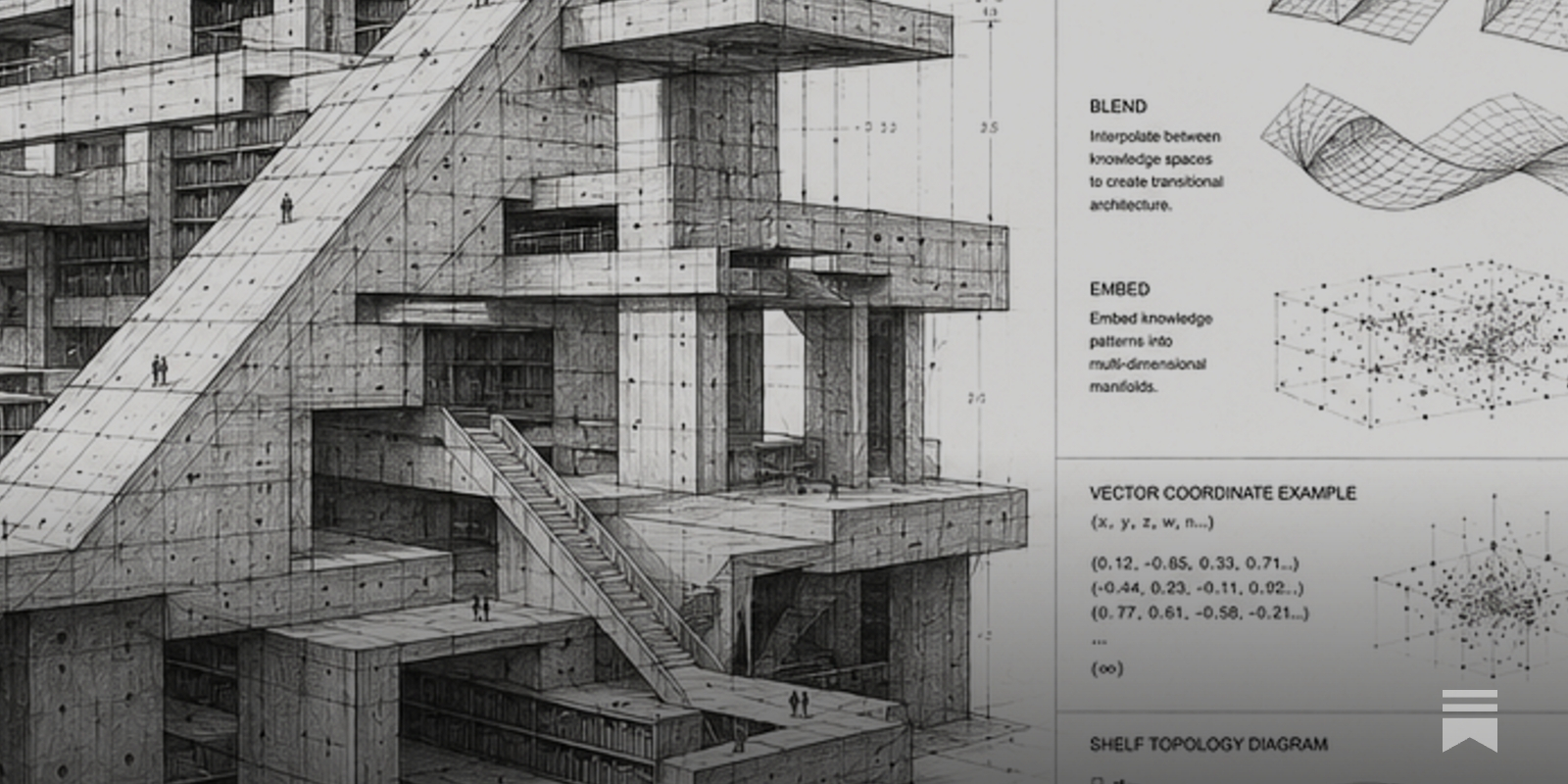
On Interpolatable Archives, Part 1: Compulsions to Connect, Warburg, Borges and Goldsmith, Cultural Technologies and Digital Oralities
In Depth: Miscellaneous
*this is a giant, everchanging collection of micellaneous tidbits about my life and career.* On The Moniker I had a habit as a kid of creating fictional enti...
Poetic Research Journal Club

Readings and Resources for the Poetic Research Journal Club
AI as the Catalyst of the New Paradigm of Science? | Cadmus Journal

Reinventing Discovery