

Andrew Ross, Technology and Below-the-Line Labor in the Copyfight over Intellectual Property, American Quarterly, Vol. 58, No. 3, Sep., 2006, Rewiring the "Nation": The Place of Technology in American Studies
From ownership to stewardship: reimagining intellectual property governance through the Knowledge Commons Framework
Contemporary intellectual property (IP) governance remains strongly shaped by proprietary logics of exclusivity, control, and rights allocation, even as knowledge production becomes increasingly co...

Pluralistic: Process knowledge (08 Apr 2026) – Pluralistic: Daily links from Cory Doctorow
"Intellectual property" was once an obscure legal backwater. Today, it is the dominant area of political economy, the organizing regime for almost all of our tech regulation, and the most valuable – and most controversial – aspect of global trade policy:
Book publishers sue Google for copyright infringement over Gemini AI training
Group of major publishers accuses the tech giant of ‘one of the most prolific infringements of copyrighted materials in history’

Why we must reclaim digital sovereignty
A new white paper envisions a radically different technological future

Technological parables and iconic illustrations: American technocracy and the rhetoric of the technological fix
This paper traces the role of American technocrats in popularizing the notion later dubbed the ‘technological fix’. Channeled by their long-term ‘chief’, Howard Scott, their claim was that technolo...

"I was forced to use AI until the day I was laid off." Copywriters reveal how AI has decimated their industry
Copywriters were one of the first to have their jobs targeted by AI firms. These are their stories, three years into the AI era.
Becoming the Product - Set Margins'
€24.00 In stock Becoming the Product quantity Add to cart Category: Books Tags: #designwriting, #institutionalcritique, #internetcritique Description Additional information Description In Becoming the Product: The Critical Internet Researcher as a Virtual Intellectual, the evolution of critical internet research takes center stage. By examining the pioneering work of early net critic Geert Lovink and the influencer-style […]

Lambda Land | Book Review: Technopoly
In Technopoly: The Surrender of Culture to Technology, Neil Postman argues that our infatuation with technology has insidiously eroded our culture. We gain much through technology, but it comes at a price; all too often we are blind to that price. This book seeks to call attention to the costs of a technology-focused society. I felt this poignantly because I, as a technology worker, know what that infatuation feels like.
Bringing experiments down to earth - Jack Stilgoe, 2026
A commentary on Thao Phan’s ‘Testing-in-the-wild: innovation nationalism and the colonial dynamics of new technology testbeds’.

The Technological Republic: The Sunday Times bestseller from the great minds behind Palantir
The Sunday Times and #1 New York Times Bestseller‘The Technological Republic is far too important to ignore’ Times Literary SupplementSilicon Valley’s brightest minds once collaborated with governments to advance technologies, securing the West’s dominance on the global stage. But that relationship has corroded – with perilous repercussions for us all.Lifting the veil on tech giant Palantir and its broader political project, visionary co-founder and CEO Alexander C. Karp and his long-time deputy Nicholas W. Zamiska offer a searing critique of our collective culture of complacency. To regain geopolitical power and preserve our freedoms, we must tackle the world’s most pressing challenges – including the artificial intelligence arms race – together and head-on. Now is the time for the West to wake up.‘Bold and ambitious ... Essential reading’ Eric Schmidt‘Fascinating’ Financial Times‘A stirring manifesto’ Niall Ferguson‘Provocative and insightful’ Jamie Dimon
AI Companies Are Buying—And Destroying—Antique Books. Here’s Why.
Laws of Tech: Commoditize Your Complement
A classic pattern in technology economics, identified by Joel Spolsky, is layers of the stack attempting to become monopolies while turning other layers into perfectly-competitive markets which are commoditized, in order to harvest most of the consumer surplus; discussion and examples.

Technological Disruption in the US Labor Market • The Aspen Institute Economic Strategy Group
DAVID DEMING, CHRISTOPHER ONG, LAWRENCE H. SUMMERS This paper explores past episodes of technological disruption in the US labor market, with the goal of learning lessons about the likely future impact of artificial intelligence (AI). The authors measure changes in the structure of the US labor market going back over a century in two ways. ...

Papers and patents are becoming less disruptive over time
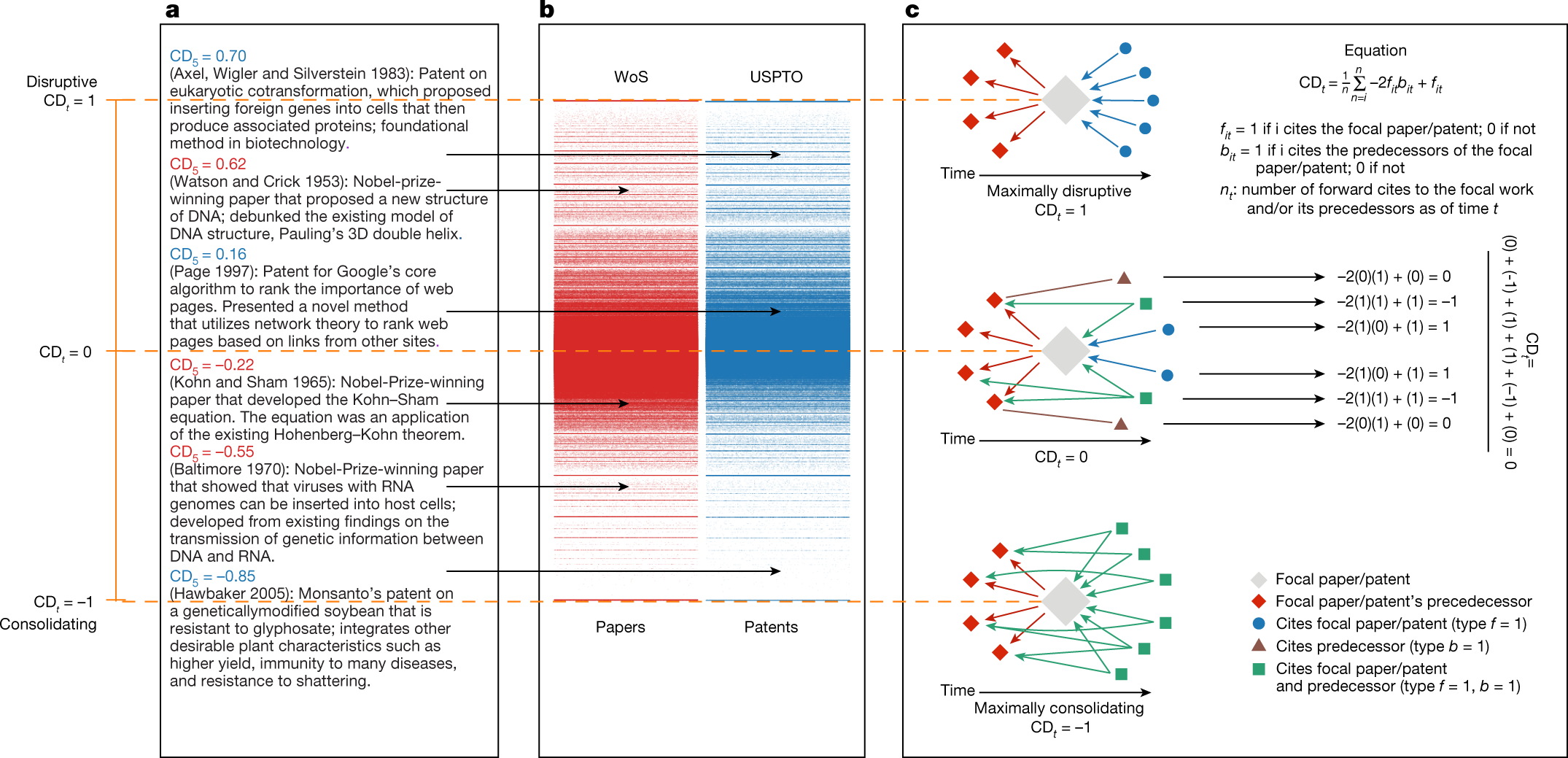
Theories of scientific and technological change view discovery and invention as endogenous processes1,2, wherein previous accumulated knowledge enables future progress by allowing researchers to, in Newton’s words, ‘stand on the shoulders of giants’3–7. Recent decades have witnessed exponential growth in the volume of new scientific and technological knowledge, thereby creating conditions that should be ripe for major advances8,9. Yet contrary to this view, studies suggest that progress is slowing in several major fields10,11. Here, we analyse these claims at scale across six decades, using data on 45 million papers and 3.9 million patents from six large-scale datasets, together with a new quantitative metric—the CD index12—that characterizes how papers and patents change networks of citations in science and technology. We find that papers and patents are increasingly less likely to break with the past in ways that push science and technology in new directions. This pattern holds universally across fields and is robust across multiple different citation- and text-based metrics1,13–17. Subsequently, we link this decline in disruptiveness to a narrowing in the use of previous knowledge, allowing us to reconcile the patterns we observe with the ‘shoulders of giants’ view. We find that the observed declines are unlikely to be driven by changes in the quality of published science, citation practices or field-specific factors. Overall, our results suggest that slowing rates of disruption may reflect a fundamental shift in the nature of science and technology.
Technopoly: The Surrender of Culture to Technology
A witty, often terrifying that chronicles our transform…

Cyber-Marx: Cycles and circuits of struggle in high technology capitalism - Nick Dyer-Witheford
The complete text of Nick Dyer-Witheford's 1999 book, which provides an analysis of information-age capitalism and the movements currently dissolving it. In PDF format.
