

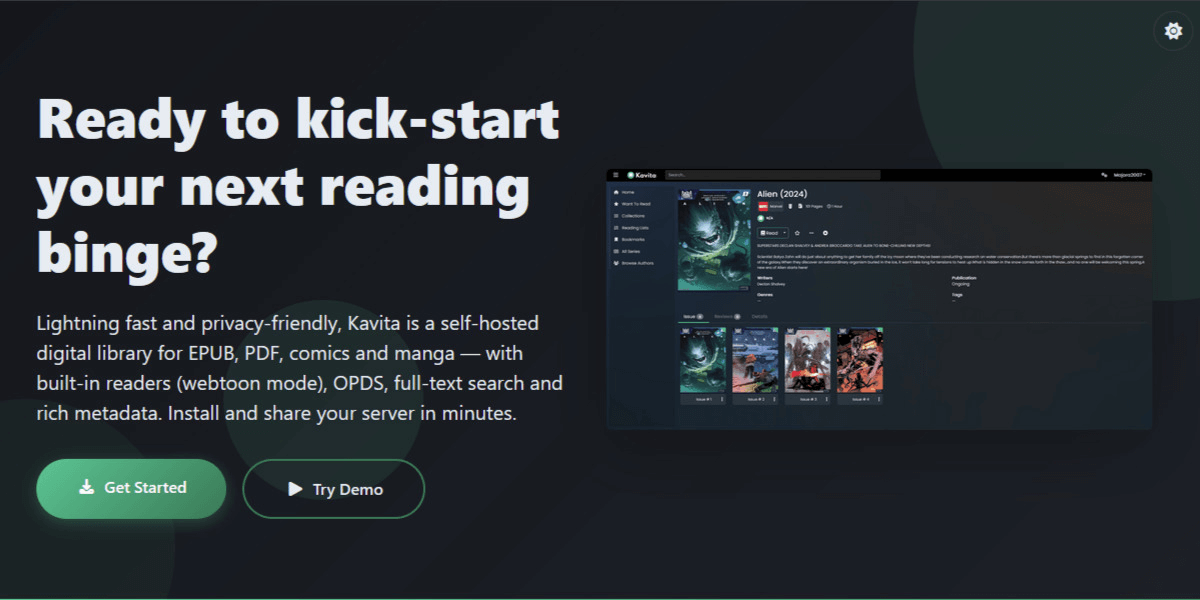
Kavita — a fast, self-hosted digital library for comics, manga, EPUB and PDF. Built-in readers, OPDS, Docker-ready, OIDC, AniList/MAL sync and rich metadata.
Kawaakibi Foundation
Kawaakibi Foundation is an accelerator for thinkers and doers, with a focus on empowering communities across the Middle East and North Africa

Foliobin by Nikita Petrov
A curated gallery of portfolios by the designers behind products you use — Anthropic, Figma, OpenAI, Spotify and more. Video previews, AI search.
TOKIMEKI Diary
A private personal archive that automatically syncs your Bluesky posts, likes, and reposts — with a calendar, full-text search, and insights to look back on.
Kagi Small Web
Discover the small web - personal blogs, independent YouTube channels, and webcomics from genuine humans on the internet.

404 Page not found
Krita is a professional FREE and open source painting program. It is made by artists that want to see affordable art tools for everyone.
Kakao Entertainment will unify its webtoon and web novel platforms into "Kakao Page" within this yea.. - MK
Kakao Entertainment will unify its webtoon and web novel platforms into "Kakao Page" within this year. This is to create synergy by integrating distributed businesses into one. As a result, 'Kakao Web..

shaarli/Shaarli
The personal, minimalist, super-fast, database free, bookmarking service - community repo
MangaDex
Read comics and manga online at MangaDex, with high quality images and support creators and translators!
[Exclusive] Kakao Entertainment to Integrate Webtoon and Web Novel Platforms, Unifying Them Under Kakao Page by Year-End - MK
Kakao Entertainment will consolidate its webtoon and web novel platforms under Kakao Page by the end of the year. The move is aimed at creating synergies by integrating its fragmented businesses into ..

GitHub - ciromattia/kcc: KCC (a.k.a. Kindle Comic Converter) is a comic and manga converter for ebook readers.
KCC (a.k.a. Kindle Comic Converter) is a comic and manga converter for ebook readers. - ciromattia/kcc
Tachiyomi APK v0.15.3 : Free Download,Safe & Ad-Free (2026)
Tachiyomi APK v0.15.3, the last official version, still works in 2026. Free, ad-free manga reader with offline reading and 100+ sources. Safe APK download.
Resilio Sync | Personal file sync and share powered by P2P
Save and share life’s most important moments—photos, videos, music, PDFs, documents, and more—securely across all your devices.
Karpathy's LLM Knowledge Base Wiki for Enterprise | Vijoy Pandey posted on the topic | LinkedIn
There's a new kind of computer media in the enterprise: Write once, Read never. The docs are perpetually stale, constantly diverging from reality, and scattered across Confluence, SharePoint, GitHub, Webex (or Slack) threads, Notion, Obsidian - and in my personal life, add Apple Notes, Goodnotes, web clippings, and multiple Google Drives worth of docs and slides that nobody is ever going back to. Karpathy tweeted his LLM knowledge base wiki architecture which went viral last weekend and I decided to give it a run yesterday. Verdict: You *have* to try this out. Prediction: You won’t be able to live without it soon. There were a few mods and decisions I made to the base Karpathy provided. First, the vault / folder structure in Obsidian. I already use Obsidian as a human. Instead of creating separate vaults and dealing with the sync nightmare, I just have folders for Human and Agent, and a Raw folder. (1) The Human/ folder is where I write long form articles and notes independent of the knowledge base wiki. No LLM or agent touches this folder. (2) I do have Arnold Layne, my OpenClaw agent, doing background tasks for me. Raw/ is where both Arnold and I, dump raw snippets. Inclusive of diverse kinds of media. (3) The Agent/ folder is where the LLM (Claude in my case) synthesizes the wiki. No human touches this folder. Second, some customizations to CLAUDE.md for enterprise-like usage - (4) Domain extensions - the agent needs to know that quantum computing and agentic AI have different entity types and different provenance thresholds. (5) Primary source protection, when I drop in my own original work, secondary sources can extend it or raise questions against it, but they cannot overwrite it. It sounds like a small thing but its’s not, especially at enterprise scale where provenance actually matters. Karpathy is upfront that what he’s built is working memory for a single agent, and it’s truly remarkable at that. The jump to Shared Context across teams, reconciling conflicting beliefs at org scale, ontologies that don’t collapse under the weight of a hundred contributors - those are much harder problems and what we are exploring with the Internet of Cognition. PS: The screenshot shows my Obsidian vault after just two runs: one with Karpathy’s original tweet and gist file itself (so meta!) and one with our Internet of Cognition paper. Claude (Sonnet) read it, compiled it into structured summaries, entity pages, concept pages, backlinks, merged all the information cohesively, and keeps it all maintained from there. You just read the Wiki. It’s simply magical.

"Kakao Entertainment plans to focus on strengthening its content competitiveness around Kakao Page wh" — highlighted by @vicwalker.dev.br
[Exclusive] Kakao Entertainment to Integrate Webtoon and Web Novel Platforms, Unifying Them Under Kakao Page by Year-End