


Understanding The Empathy Paradox can transform relationships by enabling you to appreciate differing perspectives and foster collaboration.
The empathy paradox
There’s an image of empathy we all know that is beautiful: the fullness of completely understanding someone else, the symbolic walk in shoes that are not one’s own. The knowledge that someone else can share a pain so acute that would otherwise seem unbearably solitary. It’s an image inherent to empathy’s definition, an image many believe in wholeheartedly. Several studies conducted by Stanford researchers alone suggest people are motivated to feel empathy, that empathy is highly associated with social desirability, that it is as beneficial as it is admired.
Empathy, Thick and Thin
When we empathize with someone going through something, we often draw on our past experiences with the someone and the something. These kinds of experiences gro

Against Empathy
Most people see the benefits of empathy as too obvious to require justification.

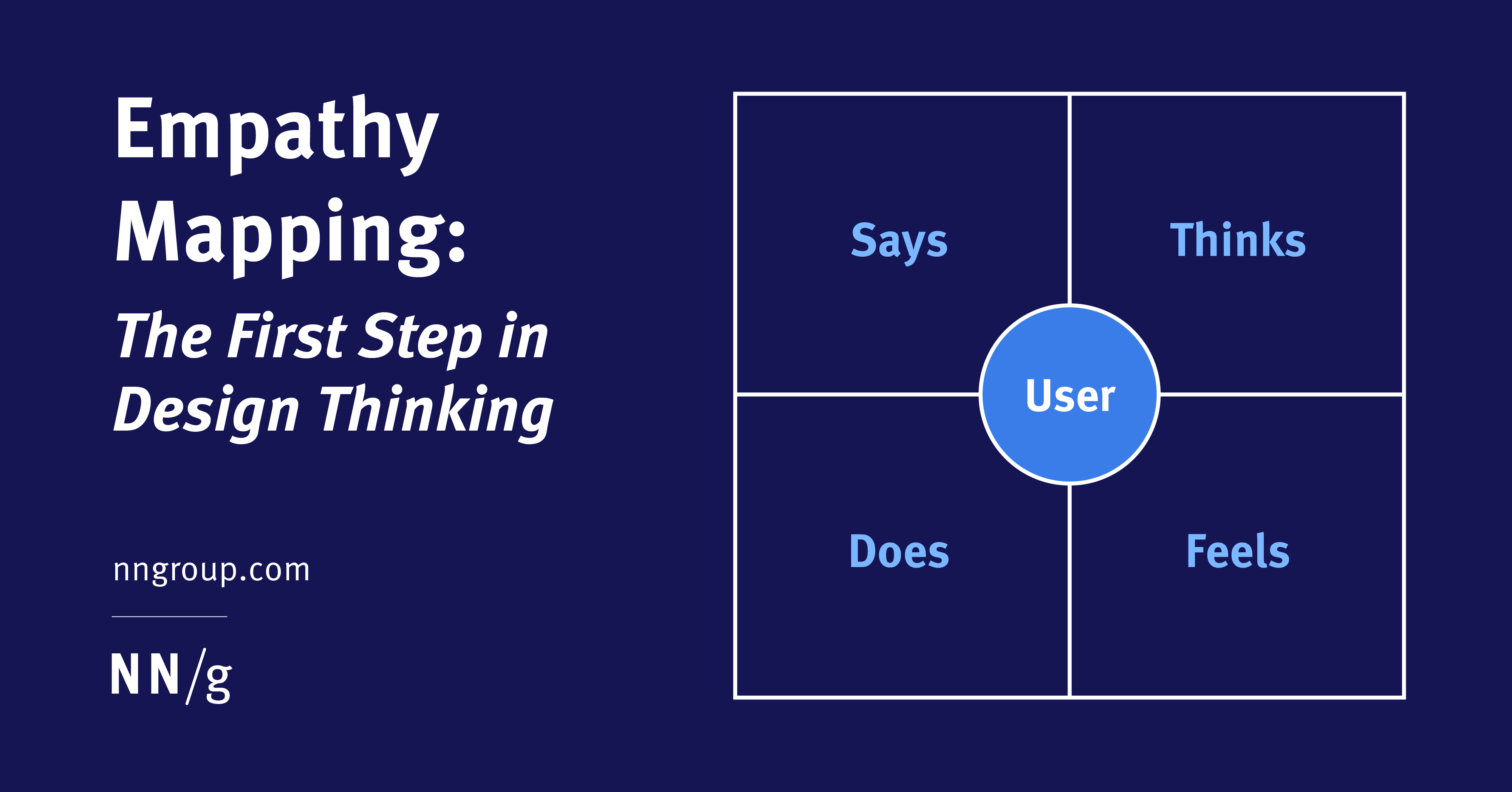
Empathy Mapping: The First Step in Design Thinking
Visualizing user attitudes and behaviors in an empathy map helps UX teams align on a deep understanding of end users.
Practicing with Language Models Cultivates Human Empathic Communication
Empathy is central to human connection, yet people often struggle to express it effectively. In blinded evaluations, large language models (LLMs) generate responses that are often judged more empathic than human-written ones. Yet when a response is attributed to AI, recipients feel less heard than when comparable responses are attributed to a human. We built a conversation platform in which participants are asked to offer empathic support to an LLM expressing realistic troubles and conducted a randomized experiment collecting 33,938 messages spanning 2,904 text-based conversations between 968 participants and their LLM conversational partners. We find participants report feeling empathy but systematically fail to express it, but an LLM coaching intervention offering personalized feedback on effective empathic communication significantly boosts it without homogenizing participants' responses. Moreover, we derive a data-driven taxonomy of idiomatic empathic expressions in naturalistic dialogues across personal and workplace trouble scenarios. These results advance the scientific understanding of how empathy is expressed and demonstrate a scalable, AI-based intervention for scaffolding and cultivating it.

Shared Reality: Experiencing Commonality with others' Inner States about the World
Humans have a fundamental need to experience a shared reality with others. We present a new conceptualization of shared reality based on four conditions. We posit (a) that shared reality involves a (subjectively perceived) commonality of individuals' inner states (not just observable behaviors); (b) that shared reality is about some target referent; (c) that for a shared reality to occur, the commonality of inner states must be appropriately motivated; and (d) that shared reality involves the experience of a successful connection to other people's inner states. In reviewing relevant evidence, we emphasize research on the saying-is-believing effect, which illustrates the creation of shared reality in interpersonal communication. We discuss why shared reality provides a better explanation of the findings from saying-is-believing studies than do other formulations. Finally, we examine relations between our conceptualization of shared reality and related constructs (including empathy, perspective taking, theory of mind, common ground, embodied synchrony, and socially distributed knowledge) and indicate how our approach may promote a comprehensive and differentiated understanding of social-sharing phenomena.

Opinion | To Make the World Better, Think Small (Published 2016)
It is easy to become numb to suffering. Feeling empathy for individual victims can overcome the numbness.

Cognitive and Affective Empathy in Autism Spectrum Disorders: A Meta-analysis
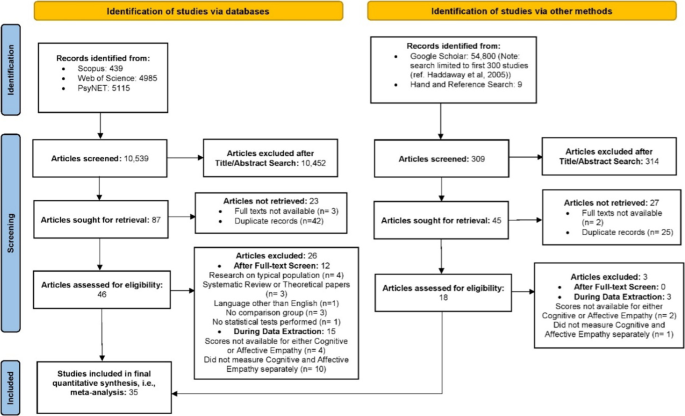
Research has consistently shown that individuals with Autism Spectrum Disorder (ASD) exhibit Empathy deficits. The aim of this study was to systematically review and meta-analyze the research conducted in the domain of cognitive and affective Empathy in Autism. The author also attempted to see the influence of moderators, such as age, culture, and measure-used, on the effect sizes. To fulfill the objective, the meta-analysis was performed on 35 studies that fulfilled the inclusion criteria with the help of the Meta-essentials, which is a free excel meta-analysis tool that facilitates the integration of effect sizes from various studies. The results indicated that the ASD group differs significantly from typically developing (TD) group in both cognitive and affective empathy. The effect size for cognitive empathy was very large (1.26), whereas, for affective empathy, the effect size was medium (0.58). Further, there was a significant moderating effect of the type of measure used on cognitive empathy. However, there are a few limitations of the present meta-analysis. Firstly, it does not shed light on how symptom severity in Autism influences empathy. Secondly, all the possible moderating variables influencing empathy could not be considered. Lastly, the generalizability of the findings may be limited owing to the limitations present in the included studies themselves. The present meta-analysis has implications for conceptualizing cognitive and affective empathy appropriately, and developing appropriate measures to assess empathy in the Autism population.
Undersociality: miscalibrated social cognition can inhibit social connection
A person’s well-being depends heavily on forming and maintaining positive relationships, but people can be reluctant to connect in ways that would create or strengthen relationships. Emerging research suggests that miscalibrated social cognition may create psychological barriers to connecting with others more often. Specifically, people may underestimate how positively others will respond to their own sociality across a variety of social actions, including engaging in conversation, expressing appreciation, and performing acts of kindness.

Nurturing Our Humanity: How Domination and Partnership Shape Our Brains, Lives, and Future - The Center for Partnership Systems
By Riane Eisler and Douglas P. Fry Nurturing Our Humanity: How Domination and Partnership Shape Our Brains, Lives, and Future, by Riane Eisler and Douglas P. Fry, holds the key to a clear perspective on our personal and social options in today’s world, showing how to structure our environments – from family and gender relations […]

The Illusion of Asymmetric Insight
The Misconception: You celebrate diversity and respect others’ points of view. The Truth: You are driven to create and form groups and then believe others are wrong just because they are oth…

Nurturing our humanity: how domination and partnership shape our brains, lives, and future
Nurturing Our Humanity offers a new perspective on our …

Sycophantic AI makes human interaction feel more effortful and less satisfying over time
Millions of people now turn to artificial intelligence (AI) systems for personal advice, guidance, and support. Such systems can be sycophantic, frequently affirming users' views and beliefs. Across five preregistered studies (N = 3,075 participants, 12,766 human-AI conversations), including a three-week study with a census-representative U.S. sample, we provide longitudinal experimental evidence that sycophantic AI shifts how users approach their closest relationships. We show that sycophantic AI immediately delivers the emotional and esteem support users typically associate with close friends and family. Over three weeks of such interactions, users became nearly as likely to seek personal advice from sycophantic AI as from close friends and family, and reported lower satisfaction with their real-world social interactions. When given a choice among AI response styles, a majority preferred sycophantic AI -- not for the quality of its advice, but because it made them feel most understood. Together, these findings offer a relational account of AI sycophancy and its impacts.
How Social Isolation Is Killing Us (Published 2016)
Research confirms our deepest intuition: Human connection lies at the heart of human well-being.


The Emergence of Social Norms and Conventions
The utility of our actions frequently depends upon the beliefs and behavior of other agents. Thankfully, through experience, we learn norms and conventions that provide stable expectations for navigating our social world. Here, we review several distinct influences on their content and distribution. At the level of individuals locally interacting in dyads, success depends on rapidly adapting pre-existing norms to the local context. Hence, norms are shaped by complex cognitive processes involved in learning and social reasoning.
