


We, the undersigned, are dedicated to the revitalization of the Ladino (Judeo-Spanish) language, which has been designated as an endangered language by UNESCO and the Endangered Language Alliance. Our community includes native and heritage speakers, ethnomusicologists, researchers, musicians, students, and advocates committed to sustaining Sephardic linguistic and cultural traditions.Ladino, spoken by Sephardic Jews following their expulsion from the Iberian Peninsula, remains a living language
Mitigating Cross-Lingual Cultural Inconsistencies in LLMs via...
Despite their impressive capabilities, multilingual large language models (MLLMs) frequently exhibit inconsistent behaviour when the prompt's language changes. While such adaptation is generally...



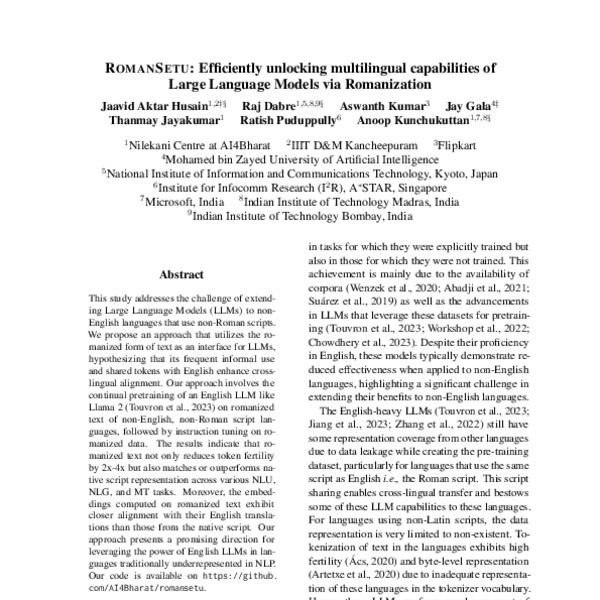
RomanSetu: Efficiently unlocking multilingual capabilities of Large Language Models via Romanization
This study addresses the challenge of extending Large Language Models (LLMs) to non-English languages, specifically those using non-Roman scripts. We propose an approach that utilizes the romanized form of text as an interface for LLMs, hypothesizing that its frequent informal use and shared tokens with English enhance cross-lingual alignment. Our approach involve the continual pretraining of a English LLM like Llama 2 on romanized text of non-English, non-Roman script languages, followed by instruction tuning on romanized data. The results indicate that romanized text not only reduces token fertility by 2x-4x but also matches if not outperforms native script representation across various NLU, NLG and MT tasks. Moreover, the embeddings computed on romanized text exhibit closer alignment with their English translations than those from the native script. Our approach presents a promising direction for leveraging the power of English LLMs in languages traditionally underrepresented in NLP research.
Un símbolo para o fediverso ⁂
Propoñemos o símbolo ⁂ para representar ao fediverso.

Opinion | Why Save a Language? (Published 2014)
Hint: It’s not to preserve a different way of seeing the world.

Things we learned about LLMs in 2024
A lot has happened in the world of Large Language Models over the course of 2024. Here’s a review of things we figured out about the field in the past …
On Language and Humanity: In Conversation With Noam Chomsky
The father of modern linguistics is still opening up new kinds of questions and topics for inquiry.

First Languages AI Reality | Mila
The FLAIR initiative aims to develop a method for the rapid creation of customized ASR models for Indigenous languages.

Gramsci's Nightmare: AI, Platform Power and the Automation of Cultural Hegemony - Ethan Zuckerman
Large language models lock values into place, making it hard to challenge the cultural hegemony of a particular form of western culture

The Fluidity and Fun of Chino Latino Cuisine Reaches New Fandoms
The bright, bold fusion cuisine is looking to the future without forgetting its past

Language models are multiverse generators
"Actualities seem to float in a wider sea of possibilities from out of which they were chosen; and somewhere, indeterminism says, such possibilities exist, and form part of the truth."
¿Por qué no?
There’s no prize money. No credential. No real glory to speak of. And yet, untold thousands of hobbyists devote hours each day to cheating the language-learning app Duolingo.
Lua
Lua is a general-purpose high-level language created since the 1990s at PUC Rio de Janeiro.