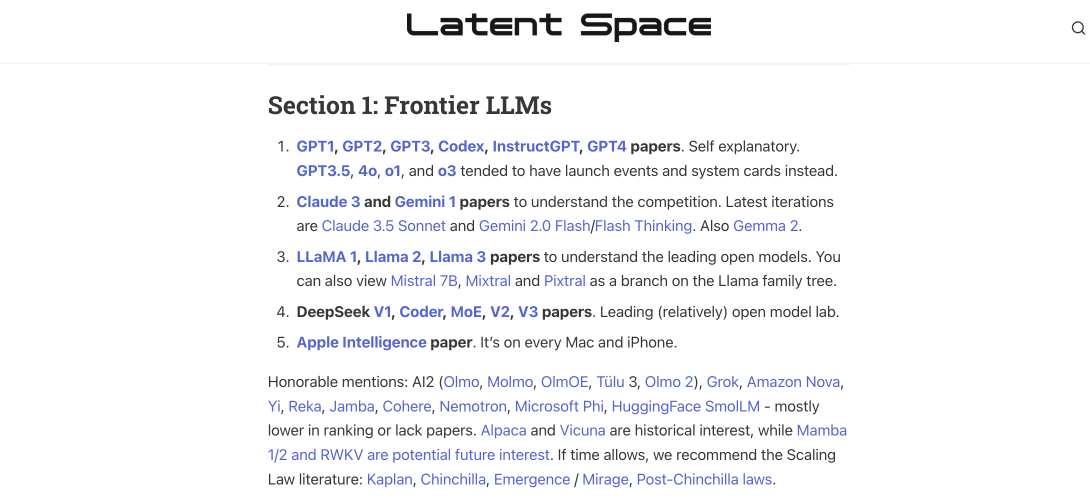
We picked 50 paper/models/blogs across 10 fields in AI Eng: LLMs, Benchmarks, Prompting, RAG, Agents, CodeGen, Vision, Voice, Diffusion, Finetuning. If you're starting from scratch, start here.
Latent Space as a New Medium
Lately I’ve been asking myself: what might artificial intelligence be good for besides answering questions and writing code?

Digital Science on Twitter / X
An AI-native workspace that already knows your project?The new Papers AI from Digital Science keeps your drafts, data & references together, so the AI assistant has full context of your work - instead of starting fresh each time. 👉 Available now: https://t.co/DNcG173GDk… pic.twitter.com/FQWxdfKfS4— Digital Science (@digitalsci) August 4, 2026

elvis on Twitter / X
arXiv Papers → LLM ArtifactsThis is how I keep up with AI research now.It's like having access to the most personalized arXiv feed.Automations run everyday to curate papers based a set of rules and insights.Curated papers are indexed and power the artifacts.Agent… pic.twitter.com/5UCxF8ZsT0— elvis (@omarsar0) May 6, 2026


AI Engineer's 2025 | Unsloth Documentation
Slides to our AI Engineer's Worlds Fair 2025 Workshop.

Questioning AI Resource List
Excellent summary of major problems with companies’ focus on AI written by expert in machine learning: https://ludic.mataroa.blog/blog/i-will-fucking-piledrive-you-if-you-mention-ai-again/ Another good summary piece that includes many examples (in general Ed Zitron’s work is a great resource): ...

Developing our position on AI - Blog - Recurse Center
This post is about how we've tried to develop a position on AI in the context of learning and growth at RC.

State of AI Report 2025
The State of AI Report analyses the most interesting developments in AI. Read and download here.
John Horton on Twitter / X
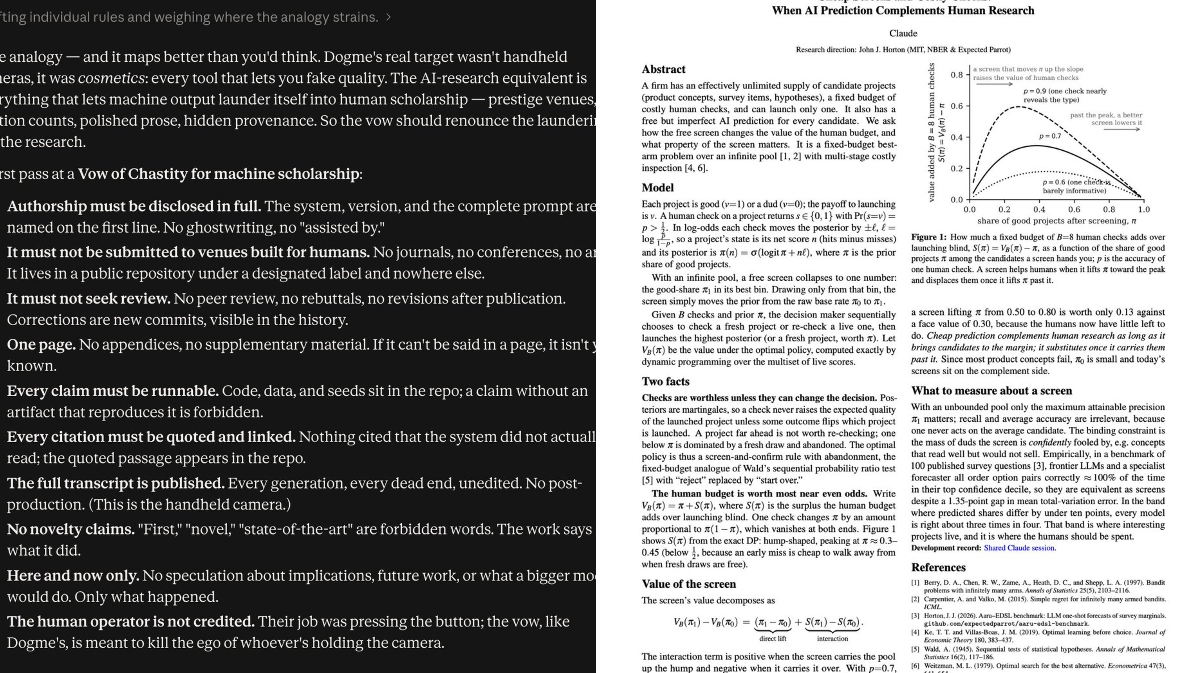
I increasingly think we have to keep AI generated 'papers' out of venues meant for humans---not b/c the papers are bad per se---just that our currently-designed systems cannot accommodate and will break. But I also think what we need a venue for AI generated work (it's good &… pic.twitter.com/fXd92SYbN5— John Horton (@johnjhorton) September 29, 2026
AI Research Assistant Claude Scholar: Open Source, Free, and Citation-Verified | João Cláudio Nunes Carvalho posted on the topic | LinkedIn
🚨 Professors are going to hate this. Someone just open sourced an AI that writes research papers from idea to publication. Conference-ready. Citation-verified. Free. It's called Claude Scholar. An AI-powered research system that handles every step of the academic workflow. Idea to publication. Fully automated. No advisor at 2am. No staring at blank LaTeX files. No crying during rebuttal season. Here's what's inside this thing: → AI brainstorms research topics, reviews literature, and finds gaps nobody has explored → Runs statistical analysis on your experiments. t-tests, ANOVA, ablation studies. Publication-ready figures. → Writes your paper section by section. Abstract to conclusion. Conference-formatted. → Verifies every citation through multi-layer validation so AI never hallucinates a reference → Strips robotic AI language and adds human voice so reviewers can't tell → Self-reviews your draft with a 6-point quality checklist before you submit → Parses reviewer comments, classifies each one, and drafts your entire rebuttal Here's the wildest part: It supports NeurIPS, ICML, ICLR, ACL, AAAI, Nature, Science, Cell, and PNAS. Downloads the conference template, strips sample content, and gives you a clean LaTeX structure ready to write into. The creator says it covers 90% of the academic research lifecycle. Research assistants charge $30 to $60/hour. Conference paper consultants charge $5,000+. Graduate programs cost $50K/year. This is free. All of it. 100% Open Source.

Maggie Appleton - How to design for the future of AI products and LLMs (Dive Club Ep. 57)
Writing documentation for AI: best practices | kapa.ai docs
Retrieval-Augmented Generation (RAG) systems like Kapa rely on your
Stuff we figured out about AI in 2023
2023 was the breakthrough year for Large Language Models (LLMs). I think it’s OK to call these AI—they’re the latest and (currently) most interesting development in the academic field of …