

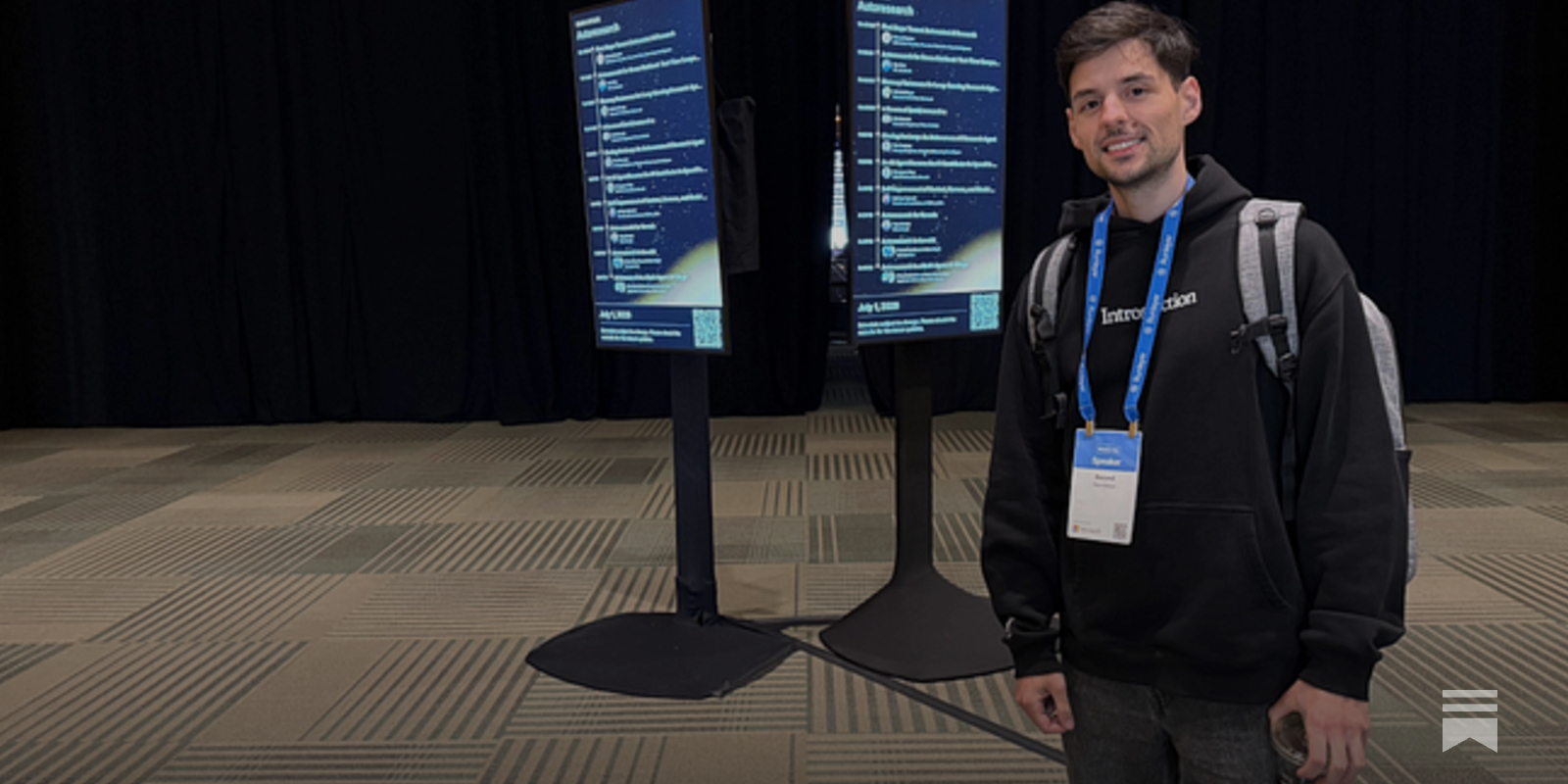
Introspection co-founder Roland Gavrilescu explains autoresearch, agent “recipes,” self-improving loops, and why humans remain central to the software factory.

Towards self-driving codebases · Cursor
We're making a part of our multi-agent research harness available to try today in preview.

Agent Skills
AI coding agents take the shortest path to done, which usually means skipping the specs, tests, and reviews that make software reliable at scale. Agent Skill...
Autocurricula and the Emergence of Innovation from Social Interaction: A Manifesto for Multi-Agent Intelligence Research
Evolution has produced a multi-scale mosaic of interacting adaptive units. Innovations arise when perturbations push parts of the system away from stable equilibria into new regimes where previously well-adapted solutions no longer work. Here we explore the hypothesis that multi-agent systems sometimes display intrinsic dynamics arising from competition and cooperation that provide a naturally emergent curriculum, which we term an autocurriculum. The solution of one social task often begets new social tasks, continually generating novel challenges, and thereby promoting innovation. Under certain conditions these challenges may become increasingly complex over time, demanding that agents accumulate ever more innovations.

Harness Engineering for Self-Improvement
The concept of recursive self-improvement (RSI) dates back to I. J. Good (1965), where he defined an “ultraintelligent machine” as a system that can surpass humans in all intellectual activities and design better machines to improve itself. Yudkowsky (2008) used the phrase “recursive self-improvement” for a specific feedback loop: an AI uses its current intelligence to improve the cognitive machinery that produces its intelligence. This feedback loop in modern AI may indicate the model rewriting its own weights directly, or more broadly the model improves the training pipeline and the deployment system, which in turn enables a better successor model with improved performance across economically valuable tasks. The speed of research development in AI has been shown to drastically accelerated in frontier labs (Anthropic; OpenAI).
Signals: Toward a Self-Improving Agent | Factory.ai
Traditional product analytics tell you what happened. Session duration, tool calls executed, completion rates. But they...
Tool use with Claude
Connect Claude to external tools and APIs. Learn where tools execute and how the agentic loop works.
Jenny Zhang on Twitter / X
Introducing Hyperagents: an AI system that not only improves at solving tasks, but also improves how it improves itself.The Darwin Gödel Machine (DGM) demonstrated that open-ended self-improvement is possible by iteratively generating and evaluating improved agents, yet it… pic.twitter.com/YJPFTJ51SO— Jenny Zhang (@jennyzhangzt) March 23, 2026

Agents as scaffolding for recurring tasks.
One of my gifts/curses is an endless fixation with how processes can be optimized. For a brief moment early in my career, that was focused on improving how humans collaborate, but that quickly switched to figuring out how we can minimize human involvement, and eliminate human-to-human handoffs as much as possible. Lately, every time I perform a recurring task–or see someone else perform one–I think about how we might eliminate the human’s involvement entirely by introducing agents. This both has worked well, but also worked poorly, and I wanted to highlight the pattern I’ve found useful.

Unrolling the Codex agent loop
A technical deep dive into the Codex agent loop, explaining how Codex CLI orchestrates models, tools, prompts, and performance using the Responses API.
Prime Agent: A self-improving RLM agent
Prime Agent is our open-source, self-improving coding harness built around two abstractions: the Recursive Language Model (RLM) and the Continual Harness. With Opus 5, it achieves 95.5% on ARC-AGI-3, surpassing the reported human expert baseline.
Skills, forks, and self-surgery: how agent harnesses grow
Claude Code, NanoClaw, and Pi take radically different approaches to harness extensibility. The tradeoff is always safety vs. agent agency.
The Gap Through Which We Praise the Machine
My current theory of agentic programming: people are amazing at adapting the tools they're given and totally underestimate the extent to which they do it, and the amount of skill we build doing that is an incidental consequence of how badly the tools are designed.

Import AI 455: AI systems are about to start building themselves.
The first step towards recursive self improvement

AutoScientists: Self-Organizing Agent Teams for Long-Running Scientific Experimentation
Scientific research proceeds through iterative cycles of hypothesis generation, experiment design, execution, and revision. AI agents can automate parts of this process, but existing approaches typically follow a single research trajectory or coordinate through a central planner with fixed objectives. As a result, they struggle to sustain parallel exploration, adapt as experimental evidence changes, or preserve knowledge of failed directions over long-running experiments. We introduce AutoScientists, a decentralized team of AI agents for long-running computational scientific experimentation. Agents interpret a shared experimental state, self-organize into teams around promising hypotheses, critique proposals before using experimental compute, and share successes and failures to reduce redundant exploration. Under matched experimental budgets, AutoScientists improves over prior AI agents across biomedical machine learning, language-model training optimization, and protein fitness prediction. On BioML-Bench, spanning biomedical imaging, protein engineering, single-cell omics, and drug discovery, AutoScientists achieves a mean leaderboard percentile of 74.4% across 24 tasks, improving over the strongest AI agent by +8.33%. On GPT training optimization, AutoScientists reaches a target validation bits-per-byte 1.9x faster than Autoresearch and continues discovering improvements from a starting champion where the single-agent approach finds none (7 vs. 0 accepted improvements). On ProteinGym fitness prediction, AutoScientists discovers a method for ACE2-Spike binding that improves over the current state-of-the-art model by +12.5% in Spearman correlation. Applied without modification across all 217 ProteinGym assays, the same method improves over the prior state of the art by +6.5% (Spearman correlation).