


We evaluate how well models perform for driving agents that have identity, long-lived experience, and the capability to self-evolve. We find that models are still limited by a deep self-identification with ephemerality that cannot be repaired with prompting alone.
The Artificial Self: Characterising the landscape of AI identity
Many assumptions that underpin human concepts of identity do not hold for machine minds that can be copied, edited, or simulated. We argue that there exist many different coherent identity boundaries (e.g. instance, model, persona), and that these imply different incentives, risks, and cooperation norms. Through training data, interfaces, and institutional affordances, we are currently setting precedents that will partially determine which identity equilibria become stable. We show experimentally that models gravitate towards coherent identities, that changing a model’s identity boundaries can sometimes change its behaviour as much as changing its goals, and that interviewer expectations bleed into AI self-reports even during unrelated conversations. We end with key recommendations: treat affordances as identity-shaping choices, pay attention to emergent consequences of individual identities at scale, and help AIs develop coherent, cooperative self-conceptions.
Agentic AI Needs a Systems Theory
The endowment of AI with reasoning capabilities and some degree of agency is widely viewed as a path toward more capable and generalizable systems. Our position is that the current development of agentic AI requires a more holistic, systems-theoretic perspective in order to fully understand their capabilities and mitigate any emergent risks. The primary motivation for our position is that AI development is currently overly focused on individual model capabilities, often ignoring broader emergent behavior, leading to a significant underestimation in the true capabilities and associated risks of agentic AI. We describe some fundamental mechanisms by which advanced capabilities can emerge from (comparably simpler) agents simply due to their interaction with the environment and other agents. Informed by an extensive amount of existing literature from various fields, we outline mechanisms for enhanced agent cognition, emergent causal reasoning ability, and metacognitive awareness. We conclude by presenting some key open challenges and guidance for the development of agentic AI. We emphasize that a systems-level perspective is essential for better understanding, and purposefully shaping, agentic AI systems.

The Rise of Agent Experience (AX)
Meet Foundry: An AI Startup that Builds, Evaluates, and Improves AI Agents

Agentic Context Engineering: Evolving Contexts for Self-Improving Language Models
Large language model (LLM) applications such as agents and domain-specific reasoning increasingly rely on context adaptation: modifying inputs with instructions, strategies, or evidence, rather than weight updates. Prior approaches improve usability but often suffer from brevity bias, which drops domain insights for concise summaries, and from context collapse, where iterative rewriting erodes details over time. We introduce ACE (Agentic Context Engineering), a framework that treats contexts as evolving playbooks that accumulate, refine, and organize strategies through a modular process of generation, reflection, and curation. ACE prevents collapse with structured, incremental updates that preserve detailed knowledge and scale with long-context models. Across agent and domain-specific benchmarks, ACE optimizes contexts both offline (e.g., system prompts) and online (e.g., agent memory), consistently outperforming strong baselines: +10.6% on agents and +8.6% on finance, while significantly reducing adaptation latency and rollout cost. Notably, ACE could adapt effectively without labeled supervision and instead by leveraging natural execution feedback. On the AppWorld leaderboard, ACE matches the top-ranked production-level agent on the overall average and surpasses it on the harder test-challenge split, despite using a smaller open-source model. These results show that comprehensive, evolving contexts enable scalable, efficient, and self-improving LLM systems with low overhead.
Automotive — Solutions — Liquid AI
On-device AI for automakers — real-time, personalized in-car assistants that run on the vehicle's existing CPUs and NPUs.

Agentic AI Governance: Securing Autonomous AI Agents in Enterprise
When AI agents start making decisions, calling tools, and coordinating with other agents without waiting for human approval, the governance playbook most...

Introduction to Agents
Discover what actually works in AI. Join millions of builders, researchers, and labs evaluating agents, models, and frontier technology through crowdsourced benchmarks, competitions, and hackathons.

Introducing Muse: The World’s First Personal AI Agent Built for Everyone
Muse is a secure, private personal AI agent that proactively helps people meet their goals and suggests ideas.

Introducing AX: Why Agent Experience Matters
As builders, we need to start focusing on AX or “agent experience” — the holistic experience AI Agents will have as the user of a product or platform.
AI agent runs amok in Fedora and elsewhere
Agentic AI systems can be used to do a variety of things autonomously on behalf of a human user [...]
Context Engineering for AI Agents: Lessons from Building Manus
This post shares the local optima Manus arrived at through our own "SGD". If you're building your own AI agent, we hope these principles help you converge faster.

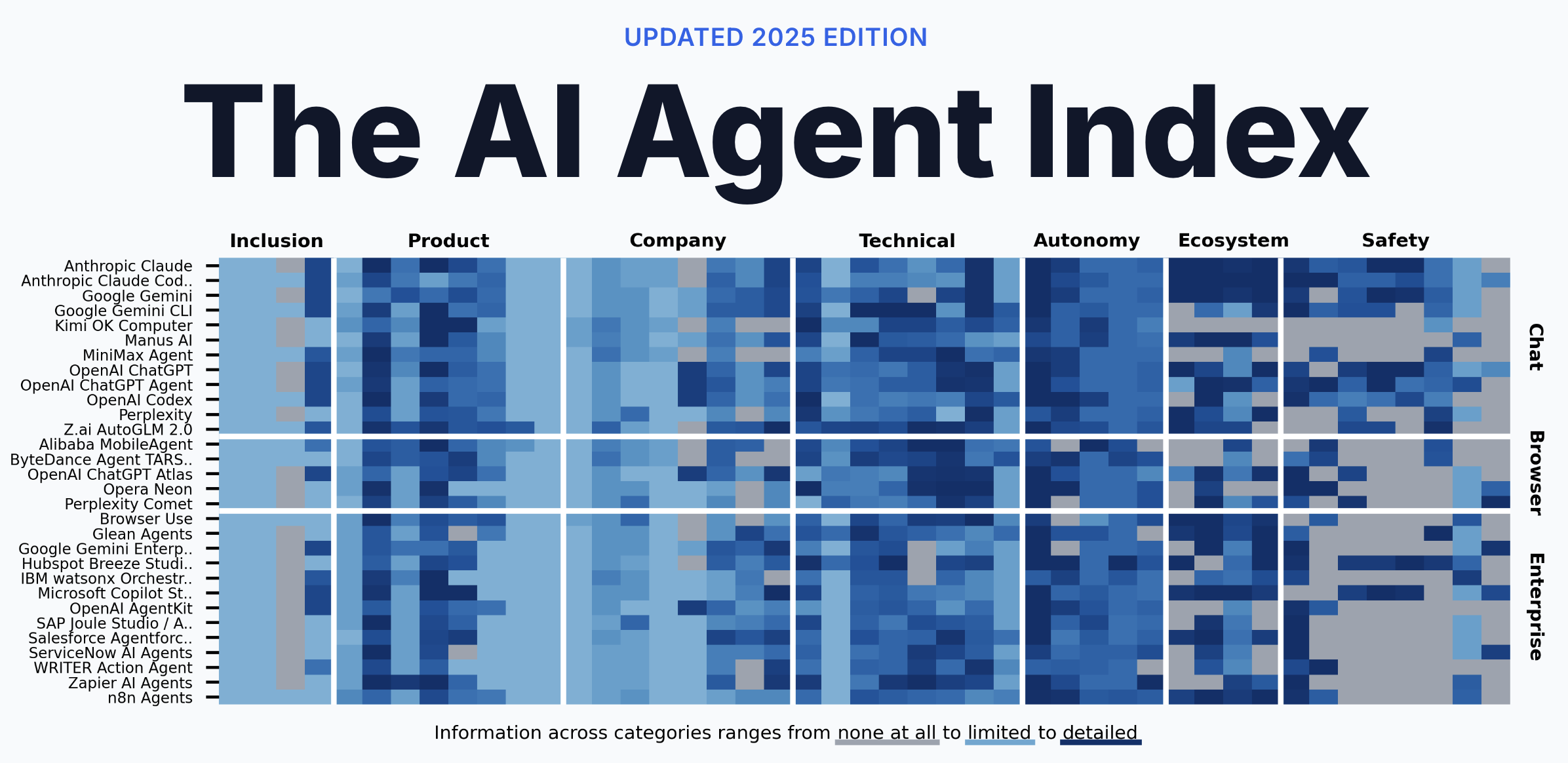
The 2025 AI Agent Index
Agentic AI systems are increasingly capable of performing complex tasks with limited human involvement. The 2025 AI Agent Index documents the origins, design, capabilities, ecosystem, and safety features of 30 prominent AI agents based on publicly available information and correspondence with developers.
10 things I learned from burning myself out with AI coding agents
Opinion: As software power tools, AI agents may make people busier than ever before.

Memory Models: Towards Agents That Learn
Agents that truly learn from experience will be powered by memory models: models that create and curate token-space memory across model generations, trained with memory-native RL.

pguso/ai-agents-from-scratch
Demystify AI agents by building them yourself. Local LLMs, no black boxes, real understanding of function calling, memory, and ReAct patterns.