


Our screens are two-way but we can easily forget that the people on the other end exist as more than characters for our enjoyment.
Ezra Klein’s “Why We’re Polarized” and the Drawbacks of Explainer Journalism
A Darwinian reading of American politics leaves little room for the motivations of conscious, rational agents.

The Internet's Meaning Crisis
Parasocial media is a response to excessive irrelevance

Social Media Vs Democracy
Redesigning algorithms to intervene on social norm misperceptions during a national election
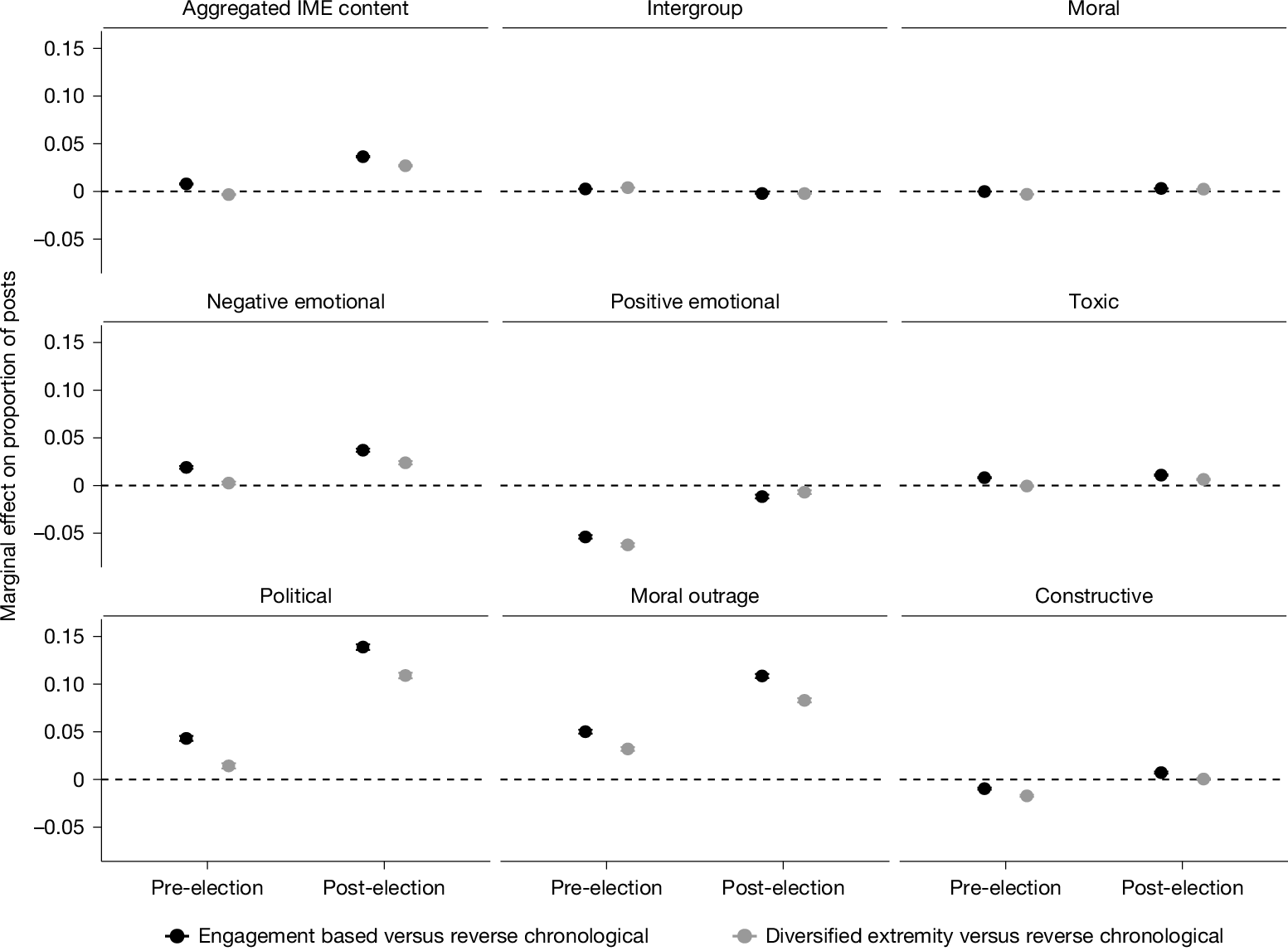
For the first time in history, civic discourse commonly occurs in digital environments in which algorithms influence exposure to social information1,2. It is increasingly important to understand whether and how these algorithms affect political discourse3–5. Here we built custom feed-ranking algorithms with full control over their features, and randomly assigned 2,000 participants to use them for 8 weeks (before and after the 2024 US presidential election). We tested whether an engagement-based algorithm (used on major social media platforms6,7) amplifies intergroup, moralized and emotional (IME) information in ways that skew perceptions of social norms around political dialogue5,8, and whether it increased engagement with IME content and perceptions of partisan animosity (compared with a reverse-chronological feed9,10). We also developed and tested a ‘diversified extremity’ algorithm to reduce the influence of extreme users11–13 to improve the accuracy of social norm perception14–16 and reduce perceptions of partisan animosity. We found that engagement-based feeds amplified IME and toxic content relative to reverse-chronological feeds, with the largest increases in moral outrage and political content. Engagement-based feeds also reduced prescriptive norm perception accuracy (albeit in an unexpected direction) and increased perceived partisan animosity. However, they did not significantly alter users’ own engagement behaviours. The diversified extremity algorithm reduced IME and toxic content exposure, improved prescriptive norm accuracy, yet maintained comparable platform enjoyment—suggesting that reducing the influence of extreme users can curb algorithmic distortions without diminishing user experience.
The Anti-Social Century
Americans are now spending more time alone than ever. It’s changing our personalities, our politics, and even our relationship to reality.

Social Media and Politics from 2023-2025
I examine the political identities, extremity, and polarization of US adults across platforms over a 2-year national survey.
How Technology Is Shaping Modern Politics
Discover how technology is reshaping politics, from digital campaigns to AI, and the challenges of misinformation and election security.
'No Politics' Rules | The Paper Pilot
The Paper Pilot's digital garden of thoughts on philosophy, politics, and sociology
Politics Is for Power
A groundbreaking analysis of political hobbyism—treating politics like a spectator sport—and an urgent and timely call to arms for the many well-me...

Hyperpolitics: Extreme Politicization without Political Consequences
POLITICS AFTER THE END OF THE END OF HISTORYWhat happens when politics is everywhere, yet nothing seems to change? From the abandoned dance floors of Thatcher’s London to the mass mobilizations of Black Lives Matter, Anton Jäger traces how public life has become infused with protest, spectacle, and moral urgency — while the old infrastructure of parties, unions, and civic solidarity has been hollowed out.Hyperpolitics revisits the illusions of the “end of history” and dissects the strange energies that replaced them: viral outrage, endless culture wars, and the digital rush of causes that flare and vanish overnight. Jäger shows how the promises of post–Cold War liberalism gave way to a restless, unsteady public sphere where private passions overflow into politics but rarely build enduring power.Ranging from Guy Debord and Wolfgang Tillmans to Houellebecq’s disenchanted fictions, Hyperpolitics makes sense of a world in which collective action remains fragmented and the social fabric thinner than ever. For anyone trying to grasp why our age feels so charged yet so inconsequential, this book offers a vital map through the new contradictions of our hyperpolitical moment.
The Search For The Apolitical Video Game
How a Chinese marketing network quietly injects political narratives into Taiwanese lifestyle content
A new investigation by Reporters Without Borders (RSF) reveals how certain Facebook pages posing as lifestyle hubs for hobbies and health tips inject Beijing’s political narratives into their feeds to influence public opinion in Taiwan. These pages are tied to the China-based digital marketing company Wubianjie, which blends entertainment, disinformation and political messaging in cognitive warfare campaigns that are difficult to detect.

The social media discourse of engaged partisans is toxic even when politics are irrelevant
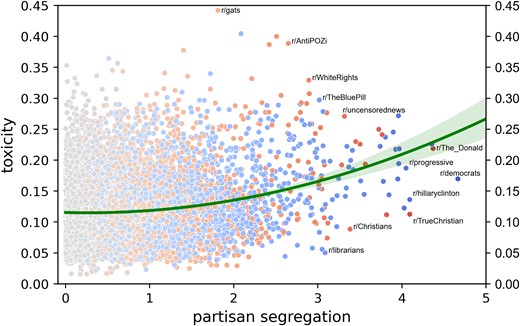
Abstract Prevailing theories of partisan incivility on social media suggest that it derives from disagreement about political issues or from status competition between groups. This study—which analyzes the commenting behavior of Reddit users across diverse cultural contexts (subreddits)—tests the alternative hypothesis that such incivility derives in large part from a selection effect: Toxic people are especially likely to opt into discourse in partisan contexts. First, we examined commenting behavior across over 9,000 unique cultural contexts (subreddits) and confirmed that discourse is indeed more toxic in partisan (e.g. r/progressive, r/conservatives) than in nonpartisan contexts (e.g. r/movies, r/programming). Next, we analyzed hundreds of millions of comments from over 6.3 million users and found robust evidence that: (i) the discourse of people whose behavior is especially toxic in partisan contexts is also especially toxic in nonpartisan contexts (i.e. people are not politics-only toxicity specialists); and (ii) when considering only nonpartisan contexts, the discourse of people who also comment in partisan contexts is more toxic than the discourse of people who do not. These effects were not driven by socialization processes whereby people overgeneralized toxic behavioral norms they had learned in partisan contexts. In contrast to speculation about the need for partisans to engage beyond their echo chambers, toxicity in nonpartisan contexts was higher among people who also comment in both left-wing and right-wing contexts (bilaterally engaged users) than among people who also comment in only left-wing or right-wing contexts (unilaterally engaged users). The discussion considers implications for democratic functioning and theories of polarization.
Views of American politics, polarization and tone of political debate
In many ways, Americans’ emotions toward politics today are as negative as their evaluations of the country’s political system. Majorities say they always or often feel exhausted (65%) and angry…
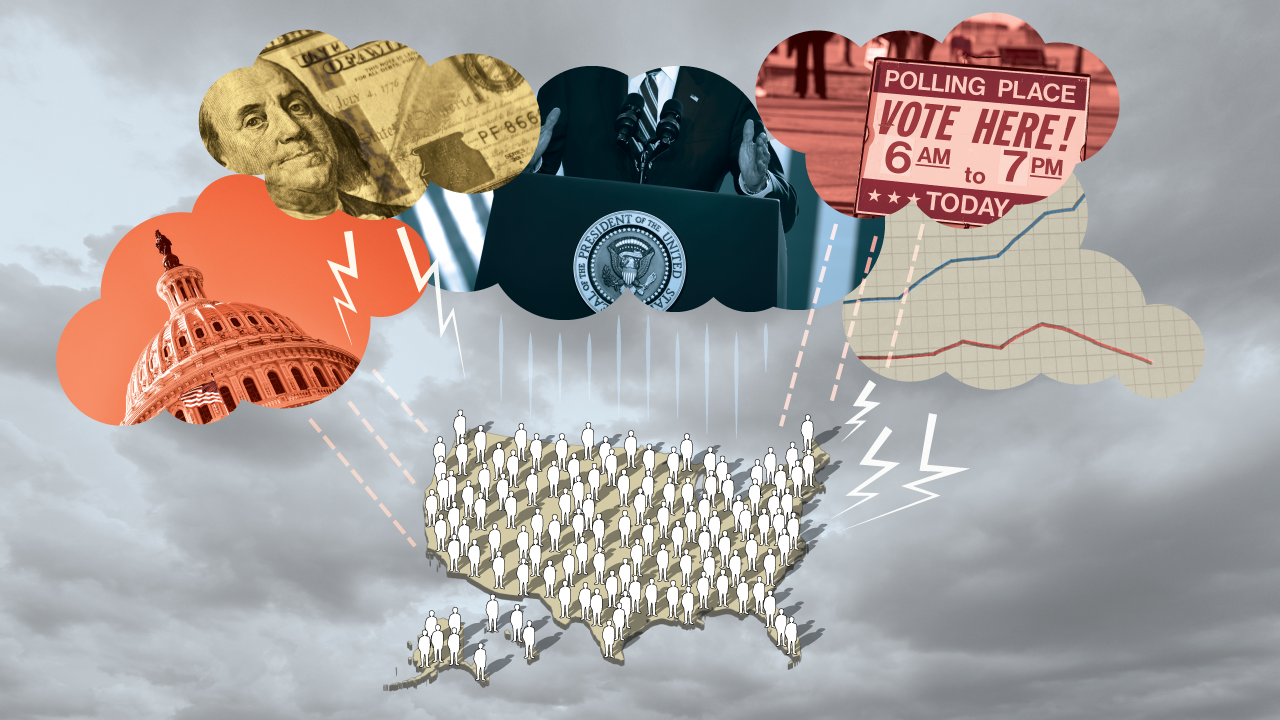
✨New paper out @nature.com ✨ For 8 weeks around the 2024 US election, we randomly assigned 2,000 people to use social media algos we built ourselves. Do engagement-based algorithms amplify intergroup, moral & emotional (IME) content—and does that distort how we see political norms? 🧵🔗 👇
