


Today, the Brain&AI team announces a new release with NeuralBench. 📊📊📊 A unified framework for benchmarking foundation models of brain activity. This wouldn’t have been possible without the tremendous work of Hubert Banville 🎉 🎉 🎉 - 🧠 36 EEG tasks - 🗄️ 94 public datasets. - 💻 Code: https://lnkd.in/dPDMwja3 - 📄 Paper: https://lnkd.in/ddDU2p6d This package allows systematic evaluation of any foundation models. NeuralBench addresses this by defining each task end-to-end with config files (data source, preprocessing, splits, optimizer, metrics, architecture) so all models can be evaluated on the same footing. We invite the community to contribute new tasks, datasets, and models, especially for fMRI, MEG, and iEEG. The long-term goal is a fully unified benchmark across neuroimaging tasks and modalities. What's in the first release, NeuralBench-EEG v1.0: - 36 EEG tasks across 94 public datasets, spanning motor imagery, clinical classification, cognitive decoding, and phenotype prediction. - Task-specific deep learning architectures (EEGNet, Deep4, EEGConformer, CTNet, ...) benchmarked side-by-side with recent EEG foundation models (BENDR, LaBraM, BIOT, CBraMod, LUNA, REVE). - Extensible to other neuroimaging modalities: the framework already runs MEG and fMRI tasks, leveraging our NeuralSet ecosystem for accessing brain imaging data and the broader neuroscientific software stack. - Released under the MIT license. Big team effort with Stéphane d'Ascoli, Simon Dahan, Jérémy RAPIN, Marlène Careil, Yohann Benchetrit, Saarang P., Antoine Ratouchniak, Lucy (Mingfang) Zhang, Elisa Cascardi, Katie Begany Teon Brooks, and Jean-Rémi King. And special thanks: Alexandre Gramfort Thomas Moreau Arnaud Delorme Bruno A. Pierre Guetschel #BrainFoundationModels #NeuroAI #EEG #MEG #fMRI #Neuroscience #MachineLearning #OpenSource #FAIR
NeuralBench: A Unifying Framework to Benchmark NeuroAI Models | Hubert Banville
🧠 NeuralBench is now open source. Today we're releasing NeuralBench, a unified framework for benchmarking foundation models of brain activity, developed by the Brain & AI team at FAIR, Meta. 💻 Code: https://lnkd.in/dNJsgBgM 📄 White paper: https://lnkd.in/dvWMg7rx Brain foundation models are starting to show positive transfer to a range of downstream tasks, from brain-computer interfacing to clinical classification. But systematically evaluating them is hard: heterogeneous preprocessing pipelines, input structures, and adaptation methodologies make results difficult to compare. Most prior work also focuses on a narrow set of downstream tasks. NeuralBench addresses this by defining each task end-to-end with config files (data source, preprocessing, splits, optimiser, metrics, architecture) so all models can be evaluated on the same footing. What's in our first release, NeuralBench-EEG v1.0: ⚡ 36 EEG tasks across 94 public datasets, spanning motor imagery, clinical classification, cognitive decoding, and phenotype prediction. 🤖 Task-specific deep learning architectures (EEGNet, Deep4, EEGConformer, CTNet, ...) benchmarked side-by-side with recent EEG foundation models (BENDR, LaBraM, BIOT, CBraMod, LUNA, REVE). 🧩 Extensible to other neuroimaging modalities: the framework already runs MEG and fMRI tasks, leveraging our NeuralSet ecosystem for accessing brain imaging data and the broader neuroscientific software stack. 📜 Released under the MIT license. Help us make it better. Through our white paper, we invite the community to contribute new tasks, datasets, and models, especially for fMRI, MEG, and iEEG. The long-term goal is a fully unified benchmark across neuroimaging tasks and modalities. 🙏🙏🙏 This was a big team effort with Stéphane d'Ascoli, Simon Dahan, Jérémy RAPIN, Marlène Careil, Yohann Benchetrit, Jarod Lévy, Saarang P., Antoine Ratouchniak, Lucy (Mingfang) Zhang, Elisa Cascardi, Katie Begany, Teon Brooks, and Jean-Rémi King. Special thanks to Alexandre Gramfort, Thomas Moreau, Arnaud Delorme, Bruno A. and Pierre Guetschel for feedback and support. #Neuroscience #AI #NeuroAI #Python #OpenSource

#neuroscience #ai #python #opensource #neuroai | Jean-Rémi King
⚡ We're happy to release NeuralSet: a fast, simple, and scalable Python framework for Neuro-AI. Already supports: 🧠 fMRI, EEG, MEG, iEEG, spikes… recordings 💬 text, 🔊 audio, ▶️ video, 🏞️ image… embeddings 📦 `pip install neuralset` 💻 Code: https://lnkd.in/eamwxBUY 📄 Paper: https://lnkd.in/epbreyDy Made possible thanks to: Hubert Banville, Katie Begany, Corentin Bel, Yohann Benchetrit, Teon Brooks, Marlène Careil, Simon Dahan, Stéphane d'Ascoli, Alexandre Défossez, Linnea Evanson, PhD, Pablo J. Diego Simón, Julien Gadonneix, Sophia Houhamdi, Shubh Khanna, Jarod Lévy, Pierre Orhan, Antoine Ratouchniak, Joséphine Raugel, Andrea Elena Santos Revilla, Alexis Thual, Lucy (Mingfang) Zhang, Jérémy RAPIN #Neuroscience #AI #Python #OpenSource #NeuroAI
#neuroscience #ai #python #opensource #neuroai | Jean-Rémi King | 34 comments
⚡ We're happy to release NeuralSet: a fast, simple, and scalable Python framework for Neuro-AI. Already supports: 🧠 fMRI, EEG, MEG, iEEG, spikes… recordings 💬 text, 🔊 audio, ▶️ video, 🏞️ image… embeddings 📦 `pip install neuralset` 💻 Code: https://lnkd.in/eamwxBUY 📄 Paper: https://lnkd.in/epbreyDy Made possible thanks to: Hubert Banville, Katie Begany, Corentin Bel, Yohann Benchetrit, Teon Brooks, Marlène Careil, Simon Dahan, Stéphane d'Ascoli, Alexandre Défossez, Linnea Evanson, PhD, Pablo J. Diego Simón, Julien Gadonneix, Sophia Houhamdi, Shubh Khanna, Jarod Lévy, Pierre Orhan, Antoine Ratouchniak, Joséphine Raugel, Andrea Elena Santos Revilla, Alexis Thual, Lucy (Mingfang) Zhang, Jérémy RAPIN #Neuroscience #AI #Python #OpenSource #NeuroAI | 34 comments on LinkedIn
#neuroscience #ai #python #opensource #neuroai | Jean-Rémi King | 34 comments
⚡ We're happy to release NeuralSet: a fast, simple, and scalable Python framework for Neuro-AI. Already supports: 🧠 fMRI, EEG, MEG, iEEG, spikes… recordings 💬 text, 🔊 audio, ▶️ video, 🏞️ image… embeddings 📦 `pip install neuralset` 💻 Code: https://lnkd.in/eamwxBUY 📄 Paper: https://lnkd.in/epbreyDy Made possible thanks to: Hubert Banville, Katie Begany, Corentin Bel, Yohann Benchetrit, Teon Brooks, Marlène Careil, Simon Dahan, Stéphane d'Ascoli, Alexandre Défossez, Linnea Evanson, PhD, Pablo J. Diego Simón, Julien Gadonneix, Sophia Houhamdi, Shubh Khanna, Jarod Lévy, Pierre Orhan, Antoine Ratouchniak, Joséphine Raugel, Andrea Elena Santos Revilla, Alexis Thual, Lucy (Mingfang) Zhang, Jérémy RAPIN #Neuroscience #AI #Python #OpenSource #NeuroAI | 34 comments on LinkedIn
🚀🚀🚀 Excited to share that our Brain&AI team is releasing NeuralSet! 🚀🚀🚀 A fast, simple, and scalable package for Neuro-AI: 📦 `pip install neuralset` 💻 Code: https://lnkd.in/eamwxBUY 📄… | Jarod Lévy | 12 comments
🚀🚀🚀 Excited to share that our Brain&AI team is releasing NeuralSet! 🚀🚀🚀 A fast, simple, and scalable package for Neuro-AI: 📦 `pip install neuralset` 💻 Code: https://lnkd.in/eamwxBUY 📄 Paper: https://lnkd.in/epbreyDy As a PhD student working extensively with neuro recordings and AI models, I find this library to be a game-changer. This has been the common backbone for the past several years of our projects (TribeV2, DynaDiff, Brain2Qwerty & more!). This library turns raw neuro-recordings into AI-ready tensors. It enables: - Event-driven processing with typed, validated DataFrames. - Multimodal extractors for fMRI, EEG, MEG, EMG, and iEEG + text, image, audio, and video. - Torch-native segmentation for efficient batching. - Caching and remote compute through exca. Huge thanks to everyone on the team who made this release possible. If you're working on brain decoding, encoding models, or foundation models for neuroscience, don’t miss this! 🧠 Jean-Rémi King Hubert Banville Katie Begany Corentin Bel Yohann Benchetrit Teon Brooks Marlène Careil Simon Dahan Stéphane d'Ascoli Alexandre Défossez Linnea Evanson, PhD Pablo J. Diego Simón, Julien Gadonneix, Sophia Houhamdi Shubh Khanna Pierre Orhan Antoine Ratouchniak Joséphine Raugel Andrea Elena Santos Revilla Alexis Thual Lucy (Mingfang) Zhang Jérémy RAPIN | 12 comments on LinkedIn

#precision #scaling #generalization #impact | Jean-Rémi King
Well, we did not expect that: in 10 days: 1.6K ⭐ on Github, 70K downloads on HuggingFace 🤗, >6M views on socials. 🧠 TRIBE v2, our new foundation model of the human brain responses to sight, sound, and language, has led to a surge of community demos, dozens of PRs and issues, and a level of engagement that rivals major flagships model at Meta (e.g. Llama4: 3.6M views, and DINOv3: 900K): https://lnkd.in/eQgqyDvf As this raised several questions, let me emphasize some elements of clarification: 1. #Precision: This model exclusively uses fMRI recordings. While powerful, these data are slow-paced proxy measurements of brain activity, and aggregate responses ~100k-3M neurons per data point. This means we are very far from a neuronal-level modeling of the brain. 2. #Scaling: We leveraged ~1,000 hours of naturalistic fMRI data. This is very substantial for a functional imaging study with naturalistic data; but still this is "small data" compared to medical or biology foundation models in general (e.g. structural MRI models are typically tens of thousands of individual brains). 3. #Generalization: The model shows surprising out-of-domain generalization, but it is **not** a replacement for new data collection. The model will almost surely fail in areas it hasn't seen: task-specific behaviors, memory protocols, touch sensation etc. And these are the "known unknowns" - I expect we'll discover many more unknown unknowns along the way. 4. #Impact: The goal of this model, and of our team in general, is fundamental research in neuroscience. While I am optimistic about how such foundation models will help clinical diagnosis, prognosis, and patient care, the physics of MRI is such that there is no clear path for making this kind of technology directly usable to consumer/wearable products. We're in for the science, hence the open sourcing: 📄 Paper: https://lnkd.in/e7cbunJp 💻 Code: https://lnkd.in/ebwBVuJp ▶️ Demo: https://lnkd.in/eEUVxP4S 🤗 Model: https://lnkd.in/e2T8nPJP
Deep learning-based electroencephalography analysis: a systematic review
CONTEXT: Electroencephalography (EEG) is a complex signal and can require several years of training, as well as advanced signal processing and feature extraction methodologies to be correctly interpreted. Recently, deep learning (DL) has shown great promise in helping make sense of EEG signals due to its capacity to learn good feature representations from raw data. Whether DL truly presents advantages as compared to more traditional EEG processing approaches, however, remains an open question. OBJECTIVE: In this work, we review 154 papers that apply DL to EEG, published between January 2010 and July 2018, and spanning different application domains such as epilepsy, sleep, brain-computer interfacing, and cognitive and affective monitoring. We extract trends and highlight interesting approaches from this large body of literature in order to inform future research and formulate recommendations. METHODS: Major databases spanning the fields of science and engineering were queried to identify relevant studies published in scientific journals, conferences, and electronic preprint repositories. Various data items were extracted for each study pertaining to (1) the data, (2) the preprocessing methodology, (3) the DL design choices, (4) the results, and (5) the reproducibility of the experiments. These items were then analyzed one by one to uncover trends. RESULTS: Our analysis reveals that the amount of EEG data used across studies varies from less than ten minutes to thousands of hours, while the number of samples seen during training by a network varies from a few dozens to several millions, depending on how epochs are extracted. Interestingly, we saw that more than half the studies used publicly available data and that there has also been a clear shift from intra-subject to inter-subject approaches over the last few years. About [Formula: see text] of the studies used convolutional neural networks (CNNs), while [Formula: see text] used recurrent neural networks (RNNs), most often with a total of 3-10 layers. Moreover, almost one-half of the studies trained their models on raw or preprocessed EEG time series. Finally, the median gain in accuracy of DL approaches over traditional baselines was [Formula: see text] across all relevant studies. More importantly, however, we noticed studies often suffer from poor reproducibility: a majority of papers would be hard or impossible to reproduce given the unavailability of their data and code. SIGNIFICANCE: To help the community progress and share work more effectively, we provide a list of recommendations for future studies and emphasize the need for more reproducible research. We also make our summary table of DL and EEG papers available and invite authors of published work to contribute to it directly. A planned follow-up to this work will be an online public benchmarking portal listing reproducible results.
Neuropeek — Accelerating the Neuro-AI convergence
Where brain data becomes shared knowledge. A community-driven platform federating neuroscience datasets, models, and tools to accelerate discovery.

#digitalbrainproject #neuroscience #artificialintelligence #openscience #callforprojects #research #ai #brain | Fondation Adolphe de Rothschild
The Rothschild Foundation Hospital is excited to launch the Digital Brain Project, a $5M collaborative research initiative to build an open source foundational model of the brain through open-access neural data. Apply by May 15th for up to $500k in funding. Help crack the neural code 👉digitalbrainproject.org Our objective is to develop a standardized, publicly available dataset of human brain recordings to accelerate fundamental research in cognitive neuroscience, AI system development, and clinical health. Our independent, multidisciplinary Scientific Committee oversees data collection, ethical review, privacy, and open science practices of our project — setting standards for large-scale brain research. The Digital Brain Project is conceived as an open collaborative infrastructure, at the intersection of neuroscience, artificial intelligence, and data science. It aims to accelerate data development, a key bottleneck to developing a foundational AI model of the human brain. Key Focus Areas: 1️⃣ Brain recording data related to visual processing, language functions and cognitive actions 2️⃣ Rigorous quality, privacy, and ethical control, along with procedures for standardizing data across sites 3️⃣ Support for teams selected by an international multidisciplinary Scientific Committee Call for applications: Research teams working in neuroscience, neuroimaging, or artificial intelligence are invited to submit their applications by May 15, 2026. Selected teams will receive up to $500k USD funding to support their work. We appreciate our Scientific Committee (Lune Bellec Anne-Marie Kermarrec Arthur Mensch Russell Poldrack Lucia Melloni Jose Alain Sahel) for their independent scientific leadership, and partners Université de Montréal and AI at Meta for collaborating on this exciting project. #DigitalBrainProject #Neuroscience #ArtificialIntelligence #OpenScience #Callforprojects #Research #AI #Brain -------------------------------------------------------------- Pierre Bourdillon Julie Boyle Elisa Cascardi Jean-Rémi King Guillaume Le Hénanff Amélie Yavchitz Julien Gottsmann Fabrice VERRIELE Charlotte Cardin-Taillia
Introducing TRIBE v2: AI Model Predicts Human Brain Responses | AI at Meta posted on the topic | LinkedIn
Today we're introducing TRIBE v2, a foundation model trained to predict how the human brain responds to almost any sight or sound. Building on our Algonauts 2025 award-winning architecture, TRIBE v2 draws on 500+ hours of fMRI recordings from 700+ people to create a digital twin of neural activity. It enables zero-shot predictions for new subjects, languages, and tasks, consistently outperforming standard modeling approaches. We’re releasing the model, codebase, paper, and an interactive demo to help researchers advance neuroscience, apply brain insights to build better AI, and use computational simulation to speed up breakthroughs in neurological disease diagnosis and treatment. Try the demo and learn more here: https://go.meta.me/tribe2 | 175 comments on LinkedIn
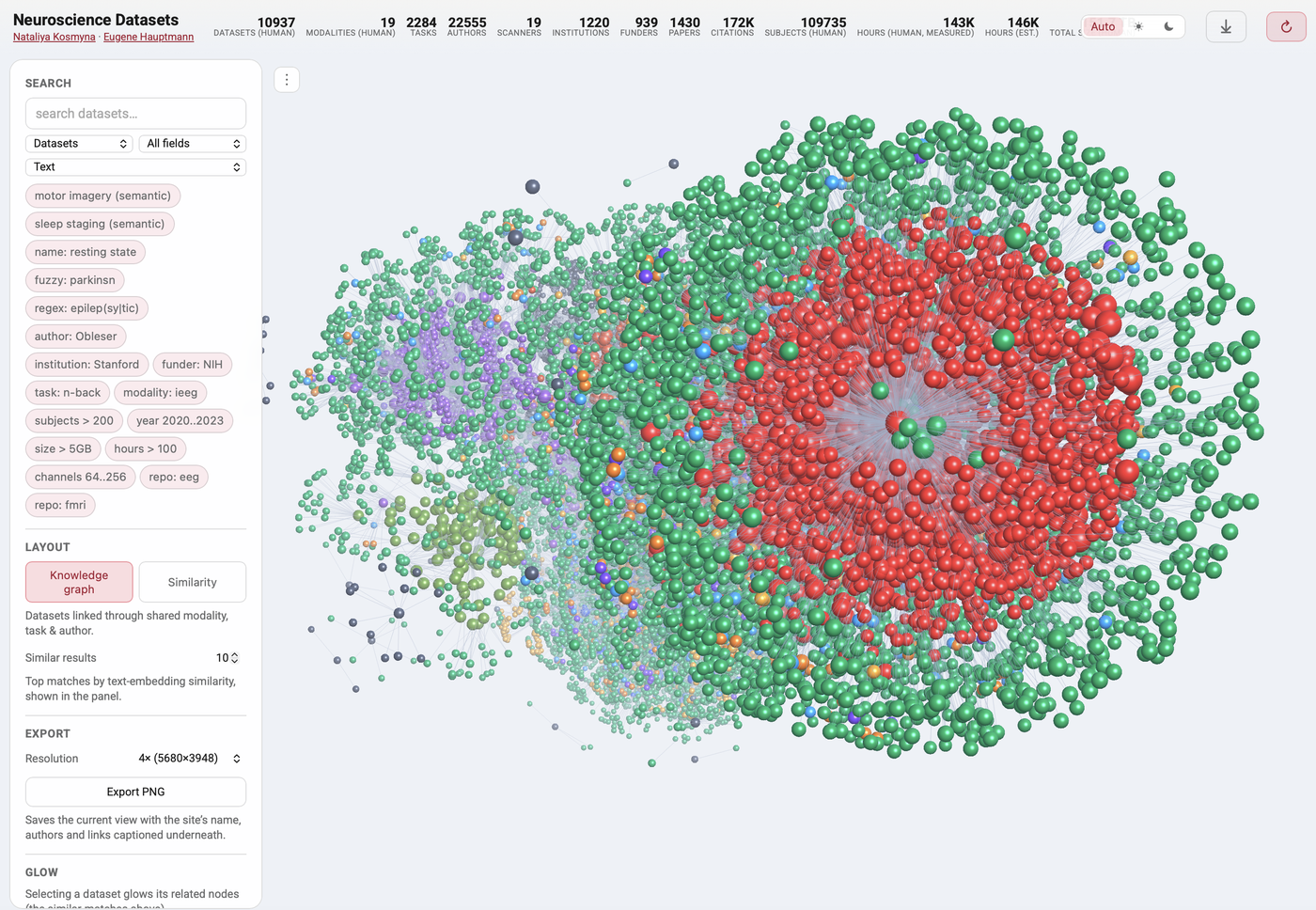
Project Overview ‹ NeuroDatasets Tool – MIT Media Lab
NeuroDatasets is tool, where one can browse and find all available neuroscience datasets for all major modalities: EEG, MRI, MEG, NIRS, PET and more. &nb…
Foundation Model Predicts Brain Responses to Visual and Auditory Stimuli | Elisa Cascardi posted on the topic | LinkedIn
Thrilled to share this work with the world! Today, we're releasing a foundation model that predicts how the human brain responds to almost any sight or sound -- and replace the need for human scans to significantly fast-track neuroscience and clinical research. 🧠 With this model, we can simulate brain responses to advance our understanding of the brain -- without the need for costly human brain scans 🌐 By using improved understanding of how efficient our brains perceive the world around us, we can guide the development of more advanced AI systems 👩⚕️ With computer-simulated experimentation, we can now speedup clinical research to diagnose neurological diseases and find treatments faster We've open sourced the model and code for researchers to use and build on, and an interactive demo for you to learn more -- see below! 📄 Paper: https://lnkd.in/e7cbunJp 💻 Code: https://lnkd.in/ebwBVuJp ▶️ Demo: https://lnkd.in/eEUVxP4S 🤗 Model: https://lnkd.in/e2T8nPJP So thrilled to be a part of this team with Stéphane d'Ascoli Jean-Rémi King Jérémy RAPIN Yohann Benchetrit Teon Brooks Katelyn Begany Joséphine Raugel Hubert Banville and for the great teamwork with Diego Marcos Dominic Giardini bringing this research to life! #neuroscience #AI #aiforscience #opensource #neuroAI
GitHub - AIM-KannLab/BrainIAC | Giovanni Giulietti
One of the biggest hurdles in neuroimaging AI has always been the scarcity of labeled data, especially for rare conditions. But a recent study published in Nature Neuroscience introduces a potential solution: BrainIAC (Brain Imaging Adaptive Core). Unlike traditional models that are trained for one specific task, BrainIAC is a "foundation model", a large-scale AI model trained on vast amounts of data that can perform many different tasks and be adapted to specific applications. It was pretrained on a massive dataset of 48965 brain structural MRI sequences (T1w, T2w, FLAIR, T1CE) using self-supervised learning, allowing it to understand the "big picture" of brain anatomy across different ages and conditions. It has been tested across seven diverse and clinically meaningful applications: - brain age prediction - IDH mutation classification - Mild Cognitive Impairment (MCI) classification - diffuse glioma overall survival prediction - MR sequence classification - time-to-stroke prediction - tumor segmentation BrainIAC consistently outperformed traditional supervised learning approaches and other medical-specific models. The real "magic" happens in low-data scenarios. While traditional AI usually needs thousands of examples, BrainIAC can adapt to new tasks using only a few samples. BrainIAC can be used for structural brain MRI analysis through two main methods: - Web Usage (BrainIAC platform): the easiest way to use BrainIAC, providing a user-friendly interface to upload structural brain MRI data and run inference. - Local usage (GitHub repository): for more advanced and customized analysis. It allows complete control over the data preprocessing, model training, and inference pipelines. It requires Python 3.9+ and NVIDIA GPU with CUDA 11.0+. 🔗 BrainIAC paper: https://lnkd.in/dq6Gprgt 🔗 BrainIAC web platform https://lnkd.in/dpreadMp 🔗 BrainIAC GitHub repo: https://lnkd.in/duwSEg4V #MedicalAI #Neuroscience #HealthTech #BrainIAC #Radiology #Innovation #DeepLearning #PrecisionMedicine

BetterBench: Assessing AI Benchmarks, Uncovering Issues, and Establishing Best Practices
AI models are increasingly prevalent in high-stakes environments, necessitating thorough assessment of their capabilities and risks. Benchmarks are popular for measuring these attributes and for comparing model performance, tracking progress, and identifying weaknesses in foundation and non-foundation models. They can inform model selection for downstream tasks and influence policy initiatives. However, not all benchmarks are the same: their quality depends on their design and usability. In this paper, we develop an assessment framework considering 46 best practices across an AI benchmark's lifecycle and evaluate 24 AI benchmarks against it. We find that there exist large quality differences and that commonly used benchmarks suffer from significant issues. We further find that most benchmarks do not report statistical significance of their results nor allow for their results to be easily replicated. To support benchmark developers in aligning with best practices, we provide a checklist for minimum quality assurance based on our assessment. We also develop a living repository of benchmark assessments to support benchmark comparability, accessible at betterbench.stanford.edu.

🚨 We're very happy to introduce TRIBE v2: a foundation model of the human brain's responses to sight, sound, and language. Leveraging 1,000+ hours of fMRI across 720 subjects, it generalizes… | Stéphane d'Ascoli | 16 comments
🚨 We're very happy to introduce TRIBE v2: a foundation model of the human brain's responses to sight, sound, and language. Leveraging 1,000+ hours of fMRI across 720 subjects, it generalizes zero-shot to new stimuli, tasks and people, finetunes efficiently, and enables in-silico experiments. ❓How does it work? Stemming from our v1, which won the Algonauts 2025 challenge, TRIBE v2 combines video, audio, and language embeddings to predict brain activity for any brain, then adapts to each individual. Key results: 📊 High-quality predictions — TRIBE v2 predicts brain activity across cortical and subcortical regions, significantly better than standard linear models, with a log-linear scaling law and no plateau in sight. 🎯 Zero-shot generalization — Without retraining, the predictions of TRIBE v2 are more correlated with group-averaged brain responses than almost any individual fMRI scan! A short finetuning step vastly improves over linear models trained, from scratch, on each individual. 🧪 In-silico experiments — Can we do useful experiments with TRIBE v2? Yes: classic vision and language paradigms replicate in-silico. It zero-shot recovers the FFA, PPA, EBA, VWFA, Broca's lateralization, and syntactic responses in STG — all without training on these artificial tasks. 🔍 Interpretability & multimodality — ICA on the weights rediscovers known functional networks (auditory, language, motion, default mode, visual) from naturalistic data alone. Ablating modalities further maps how vision, audition, and language integrate, with the largest gains at the temporo-parietal-occipital junction. 🧠 This effort is a step toward a foundation model of the human brain. Much remains to be understood, but we hope this opens a path for neuroscience, AI, and medical research alike. All code, weights, and a live demo are open — find it useful or mistaken in some conditions? Let us know, new test cases can only help improving this effort. 📄 Paper: https://lnkd.in/e7cbunJp 💻 Code: https://lnkd.in/ebwBVuJp ▶️ Demo: https://lnkd.in/eEUVxP4S 🤗 Model: https://lnkd.in/e2T8nPJP Joint work with Jérémy RAPIN, Yohann Benchetrit, Teon Brooks, Katie Begany, Joséphine Raugel, Hubert Banville and Jean-Rémi King. 🙏 Special thanks to Elisa Cascardi, Diego Marcos, Dominic Giardini, AI at Meta, and the open-source and neuroscience communities (in particular Lune Bellec and Bertrand Thirion for the amazing Courtois NeuroMod and IBC datasets) | 16 comments on LinkedIn
brainlife
The platform allows to analyze Magnetic Resonance Imaging (MRI), electroencephalography (EEG) and magnetoencephalography (MEG) data. Data can either be uploaded from local computers or imported from public archives such as OpenNeuro.org. Over 400+ data processing Apps are available on brainlife.io to build custom data workflows. Thousands of jobs can be submitted using shared clusters or on users' compute resource. Users can perform group-level statistical analysis or apply machine learning methods using Jupyter notebooks. A single record containing the entire data workflow (from raw data to published figures) can be published addressed by with a unique digital object identifier (DOI).