


For someone who’s never been a huge fan of numbers, the topic of measurement has kept me surprisingly busy lately and – to my bigger surprise – interested. My work (my passion) is to support business and organizational transformation, through social and digital initiatives that mobilize internal or
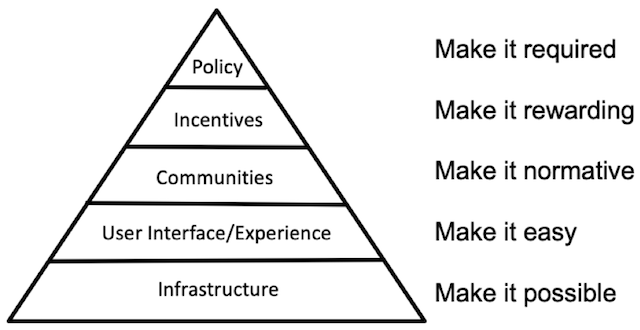
Why A Values Fit Matters More Than A Culture Fit | TechCrunch
Almost every company today screens potential hires for cultural fit. But what constitutes a company’s culture and how can you tell if a particular person fits into this particular mold?

Links on Status and Culture - January 2024
Read to the end for a longer essay critiquing Ted Gioia's idea of Macro vs. Micro cultures that explains why we get confused about niches and countercultures Personal News I’m spending 2024 writing a new book — a cultural history of the first 25 years of the 21st century.


Our Overfitted Century
Cultural stagnation is because we're stuck in-distribution

Metrics for Building, Scaling, and Funding Social Movements
Investing in movements or networks for social change is a strategy that some funders are using. But, how do you measure the results? Marino Morino, who wrote “Leap of Reason: Managing to Outcomes in an Era of Scarcity” pointed me to this recent report, “Transactions, Transformations, Translations: Metrics That Matter for Building, Scaling and Funding Social Movements” by Manual Paster, Jennifer Ito, and Rachel Rosner with the USC Program for Environmental and Regional Equity and funded by the Ford Foundation. The report addresses metrics for success for investing in broad field social movements or networked approaches to social change. The report is written for funders and those on the ground doing the work in the context of networks, although it doesn’t go deep into practice. The report captures a conundrum in measuring social change movements or networked approaches. Outcomes for “wicked problems” can be easily counted – policies passed, housing the homeless, educating children. But there are less tangible results such as “we changed the frame” or “we shifted members’ consciousness” which for grassroots organizers on the ground view as the vibrancy of the network . The report lays out some new metrics for movement building – that are paths to the more easily counted tangible results and where the unit of analysis is the movement or network, not an organization. As the report points out, movement organizers are grappling with big questions. It is less about how to raise funds for their organizations (although that’s important) but focused on the big picture: What is the long-term change that we want to see? What is needed to achieve it? What roles do different organizations play? The report identifies metrics to measure progress around this these questions – it asks and answers – “What exactly are the right metrics for today?

Differences Between Tight and Loose Cultures: A 33-Nation Study
The differences across cultures in the enforcement of conformity may reflect their specific histories. , With data from 33 nations, we illustrate the differences between cultures that are tight (have many strong norms and a low tolerance of deviant behavior) versus loose (have weak social norms and a high tolerance of deviant behavior). Tightness-looseness is part of a complex, loosely integrated multilevel system that comprises distal ecological and historical threats (e.g., high population density, resource scarcity, a history of territorial conflict, and disease and environmental threats), broad versus narrow socialization in societal institutions (e.g., autocracy, media regulations), the strength of everyday recurring situations, and micro-level psychological affordances (e.g., prevention self-guides, high regulatory strength, need for structure). This research advances knowledge that can foster cross-cultural understanding in a world of increasing global interdependence and has implications for modeling cultural change.
Redefining Culture Fit
Moving beyond superficial 'culture fit' towards shared values for building truly inclusive and effective teams.

How to Create a Great Team Culture (and Why It Matters): Build safety, share vulnerability, establish purpose.: Queue: Vol 17, No 1
As leader of the team, you have significant influence over your team's culture. You can institute policies and procedures that help make your team happy and productive, monitor team successes, and continually improve the team. Another important part of ...

Culture Change and Conflict at Twitter (Published 2021)
Two years ago, the company brought in a blunt executive to make things move faster and to promote diversity. Then the problems began.

Does modernisation erase cultural difference – or amplify it? | Psyche Ideas
We understandably fear the flattening effect of modernity. But global data from China to Peru tells a hopeful story

The Silent Majorities: six groups across society whose views point to systemic change
Expressing our shared concerns can drive public confidence in systems change.
A Practice in Emergence: Creating Resist’s New Theory of Change, Strategic Priorities, and Culture…
By Jax Gil

Systemic Change
The Paper Pilot's digital garden of thoughts on philosophy, politics, and sociology. Reading time: ~9 minute read | Published: Nov 14, 2026 | Updated: Nov 14, 2026

Social Change Networks: Keep Telling the Evolving Story - Interaction Institute for Social Change
Social change networks are complex, compared with other human organizational forms; they are not so easily controlled, directed or predicted. And that is as it should be, especially when dealing with real life diversity and uncertainty. This can cause some anxiety on the part of those who would like to be able to better control... Read More
Cultural Homogenization

Links about how our societal structures are contributing to the homogenization of culture.

Temperature Zero for Culture: Why Everything Is Starting to Look the Same