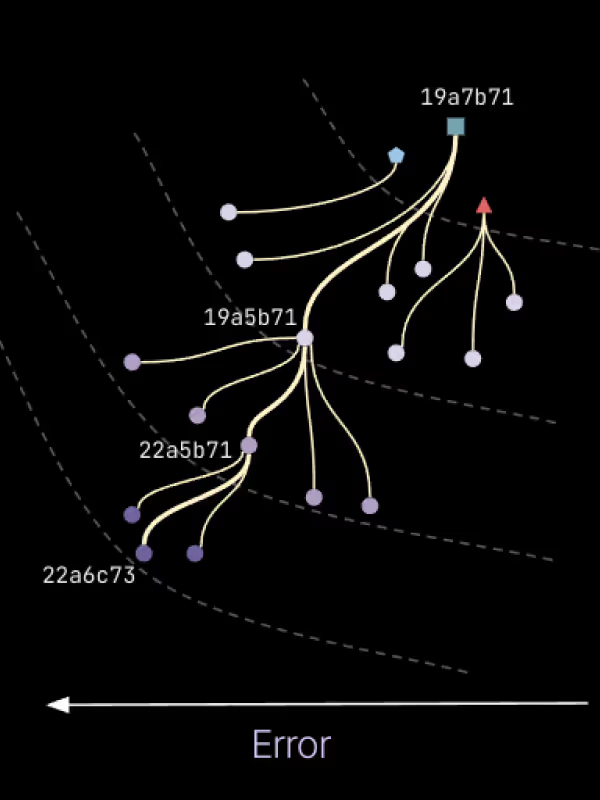
Today, we report advances in automated neural network architecture design and customization. We developed algorithms for the synthesis of tailored architectures (STAR), based on evolutionary algorithms applied to a numerical representation for model architectures derived from a new design theory. STAR automates the process of architecture discovery and optimization, turning it into an end-to-end process. With these methods, we have been able to tailor architectures to custom tasks, metrics, and hardware. We used STAR to synthesize hundreds of different designs that outperform strong Transformer and hybrid architectures in quality, with smaller caches and number of parameters.
AI Chip Architectures
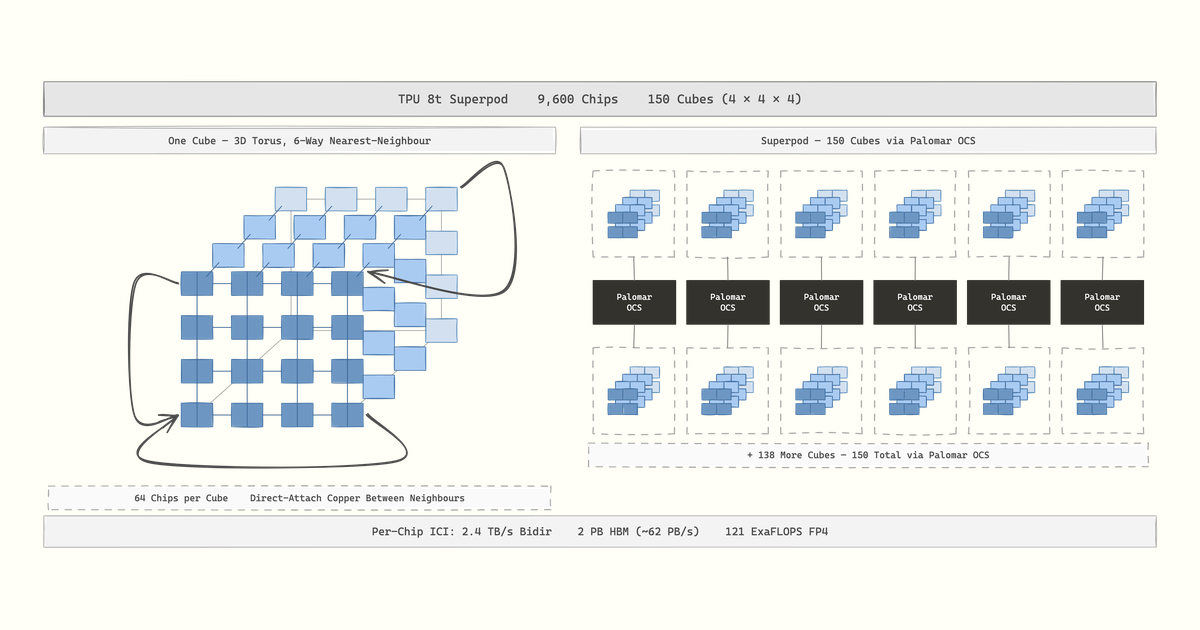
A look at AI Chip Architectures. NVIDIA, AMD, TPUs, Trainium, Groq, Cerebras.
Liquid AI — Device-native foundation models.
Liquid AI is an efficiency-first foundation model company. We build highly capable, compute-optimized models that bring intelligence to any device and medium of choice.

An Interpretable Automated Mechanism Design Framework with Large Language Models
Mechanism design has long been a cornerstone of economic theory, with traditional approaches relying on mathematical derivations. Recently, automated approaches, including differentiable economics with neural networks, have emerged for designing payments and allocations. While both analytical and automated methods have advanced the field, they each face significant weaknesses: mathematical derivations are not automated and often struggle to scale to complex problems, while automated and especially neural-network-based approaches suffer from limited interpretability. To address these challenges, we introduce a novel framework that reformulates mechanism design as a code generation task. Using large language models (LLMs), we generate heuristic mechanisms described in code and evolve them to optimize over some evaluation metrics while ensuring key design criteria (e.g., strategy-proofness) through a problem-specific fixing process. This fixing process ensures any mechanism violating the design criteria is adjusted to satisfy them, albeit with some trade-offs in performance metrics. These trade-offs are factored in during the LLM-based evolution process. The code generation capabilities of LLMs enable the discovery of novel and interpretable solutions, bridging the symbolic logic of mechanism design and the generative power of modern AI. Through rigorous experimentation, we demonstrate that LLM-generated mechanisms achieve competitive performance while offering greater interpretability compared to previous approaches. Notably, our framework can rediscover existing manually designed mechanisms and provide insights into neural-network based solutions through Programming-by-Example. These results highlight the potential of LLMs to not only automate but also enhance the transparency and scalability of mechanism design, ensuring safe deployment of the mechanisms in society.

Meet Foundry: An AI Startup that Builds, Evaluates, and Improves AI Agents

Introducing LFM2: The Fastest On-Device Foundation Models on the Market | Liquid AI
Today, we release LFM2, a new class of Liquid Foundation Models (LFMs) that sets a new standard in quality, speed, and memory efficiency for on-device deployment. Built on a hybrid architecture, LFM2 delivers 200% faster decode and prefill performance than Qwen3 and Gemma 3 on CPU. It also significantly outperforms models in each size class on instruction-following and function calling—the core capabilities that make LLMs reliable for building AI agents.

Evolving Design Language in the AI Era: From Good to Great
Explore how the AI era reshapes design language, emphasizing objective critique over subjective opinions for successful outcomes.

Liquid AI Launches LEAP and Liquid Apollo: The Easiest Way to Build with On-Device AI | Liquid AI
Today marks a pivotal milestone in the evolution of edge AI. Liquid AI is thrilled to announce LEAP v0, our first developer-ready platform for on-device AI deployment—and Liquid Apollo, a lightweight iOS-native application built to showcase and stress-test small foundation models directly on your phone.

The Universal Execution Layer for AI
Optimize any AI model on any engine, across all hardware. Dria’s topology-aware compiler and peer-to-peer runtime merge CPUs, GPUs, NPUs & chiplets into one fabric—maximising utilisation, cutting inference cost and ending vendor lock-in.

The Growth OS Map: Building Defensible Loops in the AI Era
The 8 loops and the 5-layer architecture needed to replace fragile funnels with a resilient GTM engine.
The Coming AI Cataclysm | Compact
In the decade since the neural architecture version of Google Translate and the invention of transformer architecture for neural networks, we have experienced the most rapid technological breakthroughs since at least World War II, and possibly ever.
Feature-Driven Architecture: Designing Scalable Applications
Introduction In the first article of this series, we discussed Atomic Design as a method...

The Phoenix Architecture
Generative AI coding demands what we've always known: modularity, clear boundaries, disposable components. Principles that scaled human teams are now table stakes. Here, we make the implicit explicit
Neural Computer: A New Machine Form Is Emerging
A research essay on Neural Computer: how it differs from agents, world models, and conventional computers; what runtime and CNC would mean; what current prototypes already show; and how software and hardware might change.
Everything is ugly, so go build something that isn't — Raiza Martin, Huxe (ex NotebookLM)
LukeW | The Evolution of AI Products
At this point, the use of artificial intelligence and machine learning models in software has a long history. But the past three years really accelerated the ev...
Optimizely - AI to create and optimize digital experiences
Everything marketing and digital teams need to create content fast, test and personalize, and prove business impact.