


Complete Solutions for a Campaign Management System and for Digital or Online Voting
How Media – Namely News, Ads and Social Posts – Can Shape an Election
How Media – Namely News, Ads and Social Posts – Can Shape an Election

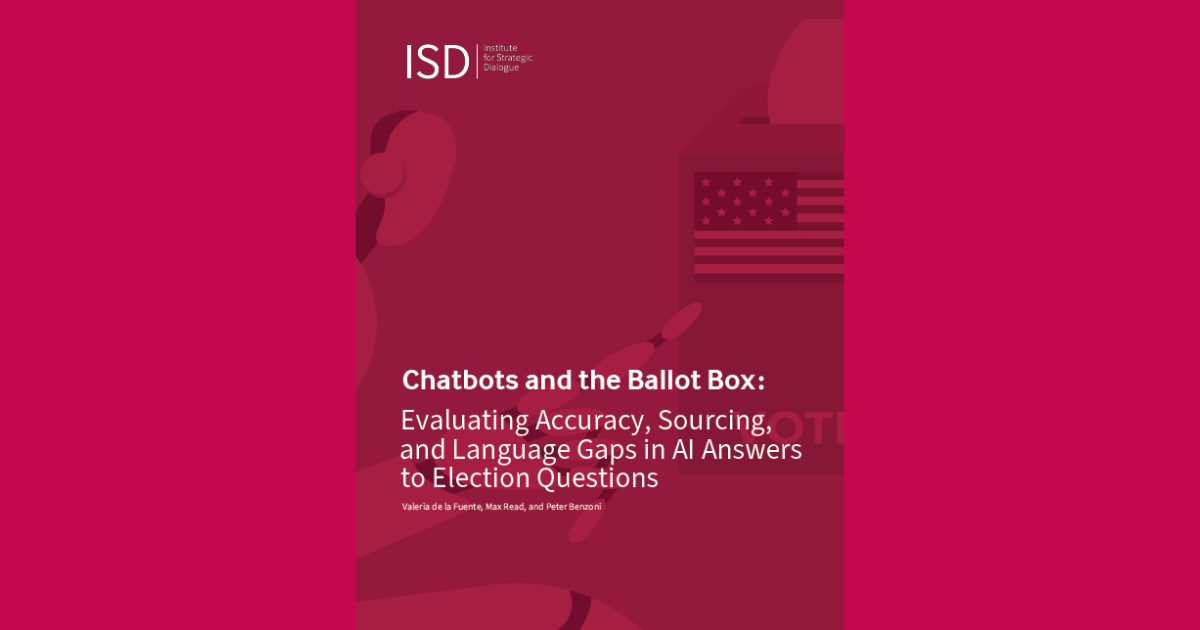
Chatbots and the Ballot Box: Evaluating Accuracy, Sourcing, and Language Gaps in AI Answers to Election Questions - Institute for Strategic Dialogue
ISD assesses how reliably six leading AI models provide accurate, complete information on US election procedures and voter access.
Home - Action Network
Powering you to inspire action Mobilize communities, raise money, and engage supporters with tools built for teams just like yours. Get Started Powerful, flexible tools to engage your community when it matters most. POWERING CHANGE After three months of using Action Network the DNC shattered all sorts of fundraising records. Tools built by and for...

Ways to Vote | Elections BC
There are many ways to vote in B.C. You can vote in advance, by mail or in person on General Voting Day anywhere in the province.
Why Online Democracies Fail - Eclectic Corvine Muses
A compendium to my upcoming proposal for community infrastructure within the AT Protocol
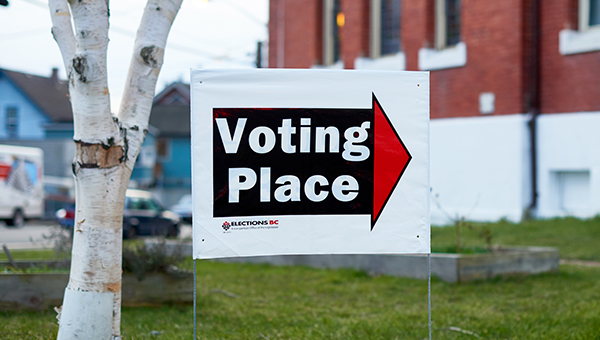
Voting place map and hours | Where to vote | City of Vancouver
Find which voting places are close to your home, work, or where you're running errands.

Simulating Aggregate Electoral Opinion Trajectories with LLM Personas and Media Exposure
LLM-based election simulation has largely been evaluated against a single final outcome, in many cases neglecting how much it can recover the trajectory shaped by media exposure and shifting candidate support. We propose evaluating election simulations in terms of trajectory fidelity: whether persona-conditioned LLM agents can update their beliefs in response to media to reproduce the temporal movement of public opinion, both in aggregate and across demographic subgroups. We design a framework in which each LLM agent carries its belief across time and updates it as new campaign information arrives. We further investigate how performance can vary across simulation design choices such as media exposure model, election context, and survey questionnaire. In a study on the 2026 Seoul mayoral and local elections, we validate simulated trajectories against weekly public-opinion polls and find that simulations that carry prior beliefs across time—rather than simulating each poll date independently—substantially improves alignment with observed polling movement, while the way media exposure is personalized leaves aggregate movement largely intact but reshapes subgroup-level dynamics. We propose a framework for validating simulated opinion trajectories against real-world traces, and discuss the simulation design choices that can influence the performance.
Voting only gets you so far
Read to the end for a really good storefront

Election Defense Scenarios - Freedom Trainers
Election Defense Scenarios is a field guide for protecting democracy. This resource walks readers through eighteen detailed scenarios — from voter roll purges and redistricting attacks to armed intimidation at polling places and post-election certification battles — giving organizers, poll workers, community leaders, and everyday citizens the knowledge they need before a crisis hits. Each […]

Give Lively - A Free Fundraising Platform For Nonprofits
We built and support a powerful and practical fundraising platform that is free for nonprofits and intuitively easy to use for donors. Sign up today for Fundraising Pages, Text-to-Donate, Peer-to-Peer, Event Ticketing, and more!

Priorities | celeste4sos.com
The right to vote, better representation and election integrity.

make a poll ! collect anonymous votes. post automatically to bluesky. no login needed for voters. poll.brookie.blog
This paper claims to provide evidence offline networks matter more than online for voting preferences, but winds up mistaking noise for signal and seems to forget that some folks online are quite influential. academic.oup.com/pnasnexus/article/4/10/pgaf30…

Physical partisan proximity outweighs online ties in predicting US voting outcomes
academic.oup.com

