


Make important decisions together without endless meetings. Loomio keeps discussion, voting, outcomes, and the reasoning behind them in one clear place.
Lody Is Now Open Source: A Shared Workspace for Teams and Coding Agents
Lody helps teams understand the context behind software decisions. We are moving Lody toward local-first, with the goal of making that context durable, portable, and ultimately controlled by the team

(PDF) Algorithmically Mediating Communication to Enhance Collective Decision-Making in Online Social Networks
PDF | Many collective decision-making contexts involve communication among group members. Sometimes this communication helps the collective reach an... | Find, read and cite all the research you need on ResearchGate

Design principles for long-lived circular organization: An Ostromian perspective
Circular organizational templates such as holacracy and sociocracy have gained popularity. In such organizations, all members have rights to participate in decision-making. Which factors enable such organizations to sustain their circular form? We investigate 18 highly diverse circular organizations to answer this question. Our findings show that Elinor Ostrom’s design principles for avoiding the tragedy of the commons may also explain circular organizations’ longevity. With regard to their relevance, we sort these principles into three groups: indispensable, queasy, and quite unproblematic principles. Our main theoretical contribution is to show that circular organizations can be understood as commons, and thus to make research on the governance of commons fruitful for the design of circular organizations. We show that implementing circular forms has to mind especially the queasy design principles of monitoring, graduated sanctions, conflict resolution mechanisms, and balancing individual contributions and rewards.
DIMACS :: Details
« IBM/DIMACS/DATA-INSPIRE Workshop on Bridging Game Theory and Machine Learning for Multi-party Decision Making
Role differentiation as ignition of a collective information...
Informational active matter shows how measurement-informed decisions produce collective order, so far in systems that reach consensus. We design collective information engines structured by...

Digital Democracy in Decentralised Autonomous Organisations
Decentralised autonomous organisations (DAOs) are institutional technologies that enable democratic governance innovation. They inherit key democratic principles such as procedural transparency and immutable records from being based on blockchain technology. This paper conducts a systematic literature review to examine governance mechanisms and challenges of digital democracy in DAOs. While issues like power concentration and coordination failures exist in current implementations, we argue that the concept of DAOs offers new opportunities for transparent governance and participatory decision-making. As testbeds for governance experiments, we find that DAOs have the potential to reshape democratic processes and foster innovative governance models in the digital era. Calling for interdisciplinary collaboration, further research is needed around Sybil-resistant voting mechanisms, ideological path dependencies and deliberation mechanisms.

Agora Citizen Network
Agora helps people overcome disagreement and find consensus, for more democratic and efficient decision-making.
Agora Citizen Network
Agora helps people overcome disagreement and find consensus, for more democratic and efficient decision-making.
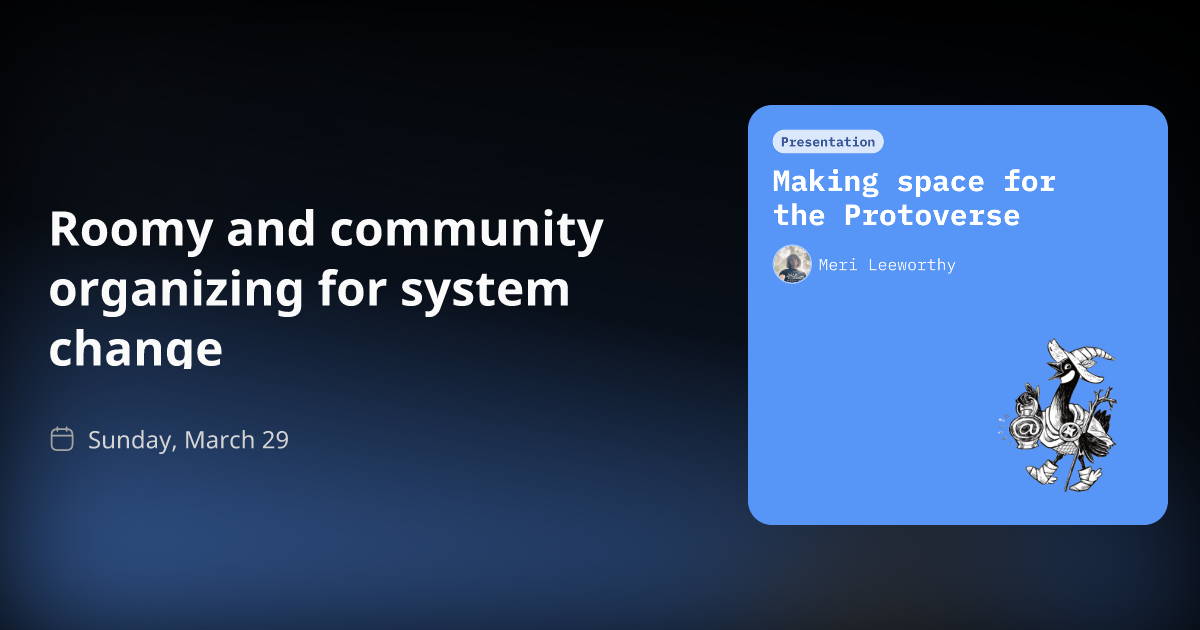
Roomy and community organizing for system change
Roomy is a group messaging app that gives online communities tools for autonomous collaboration — designable spaces not just for chat, but for cultivating a web of shared understanding together. We show how cheap, user-controlled, interoperable data on ATProto can enable online communities to channel impassioned mobilizing into sustained organizing in the shadow of Big Tech's empire.
AI and the knowledge commons
Outcomes Graph: A protocol for applied science coordination - DeepScience Ventures
In this article, we explain how our Outcomes Graph works, including how the functions of scientific knowledge shape the features we've developed and how we're using it to harness the collective intelligence of venture scientists.

WAO - The Workers' Algorithm Observatory
The WAO researches and audits work algorithms to empower workers. Companies increasingly rely on opaque, black-box algorithms to determine pay, scheduling, and access to work, while the data needed to understand and challenge these systems remains out of reach for workers and organizers. To address this gap, the WAO develops technology-enabled research tools, data infrastructure, and academic–organizer partnerships that support existing labor and worker organizations. By building meaningful relationships with worker organizers, crowdsourcing data, conducting transparent and policy-relevant research, and thinking deeply about the data workers need both now and in the next 5-20 years, the WAO aims to increase worker power, inform policymaking, and improve conditions for workers today and in the future.
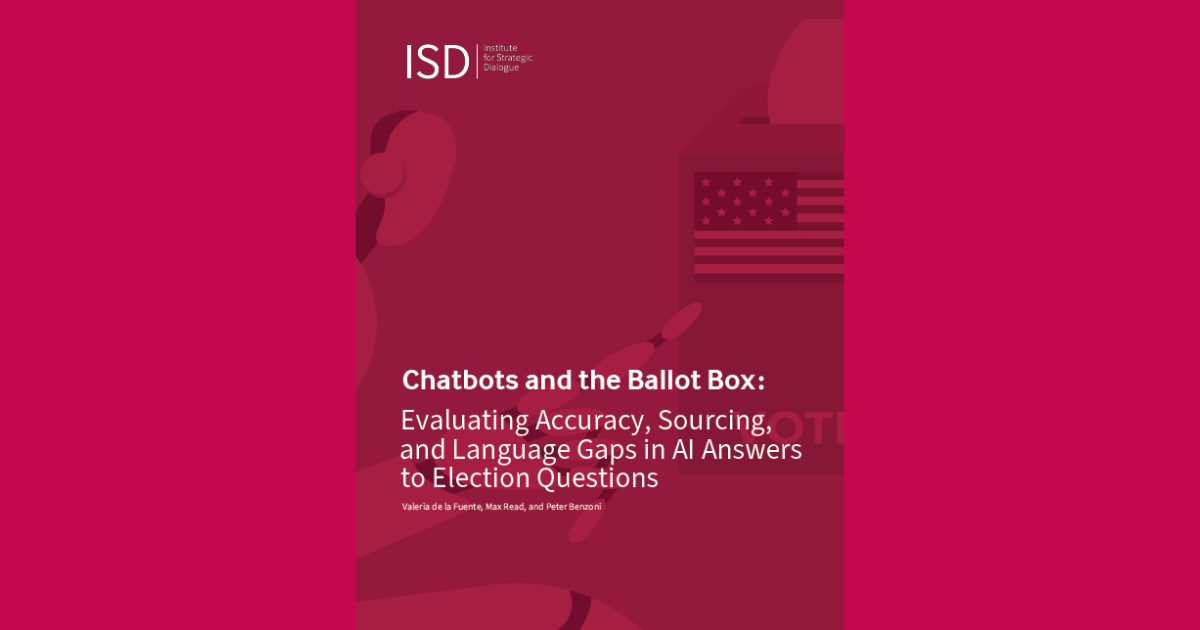
Chatbots and the Ballot Box: Evaluating Accuracy, Sourcing, and Language Gaps in AI Answers to Election Questions - Institute for Strategic Dialogue
ISD assesses how reliably six leading AI models provide accurate, complete information on US election procedures and voter access.
'Generative CI' through Collective Response Systems
How can many people (who may disagree) come together to answer a question or make a decision? "Collective response systems" are a type of generative collective intelligence (CI) facilitation...
It is a shame that "democratization" in software has come to mean broader access to products instead of participation in democratic processes — there is talk of LLMs democratizing software production, but I have yet to see social, collective and democratic processes govern the design of software.
