

Why custom models will become your only real moat
AI Cybersecurity After Mythos: The Jagged Frontier
Why the moat is the system, not the model

Business Model Pattern List |
Discover powerful business model patterns by iconic firms and learn how you can leverage them for new insights for your own business model innovation initiatives.
App creator pledges against enshittification
While researching business models that could work on atproto there are some obvious ones that won’t work on a technical/architectural level. Like you can’t really monetize the data in the PDS because it’s all completely open (as long as there’s no permissioned data, but probably not even after that). That in itself already takes away a lot of room/incentive for enshittification (which is great), since when you do users can create or move to another app. But still, I kept encountering models/ta...
Good Taste the Only Real Moat Left
AI makes competent output cheap. That makes taste more valuable, but also more incomplete. The real edge comes from pairing judgment with context, stakes, and the willingness to build.

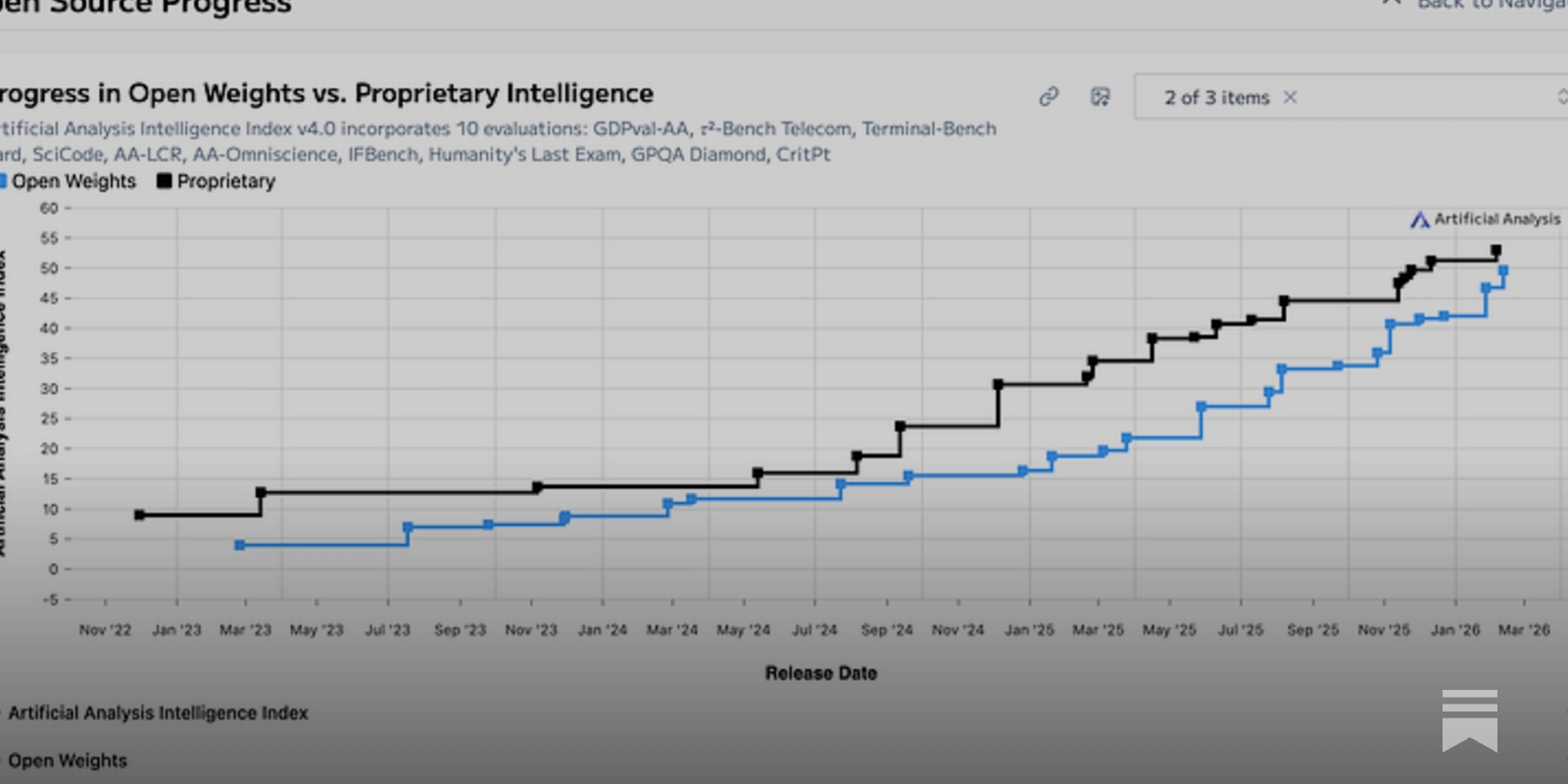
Open models in perpetual catch-up
The open-closed gap, distillation, innovation timescales, how open models win, specialized models, what’s missing, etc.
Business Model Innovation - an overview | ScienceDirect Topics
The Moat or the Commons — Warman Notes
American capital financed AI on the assumption it would be the next great monopoly. Open-weight models are commoditizing the capability that monopoly was supposed to protect. The collision between the two now defines the direction of the U.S. AI industry — and the country.
Moats & Drawbridges - augment
In a world obsessed with moats, the open social web drops drawbridges
Introducing Model Council
Today we are launching Model Council, a multi-model research feature that brings several models together for one answer.

On the Opportunities and Risks of Foundation Models
AI is undergoing a paradigm shift with the rise of models (e.g., BERT, DALL-E, GPT-3) that are trained on broad data at scale and are adaptable to a wide range of downstream tasks. We call these models foundation models to underscore their critically central yet incomplete character. This report provides a thorough account of the opportunities and risks of foundation models, ranging from their capabilities (e.g., language, vision, robotics, reasoning, human interaction) and technical principles(e.g., model architectures, training procedures, data, systems, security, evaluation, theory) to their applications (e.g., law, healthcare, education) and societal impact (e.g., inequity, misuse, economic and environmental impact, legal and ethical considerations). Though foundation models are based on standard deep learning and transfer learning, their scale results in new emergent capabilities,and their effectiveness across so many tasks incentivizes homogenization. Homogenization provides powerful leverage but demands caution, as the defects of the foundation model are inherited by all the adapted models downstream. Despite the impending widespread deployment of foundation models, we currently lack a clear understanding of how they work, when they fail, and what they are even capable of due to their emergent properties. To tackle these questions, we believe much of the critical research on foundation models will require deep interdisciplinary collaboration commensurate with their fundamentally sociotechnical nature.

Generative AI and the Digital Commons — The Collective Intelligence Project
The aim of this paper is to build models of governance for generative foundation models that enable broadly shared benefit. Our initial hypothesis is that data is a high-value lever of governance. Many of these models are trained on publicly available data and use public infrastructure, but 1) may d

Promoting User Data Autonomy During the Dissolution of a Monopolistic Firm
The deployment of AI in consumer products is currently focused on the use of so-called foundation models, large neural networks pre-trained on massive corpora of digital records. This emphasis on scaling up datasets and pre-training computation raises the risk of further consolidating the industry, and enabling monopolistic (or oligopolistic) behavior. Judges and regulators seeking to improve market competition may employ various remedies. This paper explores dissolution -- the breaking up of a monopolistic entity into smaller firms -- as one such remedy, focusing in particular on the technical challenges and opportunities involved in the breaking up of large models and datasets. We show how the framework of Conscious Data Contribution can enable user autonomy during under dissolution. Through a simulation study, we explore how fine-tuning and the phenomenon of "catastrophic forgetting" could actually prove beneficial as a type of machine unlearning that allows users to specify which data they want used for what purposes.
Maybe the real moats are the drawbridges we'll build along the way? In my latest augment piece, I re-think "moats" for the open social web by seeing what @standard.site, @blackskyweb.xyz's Acorn, and bridges like @ap.brid.gy + @wafrn.net have done for the ecosystem.

Moats & Drawbridges
www.augment.inkI’m not sure aptroto and funding quite mix Traditional apps have easy moats (data/users), atproto apps don’t have moat unless it’s via features Vc funding pushes us towards are current world (few huge players that have “won”) A world where atproto has won is one of many small businesses

dietrich
🚨 the ecosystem is delicate #atmosphereconf there's a LOT of enthusiasm + talent, but: - no magical investor monies - grant options are THIN - many first time founders - many don't want investment - few other options - scary macro env it's a collective challenge we can just pay for things?


