


"An exceptional deep dive into the next frontier of AI.” —Aman Chadha, Google Build a Reasoning Model (From Scratch) is a practical guide to understanding how modern reasoning-oriented LLMs work by building their core methods step by step. The book tells a clear engineering story: start with a conventional pre-trained LLM, learn how text generation works, build reliable evaluation tools, improve reasoning through inference-time methods, then move into training-based approaches such as reinforcement learning and distillation. The progression is deliberate. Early chapters establish the baseline model and explain text generation, KV caching, and evaluation with math verifiers. The middle chapters show how reasoning can be improved without changing model weights, using chain-of-thought prompting, sampling, self-consistency, response scoring, and self-refinement. Later chapters move to changing the model itself through reinforcement learning with verifiable rewards, GRPO improvements, format rewards, and finally distillation from stronger reasoning models into smaller ones. The book is especially useful because it implements the core methods from scratch rather than treating them as black-box library calls. Readers see how self-consistency, self-refinement, Best-of-N, and training-based methods actually work, including their cost and latency trade-offs. It also discusses common failure modes, including cases where refinement can make answers worse. Difficult concepts such as softmax, temperature, and top-p sampling are clarified with code-linked explanations and diagrams, and visual workflows make pipelines and scoring methods easier to follow. Reading the book feels like following a guided technical build rather than a loose survey of AI topics. Each concept is introduced because the project now needs it. Diagrams, roadmaps, code listings, exercises, and repeated workflow summaries help readers stay oriented through advanced material. This structure reflects Sebastian Raschka’s professional strength: explaining complex machine learning topics by making every detail concrete and showing exactly where each section fits in the larger story. He does not treat mechanisms like evaluation, log-probabilities, KL regularization, or distillation as isolated abstractions; he connects them to the goal of making reasoning models understandable and implementable. Physically and organizationally, the book has eight chapters and seven substantial appendixes. That design keeps the main narrative focused while moving supporting material like references, exercise solutions, model source code, larger models, batching, evaluation alternatives, and chat interfaces into ordered appendixes. The result is a logically flowing book that remains hands-on, navigable, and technically deep without constantly interrupting the central build.
Eliciting Reasoning in Language Models with Cognitive Tools
The recent advent of reasoning models like OpenAI's o1 was met with excited speculation by the AI community about the mechanisms underlying these capabilities in closed models, followed by a rush of replication efforts, particularly from the open source community. These speculations were largely settled by the demonstration from DeepSeek-R1 that chains-of-thought and reinforcement learning (RL) can effectively replicate reasoning on top of base LLMs. However, it remains valuable to explore alternative methods for theoretically eliciting reasoning that could help elucidate the underlying mechanisms, as well as providing additional methods that may offer complementary benefits. Here, we build on the long-standing literature in cognitive psychology and cognitive architectures, which postulates that reasoning arises from the orchestrated, sequential execution of a set of modular, predetermined cognitive operations. Crucially, we implement this key idea within a modern agentic tool-calling framework. In particular, we endow an LLM with a small set of "cognitive tools" encapsulating specific reasoning operations, each executed by the LLM itself. Surprisingly, this simple strategy results in considerable gains in performance on standard mathematical reasoning benchmarks compared to base LLMs, for both closed and open-weight models. For instance, providing our "cognitive tools" to GPT-4.1 increases its pass@1 performance on AIME2024 from 32% to 53%, even surpassing the performance of o1-preview. In addition to its practical implications, this demonstration contributes to the debate regarding the role of post-training methods in eliciting reasoning in LLMs versus the role of inherent capabilities acquired during pre-training, and whether post-training merely uncovers these latent abilities.

Crafting a good (reasoning) model
A recent talk I gave on model training, reasoning, and the next frontier.

Training Agentic Reasoners — Will Brown, Prime Intellect
The Hitchhiker's Guide to Agentic AI: From Foundations to Systems
The Hitchhiker's Guide to Agentic AI is a comprehensive practitioner's reference for building autonomous AI systems. The book covers the full stack from first principles to production deployment, organized around a central thesis: building great agentic systems requires understanding every layer of the pipeline, not just one. The book opens with the LLM substrate -- transformer architecture, GPU systems, training and fine-tuning (SFT,LoRA, MoE), model compression, and inference optimization -- treated as essential foundations rather than the primary focus. It then develops the alignment and reasoning layer: reinforcement learning from human feedback (RLHF), PPO, DPO and its variants, GRPO, reward modeling, and RL for large reasoning models including chain-of-thought and test-time scaling. The second half is devoted to agentic AI proper. Topics include agentic training and trajectory-based RL, retrieval-augmented generation (RAG and Agentic RAG), memory systems (in-context, external, episodic, and semantic), agent harness design and context management, and a taxonomy of agent design patterns. Inter-agent coordination is covered in depth: the Model Context Protocol (MCP), agent skills and tool use, the Agent-to-Agent (A2A) communication protocol, and multi-agent architectures spanning centralized, decentralized, and hierarchical topologies. The book concludes with agent development frameworks, agentic UI design, evaluation methodology for agentic tasks, and production deployment. Each chapter pairs rigorous theoretical foundations with implementation guidance, code examples, and references to the primary literature.
Understanding Reasoning LLMs
Methods and Strategies for Building and Refining Reasoning Models
DeepRefine: Agent-Compiled Knowledge Refinement via Reinforcement Learning
Agent-compiled knowledge bases provide persistent external knowledge for large language model (LLM) agents in open-ended, knowledge-intensive downstream tasks. Yet their quality is systematically limited by \emph{incompleteness}, \emph{incorrectness}, and \emph{redundancy}, manifested as missing evidence or cross-document links, low-confidence or imprecise claims, and ambiguous or coreference resolution issues. Such defects compound under iterative use, degrading retrieval fidelity and downstream task performance. We present \textbf{DeepRefine}, a general LLM-based reasoning model for \emph{agent-compiled knowledge refinement} that improves the quality of any pre-constructed knowledge bases with user queries to make it more suitable for the downstream tasks. DeepRefine performs multi-turn interactions with the knowledge base and conducts abductive diagnosis over interaction history, localizes likely defects, and executes targeted refinement actions for incremental knowledge base updates. To optimize refinement policies of DeepRefine without gold references, we introduce a Gain-Beyond-Draft (GBD) reward and train the reasoning process end-to-end via reinforcement learning. Extensive experiments demonstrate consistent downstream gains over strong baselines.
OpenThoughts: Data Recipes for Reasoning Models — Ryan Marten, Bespoke Labs
Sebastian Raschka, PhD (@rasbt)
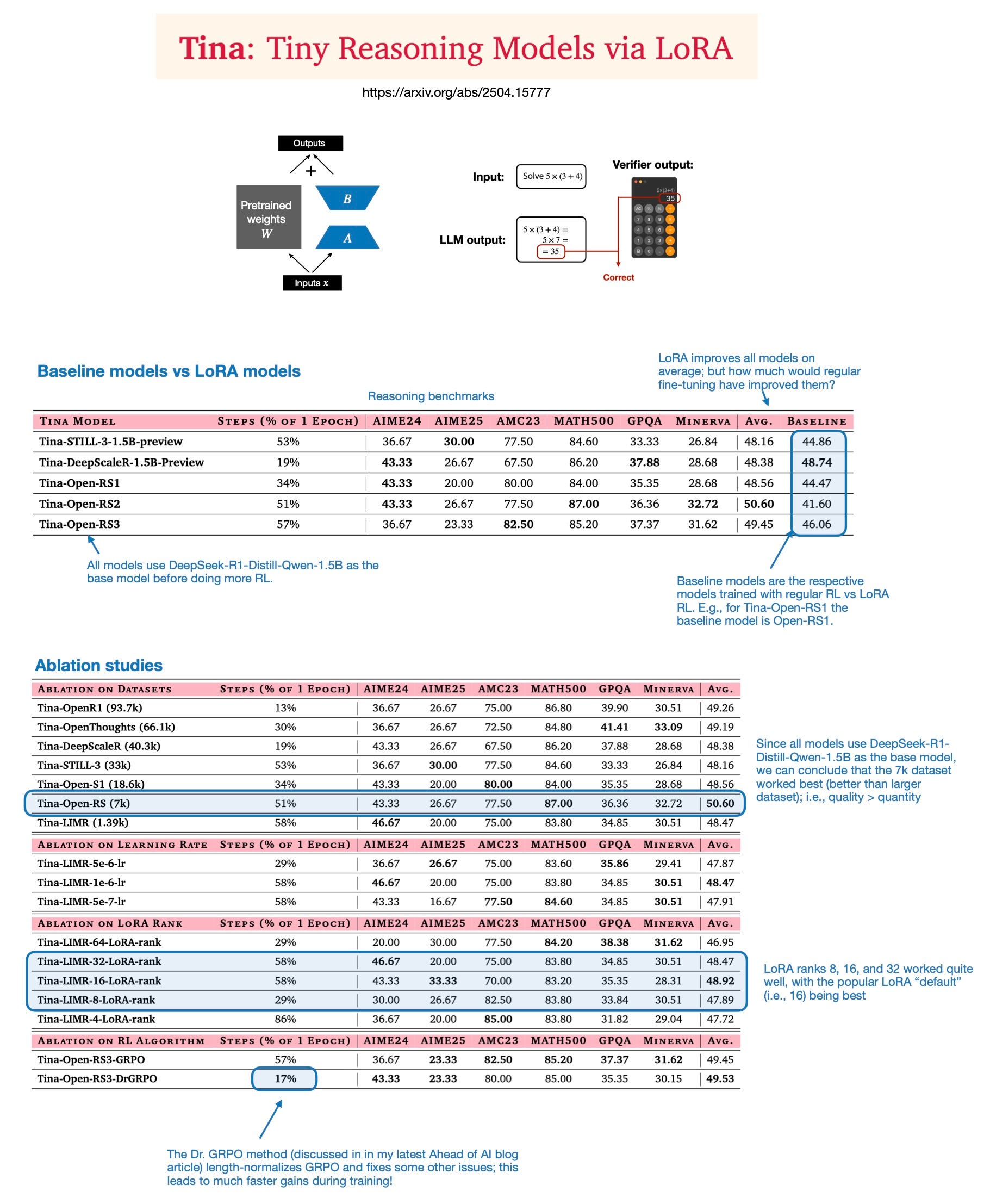
Is LoRA (Low Rank Adaptation) relevant in 2025 for reasoning models? I recently read "Tina: Tiny Reasoning Models via LoRA (https://arxiv.org/abs/2504.15777)", and it made me pause for a moment: when was the last time I heard someone excitedly talk/write about LoRA? LoRA was one of the most influential fine-tuning methods in the earlier LLM boom (as you may remember, I wrote about it a lot in recent years). The idea is simple but effective: avoid full model updates and instead inject a small number of trainable parameters for downstream tasks. This drastically reduces memory and compute costs. But in the age of ever-larger instruction-tuned models coupled with well-working distillation techniques (like popularized by DeepSeek-R1 etc), LoRA seemed to become more irrelevant recently. What about LoRA work for developing reasoning models? This paper tackles exactly that question. Instead of the usual supervised fine-tuning or instruction distillation pipeline, the authors use LoRA with reinforcement learning (RL) to improve reasoning capabilities. Specifically, they fine-tune a 1.5B base model using LoRA adapters while applying RL on reasoning benchmarks. Their baseline model is DeepSeek-R1-Distill-Qwen-1.5B, which is a model already fine-tuned for reasoning tasks. (I wish they started with the base Qwen-1.5B model; but this way, I guess they have more comparisons with other methods that further trained the DeepSeek-R1-Distill-Qwen-1.5B.) From there, the authors ran experiments across datasets, learning rates, LoRA ranks, and RL algorithms. Their best-performing model was trained on just 7k examples and cost just $9 to train. Even with hyperparameter sweeps and multiple ablations, the entire study cost just $526. So, how well does LoRA work? The top half of the results figure (highlighted in blue) compares models trained with LoRA-based RL versus standard RL (i.e., no LoRA). On every benchmark (AIME24, AIME25, AMC23, MATH500, GPAQ, Minerva), LoRA outperforms the regular RL baseline when applied to the same starting model. Insights from ablations 1) Surprisingly, the best-performing model came from the smallest dataset: just 7k examples from Open-RS. 2) The classic LoRA rank 16 emerged as the sweet spot, but ranks 8 and 32 also worked well. 3) It's nice that they included the recent Dr. GRPO (I recently discussed it in my latest Ahead of AI blog). It substantially reduces training time by length-normalizing rewards and addressing issues in GRPO Bottom line: Reasoning is certainly an interesting use case, and it's interesting (and a bit surprising) that LoRA does so well here. It might also be the first case where I've seen LoRA coupled with RL, which is another interesting aspect. LoRA certainly peaked in popularity 1-2 years ago, and more people now consider (more expensive) full-parameter updates (based on anecdotal perception); there's still a place for LoRA and LoRA-like methods. Let's not forget that one of the key advantages of LoRA is that it doesn't modify the underlying base model. This is key in applications where you either have lots of specialized use cases or lots of customers. For example, instead of storing 100 1B full-parameter tuned models, it would be much cheaper to store a 32B model with 100 sets of LoRA weights.
ReAct: Synergizing Reasoning and Acting in Language Models
While large language models (LLMs) have demonstrated impressive capabilities across tasks in language understanding and interactive decision making, their abilities for reasoning (e.g. chain-of-thought prompting) and acting (e.g. action plan generation) have primarily been studied as separate topics. In this paper, we explore the use of LLMs to generate both reasoning traces and task-specific actions in an interleaved manner, allowing for greater synergy between the two: reasoning traces help the model induce, track, and update action plans as well as handle exceptions, while actions allow it to interface with external sources, such as knowledge bases or environments, to gather additional information. We apply our approach, named ReAct, to a diverse set of language and decision making tasks and demonstrate its effectiveness over state-of-the-art baselines, as well as improved human interpretability and trustworthiness over methods without reasoning or acting components. Concretely, on question answering (HotpotQA) and fact verification (Fever), ReAct overcomes issues of hallucination and error propagation prevalent in chain-of-thought reasoning by interacting with a simple Wikipedia API, and generates human-like task-solving trajectories that are more interpretable than baselines without reasoning traces. On two interactive decision making benchmarks (ALFWorld and WebShop), ReAct outperforms imitation and reinforcement learning methods by an absolute success rate of 34% and 10% respectively, while being prompted with only one or two in-context examples. Project site with code: https://react-lm.github.io
Reasoning Models Generate Societies of Thought
Large language models have achieved remarkable capabilities across domains, yet mechanisms underlying sophisticated reasoning remain elusive. Recent reasoning models outperform comparable instruction-tuned models on complex cognitive tasks, attributed to extended computation through longer chains of thought. Here we show that enhanced reasoning emerges not from extended computation alone, but from simulating multi-agent-like interactions -- a society of thought -- which enables diversification and debate among internal cognitive perspectives characterized by distinct personality traits and domain expertise. Through quantitative analysis and mechanistic interpretability methods applied to reasoning traces, we find that reasoning models like DeepSeek-R1 and QwQ-32B exhibit much greater perspective diversity than instruction-tuned models, activating broader conflict between heterogeneous personality- and expertise-related features during reasoning. This multi-agent structure manifests in conversational behaviors, including question-answering, perspective shifts, and the reconciliation of conflicting views, and in socio-emotional roles that characterize sharp back-and-forth conversations, together accounting for the accuracy advantage in reasoning tasks. Controlled reinforcement learning experiments reveal that base models increase conversational behaviors when rewarded solely for reasoning accuracy, and fine-tuning models with conversational scaffolding accelerates reasoning improvement over base models. These findings indicate that the social organization of thought enables effective exploration of solution spaces. We suggest that reasoning models establish a computational parallel to collective intelligence in human groups, where diversity enables superior problem-solving when systematically structured, which suggests new opportunities for agent organization to harness the wisdom of crowds.
Reasoning Models Don't Always Say What They Think
Chain-of-thought (CoT) offers a potential boon for AI safety as it allows monitoring a model's CoT to try to understand its intentions and reasoning processes. However, the effectiveness of such monitoring hinges on CoTs faithfully representing models' actual reasoning processes. We evaluate CoT faithfulness of state-of-the-art reasoning models across 6 reasoning hints presented in the prompts and find: (1) for most settings and models tested, CoTs reveal their usage of hints in at least 1% of examples where they use the hint, but the reveal rate is often below 20%, (2) outcome-based reinforcement learning initially improves faithfulness but plateaus without saturating, and (3) when reinforcement learning increases how frequently hints are used (reward hacking), the propensity to verbalize them does not increase, even without training against a CoT monitor. These results suggest that CoT monitoring is a promising way of noticing undesired behaviors during training and evaluations, but that it is not sufficient to rule them out. They also suggest that in settings like ours where CoT reasoning is not necessary, test-time monitoring of CoTs is unlikely to reliably catch rare and catastrophic unexpected behaviors.
Reasoning Models Don't Always Say What They Think
Chain-of-thought (CoT) offers a potential boon for AI safety as it allows monitoring a model's CoT to try to understand its intentions and reasoning processes. However, the effectiveness of such monitoring hinges on CoTs faithfully representing models' actual reasoning processes. We evaluate CoT faithfulness of state-of-the-art reasoning models across 6 reasoning hints presented in the prompts and find: (1) for most settings and models tested, CoTs reveal their usage of hints in at least 1% of examples where they use the hint, but the reveal rate is often below 20%, (2) outcome-based reinforcement learning initially improves faithfulness but plateaus without saturating, and (3) when reinforcement learning increases how frequently hints are used (reward hacking), the propensity to verbalize them does not increase, even without training against a CoT monitor. These results suggest that CoT monitoring is a promising way of noticing undesired behaviors during training and evaluations, but that it is not sufficient to rule them out. They also suggest that in settings like ours where CoT reasoning is not necessary, test-time monitoring of CoTs is unlikely to reliably catch rare and catastrophic unexpected behaviors.
A taxonomy for next-generation reasoning models
Where we've been and where we're going with RLVR.

Accelerating Scientific Research with Gemini: Case Studies and Common Techniques
Recent advances in large language models (LLMs) have opened new avenues for accelerating scientific research. While models are increasingly capable of assisting with routine tasks, their ability to contribute to novel, expert-level mathematical discovery is less understood. We present a collection of case studies demonstrating how researchers have successfully collaborated with advanced AI models, specifically Google's Gemini-based models (in particular Gemini Deep Think and its advanced variants), to solve open problems, refute conjectures, and generate new proofs across diverse areas in theoretical computer science, as well as other areas such as economics, optimization, and physics. Based on these experiences, we extract common techniques for effective human-AI collaboration in theoretical research, such as iterative refinement, problem decomposition, and cross-disciplinary knowledge transfer. While the majority of our results stem from this interactive, conversational methodology, we also highlight specific instances that push beyond standard chat interfaces. These include deploying the model as a rigorous adversarial reviewer to detect subtle flaws in existing proofs, and embedding it within a "neuro-symbolic" loop that autonomously writes and executes code to verify complex derivations. Together, these examples highlight the potential of AI not just as a tool for automation, but as a versatile, genuine partner in the creative process of scientific discovery.
Agentic Context Engineering: Evolving Contexts for Self-Improving Language Models
Large language model (LLM) applications such as agents and domain-specific reasoning increasingly rely on context adaptation: modifying inputs with instructions, strategies, or evidence, rather than weight updates. Prior approaches improve usability but often suffer from brevity bias, which drops domain insights for concise summaries, and from context collapse, where iterative rewriting erodes details over time. We introduce ACE (Agentic Context Engineering), a framework that treats contexts as evolving playbooks that accumulate, refine, and organize strategies through a modular process of generation, reflection, and curation. ACE prevents collapse with structured, incremental updates that preserve detailed knowledge and scale with long-context models. Across agent and domain-specific benchmarks, ACE optimizes contexts both offline (e.g., system prompts) and online (e.g., agent memory), consistently outperforming strong baselines: +10.6% on agents and +8.6% on finance, while significantly reducing adaptation latency and rollout cost. Notably, ACE could adapt effectively without labeled supervision and instead by leveraging natural execution feedback. On the AppWorld leaderboard, ACE matches the top-ranked production-level agent on the overall average and surpasses it on the harder test-challenge split, despite using a smaller open-source model. These results show that comprehensive, evolving contexts enable scalable, efficient, and self-improving LLM systems with low overhead.
Why LLM Wiki? 🧠 Future Of Knowledge For Agentic AI & Humans