


A manifesto on human dignity in marketing. Against the Great Human Flattening.
Everyone is a Strategist and No One is a Writer
From politics to culture, we face a crisis of cleverness and a society addicted to marketing
Everyone is a Strategist and No One is a Writer
From politics to culture, we face a crisis of cleverness and a society addicted to marketing
Jessica Livingston – Why Startups Need to Focus on Sales, Not Marketing
The most important thing an early-stage startup should know about marketing is rather counterintuitive: that you probably shouldn’t be doing anything you’d use the term “marketing

Cognitive Capitalism - Public Seminar
There are broadly three ways of thinking historically about capitalism. One draws on Marx’s value theory and pretty much treats...Read More

Consumerism | The Paper Pilot
The Paper Pilot's digital garden of thoughts on philosophy, politics, and sociology
Advertising is a cancer on society — Jacek Złydach
A detailed explanation of why I keep saying that advertising is a cancer on modern society.
Opinion | Why Is Behavioral Economics So Popular? (Published 2018)
The recent vogue for this academic field is in part a triumph of marketing.

Aspiration Manifesto | Aspiration
Aspiration is a values-driven nonprofit technology organization. Our work, our passion, and our focus derive from a set of philosophies that come down to a single unassailable conviction: technology and technologists should be in service to nonprofits and their missions, not the other way around.
Evolution of Consumption: A Psychological Ownership Framework
Technological innovations are creating new products, services, and markets that satisfy enduring consumer needs. These technological innovations create value for consumers and firms in many ways, but they also disrupt psychological ownership––the feeling that a thing is “MINE.” The authors describe two key dimensions of this technology-driven evolution of consumption pertaining to psychological ownership: (1) replacing legal ownership of private goods with legal access rights to goods and services owned and used by others and (2) replacing “solid” material goods with “liquid” experiential goods. They propose that these consumption changes can have three effects on psychological ownership: they can threaten it, cause it to transfer to other targets, and create new opportunities to preserve it. These changes and their effects are organized in a framework and examined across three macro trends in marketing: (1) growth of the sharing economy, (2) digitization of goods and services, and (3) expansion of personal data. This psychological ownership framework generates future research opportunities and actionable marketing strategies for firms aiming to preserve the positive consequences of psychological ownership and navigate cases for which it is a liability.

Paul's Leaflets
There's a surprisingly nuanced discussion in development about the political economy of clients and servers in the Atmosphere
Restoring Consumer Sovereignty
For decades, there has been broad consensus within antitrust, intellectual property, and consumer law scholarship that consumers make decisions in their own best interests by consciously weighting the market’s relative prices, quantities, and qualities against each other. That consensus is unraveling in light of novel findings from cognitive and social psychology that explain how individuals’ concepts of what they prefer drive the global economy. At the same time, producers nowadays no longer merely satisfy consumers’ needs but also communicate their values, identities, and aspirations through the sale and marketing of products. As part of the growing interest in observations such as these, a wealth of psychological studies challenge the fundamental teaching of economics that the interplay of demand and supply of goods in a free market economy provides us with material wealth. This book provides a normative defense of that assumption and a theoretical framework for understanding its contradictions. It argues that the erosion of consumer sovereignty through the ability of product manufacturers and sellers to systematically take advantage of individuals’ psychological weaknesses demands a twenty-first-century reconceptualization of the consumer and a modern account of how the law should regulate the digital economy. Such an account is justified to ensure a diverse marketplace in which consumers can influence how our societies are structured and arranged. By examining the role that market manipulation plays, it offers ingredients for a realistic descriptive and normative market regulatory theory that is aware of its political economy, its behavioral suppositions, and its distributional consequences.
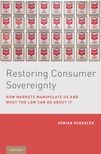
Restoring Consumer Sovereignty: How Markets Manipulate Us and What the Law Can Do About It
Abstract. For decades, there has been broad consensus within antitrust, intellectual property, and consumer law scholarship that consumers make decisions i
Search, Discovery, Pills, and Portals
Solving the distribution crisis in marketing

Uniting the Tribes: Using Text for Marketing Insight
Words are part of almost every marketplace interaction. Online reviews, customer service calls, press releases, marketing communications, and other interactions create a wealth of textual data. But how can marketers best use such data? This article provides an overview of automated textual analysis and details how it can be used to generate marketing insights. The authors discuss how text reflects qualities of the text producer (and the context in which the text was produced) and impacts the audience or text recipient. Next, they discuss how text can be a powerful tool both for prediction and for understanding (i.e., insights). Then, the authors overview methodologies and metrics used in text analysis, providing a set of guidelines and procedures. Finally, they further highlight some common metrics and challenges and discuss how researchers can address issues of internal and external validity. They conclude with a discussion of potential areas for future work. Along the way, the authors note how textual analysis can unite the tribes of marketing. While most marketing problems are interdisciplinary, the field is often fragmented. By involving skills and ideas from each of the subareas of marketing, text analysis has the potential to help unite the field with a common set of tools and approaches.
Marketplace - Business News & Economic Stories for Everyone
Marketplace raises the economic intelligence of the country through the unorthodox story, casual conversations and unexpected angles on the news.
Three notes: (1) this is not *just* marketing. These guys really do mean it. They are convinced they’ve built a vengeful digital god. (2) but also they’re a cult. They are not impartial scientific experts. (3) and one of the byproduct of their endless confidence is marketing hype.

Alejandra Caraballo
The alarms are all flashing red.
