

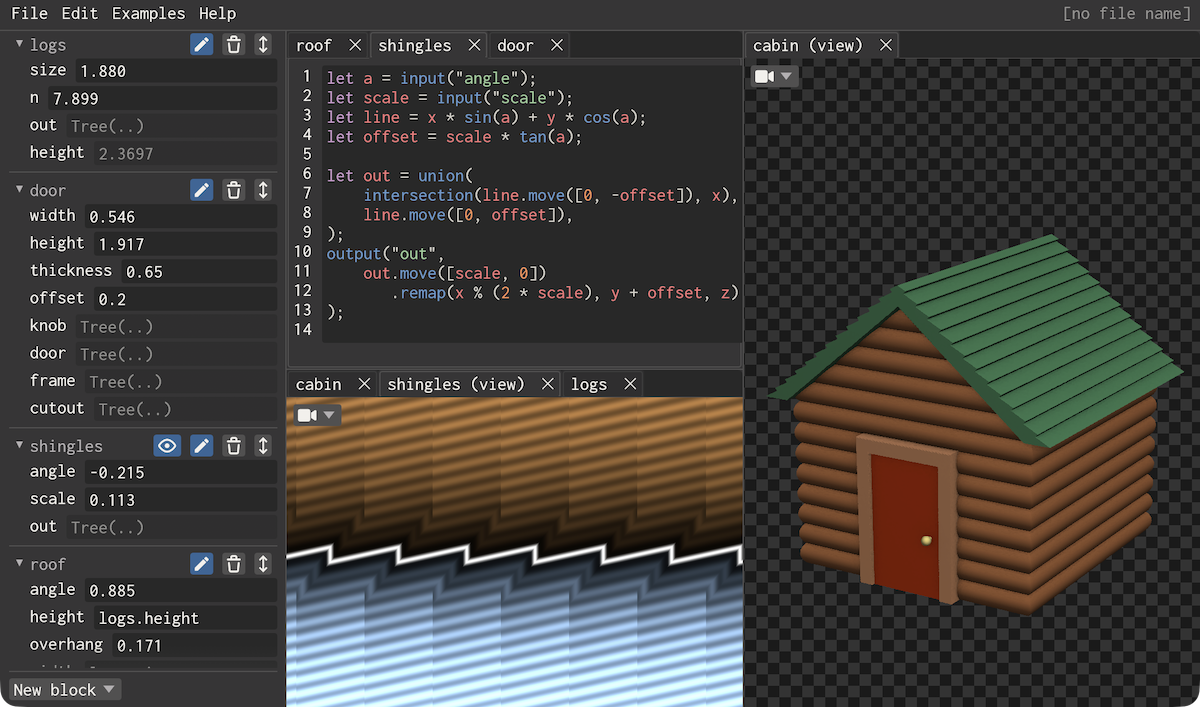
An IDE for solid modelling with distance fields
Signed Distance Fields – Render Diagrams
Nicole Feng
We introduce a method for approximating the signed distance function (SDF) of geometry corrupted by holes, noise, or self-intersections. The method implicitly defines a completed version of the shape, rather than explicitly repairing the given input. Our starting point is a modified version of the heat method for geodesic distance, which diffuses normal vectors rather than a scalar distribution. This formulation provides robustness akin to generalized winding numbers (GWN), but provides distance function rather than just an inside/outside classification. Our formulation also offers several features not common to classic distance algorithms, such as the ability to simultaneously fit multiple level sets, a notion of distance for geometry that does not topologically bound any region, and the ability to mix and match signed and unsigned distance. The method can be applied in any dimension and to any spatial discretization, including triangle meshes, tet meshes, point clouds, polygonal meshes, voxelized surfaces, and regular grids. We evaluate the method on several challenging examples, implementing normal offsets and other morphological operations directly on imperfect curve and surface data. In many cases we also obtain an inside/outside classification dramatically more robust than the one obtained provided by GWN.
Timothy Gowers @wtgowers on Twitter / X
AI has now solved a major open problem -- one of the best known Erdos problems called the unit distance problem, one of Erdos's favourite questions and one that many mathematicians had tried.https://t.co/SD1vVPkrHR— Timothy Gowers @wtgowers (@wtgowers) May 20, 2026
Nicole Feng
We describe a method for computing signed distance to point clouds that allows fast pointwise evaluation at arbitrary spatial resolution. As input, our method takes a point cloud with normals; as output, it provides an analytical parameterization that allows queries of signed distance to the approximate underlying surface at arbitrary points — simultaneously providing reconstruction and distance. Our key idea is to reconstruct shapes by locally fitting point clouds with tori, which have closed-form signed distance functions. Tori are fitted in a feed-forward manner, using a pre-trained network to output per-point curvature and shift parameters. Importantly, our method does not require costly global optimization or spatial discretization, and is easily parallelizable. Underlying our method is a new theory that unifies signed distance with the classic reconstruction methods of winding numbers and Poisson surface reconstruction. We use our method to compute signed distance to point clouds arising from photogrammetry, meshes, 3D Gaussians, and neural implicits. Our method allows point clouds to be used directly in applications, without explicit surface reconstruction: as examples, we take offsets of point clouds, apply morphological and Boolean operations, and directly visualize offset surfaces using sphere tracing.
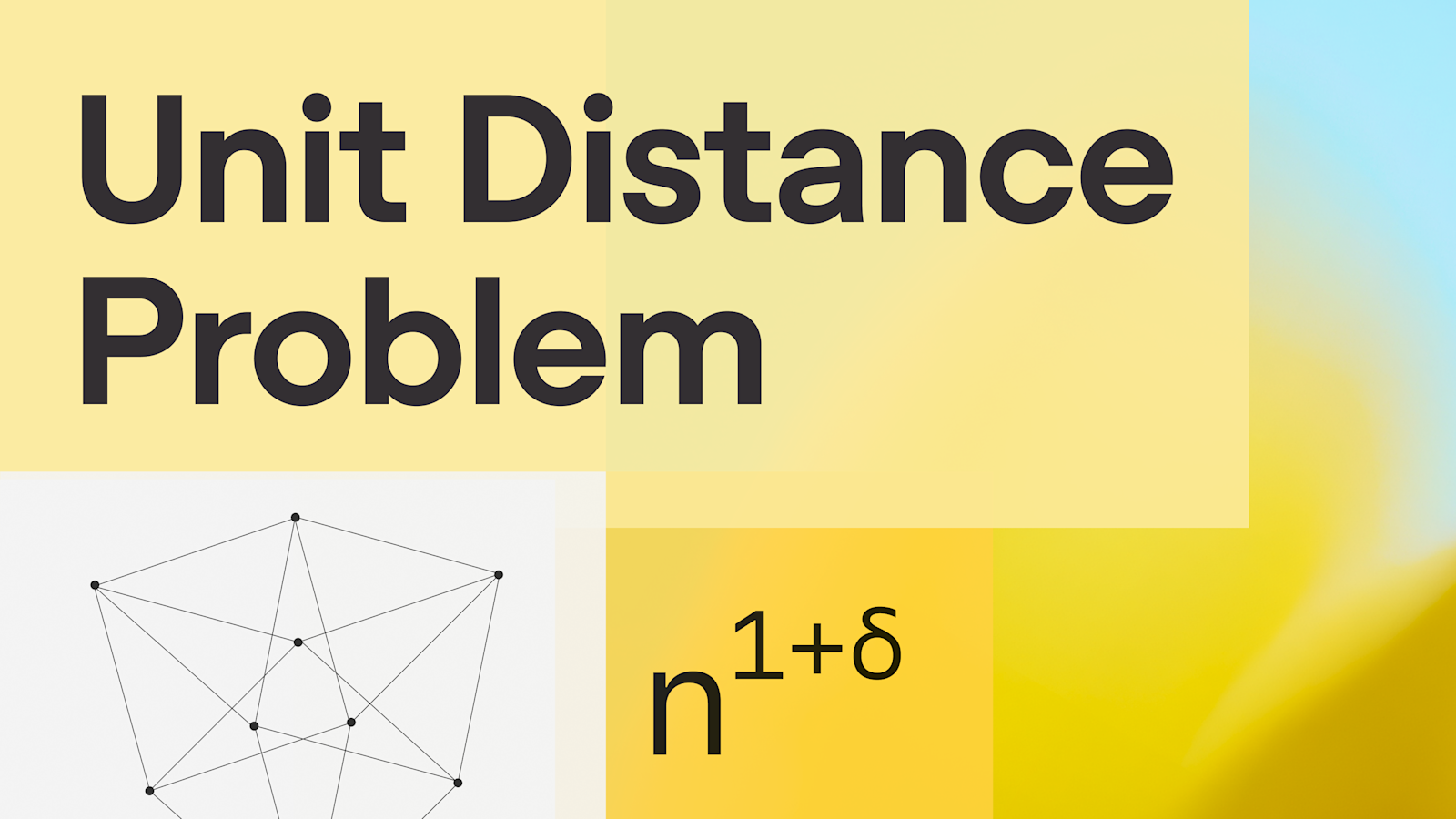
An OpenAI model has disproved a central conjecture in discrete geometry
An OpenAI model solved the 80-year-old unit distance problem, disproving a major conjecture in discrete geometry and marking a milestone in AI-driven mathematics.
DiffusionGemma as Jev: Open-Source vLLM Patch (2026) | explainx.ai Blog
A vLLM contributor built an open-source Jev clone using DiffusionGemma — roughly matching TypeSafe's proprietary model on accuracy.

[10 05 2025 The Curve] Open Models
Open Models in 2025 Nathan Lambert Interconnects // Ai2 The Curve // 5 October 2025

Notes from the Lab - March 2025 · folk-js folkjs · Discussion #36
This month, we restructured the repository in preparation for publishing. We extracted and optimized geometry utilities into a separate package, implemented Bounding Volume Hierarchies for efficien...
paper/paper.pdf at main · cordiverse/paper
A Programming Paradigm for Spatiotemporal Composability - cordiverse/paper
Tomb of Glowing Lava - How to Model Ultra Realistic Lava
Mutual intelligibility for schema idiolects.

GitHub - idiolect-dev/idiolect: Mutual intelligibility for schema idiolects.
github.com