

Figure 1: An assortment of implicit surfaces rendered using our technique. Left: an extruded text string, rotated and rendered as a heightmap. Center: a bear head sculpted using smooth blending operations, with normals found by automatic differentiation. Right: a complex architectural model rendered with screen-space ambient occlusion and perspective. All models are rendered directly from their mathematical representations, without triangulation or raytracing.
Voxel Displacement Renderer — Modernizing the Retro 3D Aesthetic
This is the first of two posts about a renderer I have been developing, focusing on what I've built and how it works. The second post discusses why I've built it and my plans for the future. I've been developing a custom real-time renderer which uses very small voxels to produce a distinctive visual style that modernizes the look and feel of classic 90's 3D games. By approaching the problem of rendering voxels in an unusual way, I'm able to produce these visuals from conventional art assets — low-poly triangle meshes and textures — that are familiar and efficient to create. [...]

Evaluating and Sampling Glinty NDFs in Constant Time
Geometric features between the micro and macro scales produce an expressive family of visual effects grouped under the term 'glints'. Efficiently rendering these effects amounts to finding the highlights caused by the geometry under each pixel. To allow for fast rendering, we represent our faceted geometry as a 4D point process on an implicit multiscale grid, designed to efficiently find the facets most likely to cause a highlight. The facets' normals are generated to match a given micro-facet normal distribution such as Trowbridge-Reitz (GGX) or Beckmann, to which our model converges under increasing surface area. Our method is simple to implement, memory-and-precomputation-free, allows for importance sampling and covers a wide range of different appearances such as anisotropic as well as individually colored particles. We provide a base implementation as a standalone fragment shader.
Uniform | Sparseal
General purpose 3D editor with sculpting, modeling, texturing, and rendering capabilities.


Generating 3D Meshes From Text
I recently had a desire to convert text to 3D meshes that I could render and manipulate as part of my Geotoy project and Geoscript language. I did some research into tools and libraries that could solve different pieces of this, and I put together a pipeline that implements the whole thing - yielding nice, 2-manifold 3D meshes with arbitrary fonts, text styles, and more.

A Topological Picture Book, Rendered
Hand-hatched surfaces after the mid-century manner of Francis, Apéry, Hilbert–Cohn-Vossen. Drag to turn the model freely (shift-drag to roll it); scroll to approach.
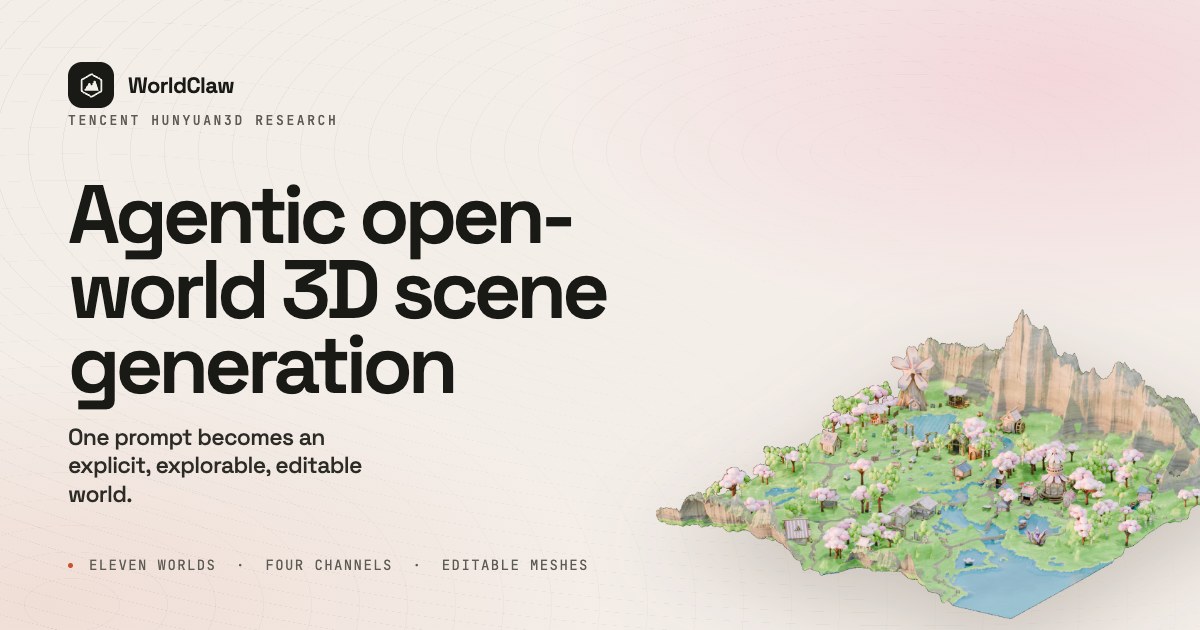
WorldClaw: Agentic 3D Open-World Generation at Scale
From one open-ended prompt to an explicit, explorable, and editable 3D world.
3D Models Free Download - Open3dModel.com
Free 3D Models with over 150.000+ 3d models for Free Download. Available in Blend, Max, Obj, Fbx, Skp, C4d, Ma, Mb, Fbx, Dae, Stl formats with highly detailed, low poly, rigged, animated, and printable.
Nicole Feng
We describe a method for computing signed distance to point clouds that allows fast pointwise evaluation at arbitrary spatial resolution. As input, our method takes a point cloud with normals; as output, it provides an analytical parameterization that allows queries of signed distance to the approximate underlying surface at arbitrary points — simultaneously providing reconstruction and distance. Our key idea is to reconstruct shapes by locally fitting point clouds with tori, which have closed-form signed distance functions. Tori are fitted in a feed-forward manner, using a pre-trained network to output per-point curvature and shift parameters. Importantly, our method does not require costly global optimization or spatial discretization, and is easily parallelizable. Underlying our method is a new theory that unifies signed distance with the classic reconstruction methods of winding numbers and Poisson surface reconstruction. We use our method to compute signed distance to point clouds arising from photogrammetry, meshes, 3D Gaussians, and neural implicits. Our method allows point clouds to be used directly in applications, without explicit surface reconstruction: as examples, we take offsets of point clouds, apply morphological and Boolean operations, and directly visualize offset surfaces using sphere tracing.
PixelGuys/Cubyz
Voxel sandbox game with a large render distance, procedurally generated content and some cool graphical effects.
Mesh Outlines Without Post-Processing in Unreal Engine
Some time ago I saw a neat solution by Cory Spooner on outlining meshes using particle sprites. The concept has been done before – but it’s interesting enough to cover it regardless for Unreal Engine...
