

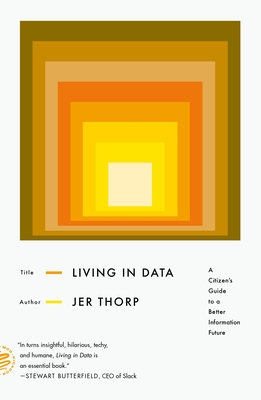
Jer Thorp’s analysis of the word “data” in 10,325 New York Times stories written between 1984 and 2018 shows a distinct trend: among the words most closely associated with “data,” we find not only its classic companions “information” and “digital,” but also a variety of new neighbors—from “scandal” and “misinformation” to “ethics,” “friends,” and “play.”To live in data in the twenty-first century is to be incessantly extracted from, classified and categorized, statistic-ified, sold, and surveilled. Data—our data—is mined and processed for profit, power, and political gain. In Living in Data, Thorp asks a crucial question for our time: How do we stop passively inhabiting data, and instead become active citizens of it?Threading a data story through hippo attacks, glaciers, and school gymnasiums, around colossal rice piles, and over active minefields, Jer Thorp reminds us that the future of data is still wide open, that there are ways to transcend facts and figures to engage more viscerally with data, and that there are always new stories to be told about how data can be used. Punctuated with Thorp’s original and informative illustrations, Living in Data not only redefines what data is, but also reimagines who gets to speak its language and how to use its power to create a more just and democratic future. Timely and inspiring, Living in Data gives us a much-needed path forward.
MyData
The human-centric approach to data is aimed at a fair, sustainable, and prosperous digital society. In such a society, people get value from their data and set the agenda on how it is used. And for organisations, the ethical use of data is always the most attractive option.

Data Feminism
Today, data science is a form of power. It has been used to expose injustice, improve health outcomes, and topple governments. But it has also been used to d...
Everything is miscellaneous : the power of the new digital disorder
Includes bibliographical references (p. [235]-257) and index; Prologue : information in space -- The new order of order -- Alphabetization and its discontents -- The geography of knowledge -- Lumps and splits -- The laws of the jungle -- Smart leaves -- Social knowing -- What nothing says -- Messiness as a virtue -- The work of knowledge -- Coda : misc; Philosopher Weinberger shows how the digital revolution is radically changing the way we make sense of our lives. Human beings constantly collect, label, and organize data--but today, the shift from the physical to the digital is mixing, burning, and ripping our lives apart. In the past, everything had its one place--the physical world demanded it--but now everything has its places: multiple categories, multiple shelves. Everything is suddenly miscellaneous. Weinberger charts the new principles of digital order that are remaking business, education, politics, science, and culture. He examines how Rand McNally decides what information not to include in a physical map (and why Google Earth is winning that battle), how Staples stores emulate online shopping to increase sales, why your children's teachers will stop having them memorize facts, and how the shift to digital music stands as the model for the future.--From publisher description; From A to Z, Everything Is Miscellaneous will completely reshape the way you think - and what you know - about the world. Includes information on alphabetical order, Amaxon.com, animals, Aristotle, authority, Bettmann Archive, blogs (weblogs), books, broadcasting, British Broadcasting Corporation (BBC), business, card catalog, categories and categorization, clusters, companies, Colon Classification, conversation, Melvil Dewey, Dewey Decimal Classification system, Encyclopaedia Britannica, encyclopedia, essentialism, experts, faceted classification system, first order of order, Flickr.com, Google, Great Books of the Western World, ancient Greeks, health and medical information, identifiers, index, inventory tracking, knowledge, labels, leaf and leaves, libraries, Library of Congress, links, Carolus Linnaeus, lumping and splitting, maps and mapping, marketing, meaning, metadata, multiple listing services (MLS), names of people, neutrality or neutral point of view, New York Public Library, Online Computer Library Center (OCLC), order and organization, people, physical space, everything having place, Plato, race, S.R. Ranganathan, Eleanor Rosch, Joshua Schacter, science, second order of order, simplicity, social constructivism, social knowledge, social networks, sorting, species, standardization, tags, taxonomies, third order of roder, topical categorization, tree, Uniform Product Code (UPC), users, Jimmy Wales, web, Wikipedia, etc

The Limits of Data
Policymakers want to make decisions based on clear data, but important factors are lost when we rely solely on data. A philosopher writes:
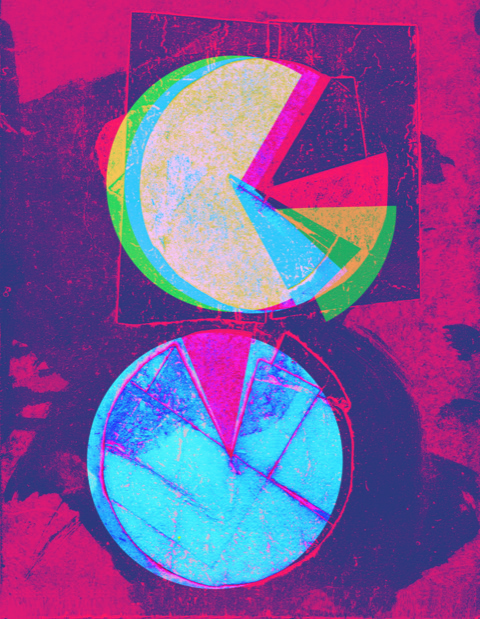
Data Feminism
A new way of thinking about data science and data ethics that is informed by the ideas of intersectional feminism.Today, data science is a form of power. I
Nonrivalry and the Economics of Data
(September 2020) - Data is nonrival: a person's location history, medical records, and driving data can be used by many firms simultaneously. Nonrivalry leads to increasing returns. As a result, there may be social gains to data being used broadly across firms, even in the presence of privacy considerations. Fearing creative destruction, firms may choose to hoard their data, leading to the inefficient use of nonrival data. Giving data property rights to consumers can generate allocations that are close to optimal. Consumers balance their concerns for privacy against the economic gains that come from selling data broadly.
Data Feminism
A new way of thinking about data science and data ethics that is informed by the ideas of intersectional feminism.

Reclaiming Data Autonomy as a Peasant
forthcoming — on the quiet enclosure of the transcript commons.
Feminist Data Manifest-No
1. We refuse to operate under the assumption that risk and harm associated with data practices can be bounded to mean the same thing for everyone, everywhere, at every time. We commit to acknowledging how historical and systemic patterns of violence and exploitation produce differential vulnerabilities for communities.
Fakebook: Using Data Science to Spot Fake News
In the face of rampant AI, is ‘data poisoning’ a new form of civil disobedience?
Boycotts, sabotage and other types of civil disobedience have long served collective action against injustice.

In the face of rampant AI, is ‘data poisoning’ a new form of civil disobedience?
Boycotts, sabotage and other types of civil disobedience have long served collective action against injustice.
Resilient Data Futures — Discourse Graph
A living, content-addressed, contributable form of the SciOS Resilient Data Futures whitepaper.

Resilient Data Futures — Discourse Graph
A living, content-addressed, contributable form of the SciOS Resilient Data Futures whitepaper.
Resilient Data Futures — Discourse Graph
A living, content-addressed, contributable form of the SciOS Resilient Data Futures whitepaper.
Resilient Data Futures — Discourse Graph
A living, content-addressed, contributable form of the SciOS Resilient Data Futures whitepaper.