


In the famous medieval magical manual called the Picatrix, the unknown author describes the phenomenon of magic with the term nigromantia. As is well known, the original meaning of the Greek term necromantia has a more concise meaning. It is used for a special kind of divination, i.e., divination through the parts of a cadaver and the conjured spirit of the dead. Seemingly, in the Picatrix, no necromantic ritual can be found; moreover, the author stresses that his main goal is pious, i.e., to find the path leading to the ultimate source of the universe, the one and only God. In my article, I show that on some pages of the Picatrix, there are traces of divinatory practices that may be connected to the original meaning of the term nigromantia. In the third book of the manual, descriptions of some interesting rituals attributed to the pagan Sabeans of Harran and their teacher, the god Hermes can be found. During the practices, the magician involved conjured spirits of the heavenly bodies and powers as well. Because of this, by looking closely at and analyzing the given text, it is possible to piece together a complex web of necromantic and demonic divinatory rituals.
Picatrix: A Medieval Treatise on Astral Magic Translated with an introduction by Dan Attrell and David Porreca
A manual for constructing talismans, mixing magical compounds, summoning planetary spirits, and determining astrological conditions, Picatrix is a cornerstone of Western esotericism. It offers important insights not only into occult practices and beliefs but also into the transmission of magical ideas from antiquity to the present. Dan Attrell and David Porreca’s English translation opens the world of this vital medieval treatise to modern-day scholars and lay readers.
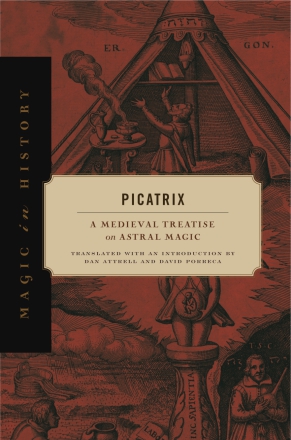
19.09.12 Attrell/Porreca (eds.), Picatrix: A Medieval Treatise on Astral Magic
Attrell, Dan, and David Porreca, trans. Picatrix: A Medieval Treatise on Astral Magic, Magic in History. University Park, PA: Pennsylvania State University Press, 2019. pp. xii, 372. $39.95 (hardback). ISBN: 978-0-271-08212-7 (hardback).
How Angel Magic Gave Us the Internet - The Steganographia of Trithemius
Face of a Bird, Legs of an Eagle: The Hybrid Venus in Medieval Texts of Image Magic and the So-Called Talisman of Catherine de’ Medici
This article examines the imagery of the goddess Venus in medieval sources of astrological magic, focusing on a zoomorphic hybrid Venus characterized by avian features. Furthermore, the article examines the transmission of this motif into early modern printed sources and talismans. The most renowned among surviving items related to the hybrid Venus is the 18th-century medallion known as Catherine de Medici’s talisman, depicting on one side a classical Venus figure, and on the other, a seated Jupiter alongside a hybrid with the head and feet of a bird. In previous scholarship it has been argued that the hybrid figure, interpreted as Venus, derives from Cornelius Agrippa and the medieval magical compendium Picatrix. The study demonstrates that the same hybrid Venus appears in several other medieval sources predating Agrippa and independent of the Picatrix. These sources, explored in this article in detail, offer a new insight into the evolution of the zoomorphic Venus, providing a deeper understanding of the ways in which non-Christian and non-classical astrological iconography was transformed and found pathways within medieval literature. Based on the findings of this research, De sigillis attributed to Arnoldus Saxo, seems to provide the most direct model for depicting two distinct Venus figures within the same talisman. The article further argues that the avian hybrid Venus was a dynamic figure among non-classical hybrids, appearing in a relatively wide range of sources, including contexts where astrological hybrids were a rarity.
“If you want to pray to Mercury, wear the garments of a scribe:” <i>kuttāb</i> , <i>udabāʾ,</i> and readers of the <i>Ghāyat al-Ḥakīm</i> in the court of ʿAbd al-Raḥmān III
This work addresses the question of the intended audience of the Ghāyat al-Ḥakīm, the famous Andalusi treatise on magic, better known by its Latin moniker, Picatrix. I propose that a substantial po...

Entangled Magic in the Medieval Latin West
This article focusses on the history of learned magic in late medieval Europe, breaking a period of about 500 years into chronological stages to explore how medieval supporters and critics of magic represented the art and responded to each other’s arguments, then reframed their own in a continuous dynamic entanglement. In this period learned magic texts from diverse religious and cosmological traditions (primarily Christian, Jewish, Arabic and Greco-Roman) circulated among people familiar with, and emotionally invested in, a great variety of institutional and informal rituals. Sources reveal a vibrant culture of exchanges of texts between members of religious orders, physicians and lay men, clerics and lay women – a culture of entanglement: discussion, borrowing, critique and adaptation alongside practitioner-client relationships and necessary secrecy and concealment.
Esotericism in One Piece: Navigating Magic, Symbolism and Spirituality
Introduction Idea Presentation

Necropolitics (Theory in Forms)
El nuevo capitalismo del siglo XXI se rige por la «necr…

The Ascendancy of the Scientific Dictatorship: An Examination of Epistemic Autocracy, from the 19th to the 21st Century
A. In the past, the elite manipulated the population through a more mystical belief system. In particular, there was the institution of Sun worship (typified by deities such as Osiris and Set). However, as antiquity gave way to modern history, this system of control began to lose its effectiveness. During the sixteenth century, the ruling class managed to co-opt a relatively new methodology of truth discernment...science. Over the years, they would contaminate this institution with their own virulent strains of thought...metaphysical naturalism, radical empiricism, Malthusianism, Darwinism, behaviorism, radical environmentalism, etc. Many of these paradigms were derivative of their own occult doctrines, thinly veiled to appear as objective science. All of these concepts correlate in some way and, at some point, coalesce. Together, they are gradually paving the way for the re-introduction of the hidden god of the Ancient Mysteries.

Dacian mythology | Myth and Folklore Wiki | Fandom
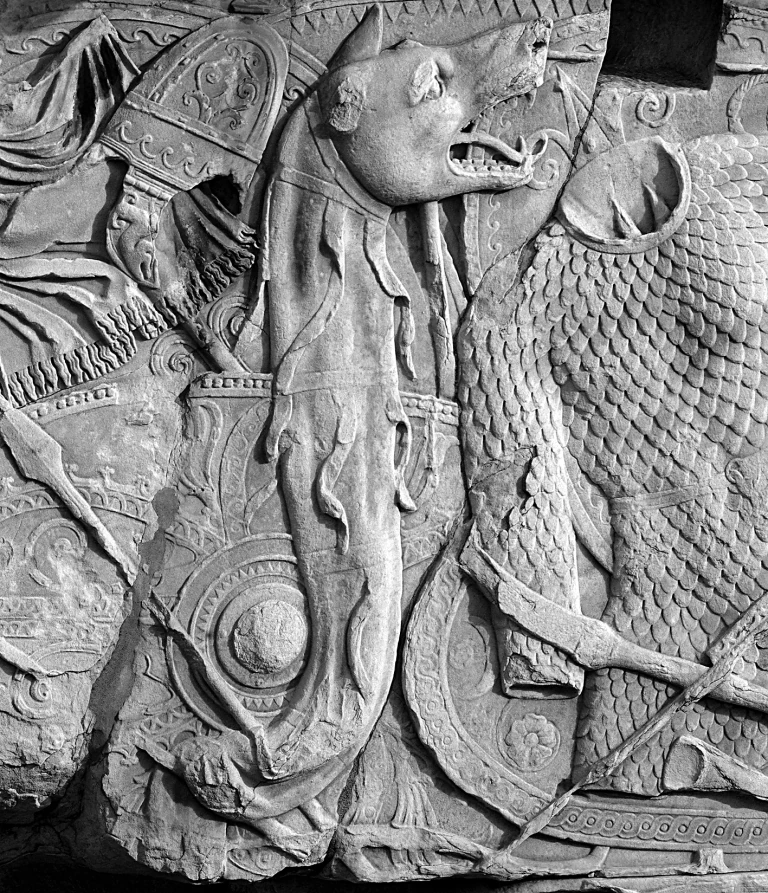
Rich and diverse, the Dacian mythology is overshadowed by the Greek or Roman mythologies. It stands out particularly for its wolf cult, for its fantastic characters such as the werewolf or the...
Methodology in Research on the Rainbow Body: Anthropological and Psychological Reflections on Death and Dying
The rainbow body research project, engaging claims of spiritual attainment and personal transformation, enables us to examine key features of anthropological research. Engagement with communities of discourse exposed aspects of the artificial emic–etic divide, allowing the anthropological study of religion to advance methods in religious studies. The study of paranormal phenomena cannot be isolated from societal contextualization. In this instance, a study of death and dying, contextualized in a traditional community, required unique features of engagement for the researcher who would be present to the social dynamics surrounding the death of a person of high repute.
Ethereal Ascension
41❤ 1.9⭐ | by cakey Ethereal Ascension invites you into a mystical realm where the fundamental energies of existence flow through your fingertips, waiting to be harnessed and shaped by your will. As a seeker of power in this ethereal dimension, you'll channel essence, create realms, collect artifacts, explore dungeons, and ultimately transcend the mortal plane through multiple ascensions. Start your adventure by channeling Etheric Essence - the fundamental energy of all creation. With each click, you harness more power, slowly building your reservoir of mystical energy. As your essence grows, unlock access to Mystical Realms that automatically generate essence for you - from the serene Luminous Gardens to the cosmic majesty of the Divine Nexus and beyond. We've got a complete extensive in-game Grimoire, accessible via the "Grimoire" button at the top of your screen. This ancient tome of knowledge contains detailed explanations of all game mechanics, strategic advice, and the complete lore of the ethereal realms. **Build your collection of Realms** Create and upgrade a diverse portfolio of 20 unique realms, each with its own production rate and essence flow. Strategically balance your realm acquisitions to maximize essence generation through powerful synergy effects. Watch as your essence production grows from mere droplets to a cascading flood of cosmic energy! **Discover Ancient Artifacts** Uncover and collect over 50 powerful artifacts that enhance your abilities in various ways: * Channeling Artifacts that multiply your essence gain per click * Realm Artifacts that boost production of specific realms * Global Artifacts that improve all essence generation * Ascension Artifacts that persist through ascensions and enhance power point gain **Master the Arcane Skill Tree** Ascend beyond the mortal plane to earn Power Points, which unlock permanent abilities in your Arcane Powers tree. Master over 30 unique powers organized in a strategic skill grid: * Production Powers enhance essence generation * Economy Powers reduce costs and improve efficiency * Special Powers transform gameplay mechanics with unique effects * Synergy Powers create powerful interactions * Dungeon Powers improve your combat performance **Delve Into Ethereal Dungeons** Test your might in procedurally generated dungeons filled with challenges and rewards: * Navigate through interconnected rooms with different types and dangers * Battle enemies in turn-based combat using both physical attacks and essence magic * Discover treasures and increase your power through permanent upgrades * Hunt for legendary dungeon artifacts that persist through ascensions * Defeat powerful bosses to claim the ultimate rewards **Legendary Feats Await** Complete over 90 challenging achievements across multiple categories: * Essence Feats for production milestones * Realm Feats for expanding your cosmic footprint * Power Feats for mastering arcane abilities * Dungeon Feats for combat prowess and exploration * Ascension Feats for transcendence beyond the material plane **Persistent Progress** Your journey through the ethereal realms is automatically saved, ensuring your progress is never lost. Export your save data for safekeeping or to continue your adventure across devices. -------------------------------------------------------- With infinite ascensions, each enhancing your power for the next cycle, your journey through Ethereal Ascension never truly ends. How far into the cosmic void will your power reach? *Transcend the mundane. Channel the ethereal. Ascend beyond.* Ethereal Ascension awaits - will you answer the call to cosmic power?

Coding the Digital Occult - Vodun Algorithms
Coding the Digital Occult: The Binary Techno Pagan and Vodun Ontologies of Cyberspace

Reckless Rites
Historical accounts of Jewish violence—particularly against Christians—have long been explosive material. Some historians have distorted these records for anti-Semitic purposes. Others have discounted, dismissed, or simply ignored the evidence, often for apologetic purposes. In Reckless Rites, Elliott Horowitz takes a new and forthright look at both the history of Jewish violence since late antiquity and the ways in which generations of historians have grappled with that history. In the process, he has written the most wide-ranging book on Jewish violence in any language, and the first to fully acknowledge and address the actual anti-Christian practices that became part of the playful, theatrical violence of the Jewish festival of Purim. He has also examined the different ways in which the book of Esther, upon which the festival is based, was used by Jews and Christians over the centuries—whether as an ancient mirror of modern tribulations or as the scriptural basis for anti-Semitic claims regarding the bloodthirstiness of the Jews. Reckless Rites reassesses the historical interpretation of Jewish violence—from the alleged massacre of thousands of Christians in seventh-century Jerusalem to later medieval attacks on Christian symbols such as the crucifix, transgressions that were often committed in full knowledge that their likely consequence would be death. A book that calls for major changes in the way that Jewish history is written and conceptualized, Reckless Rites will be essential reading for scholars and students of history, religion, and Jewish-Christian relations.
