


Digital business plays a crucial role in driving energy efficiency and sustainability by enabling innovative solutions such as smart grid technologies, data analytics for energy optimization, and remote monitoring and control systems. Through digitalization, businesses can streamline processes, minimize energy waste, and make informed decisions that lead to more efficient resource utilization and reduced environmental impact. This paper aims at analyzing the character of digital business’ impact on energy efficiency to outline the relevant instruments to unleash EU countries’ potential for attaining sustainable development. The study applies the panel-corrected standard errors technique to check the effect of digital business on energy efficiency for the EU countries in 2011–2020. The findings show that digital business has a significant negative effect on energy intensity, implying that increased digital business leads to decreased energy intensity. Additionally, digital business practices positively contribute to reducing CO2 emissions and promoting renewable energy, although the impact on final energy consumption varies across different indicators. The findings underscore the significance of integrating digital business practices to improve energy efficiency, lower energy intensity, and advance the adoption of renewable energy sources within the EU. Policymakers and businesses should prioritize the adoption of digital technologies and e-commerce strategies to facilitate sustainable energy transitions and accomplish environmental objectives.
Evaluating Sustainable Digitalization: A Carbon-Aware Framework for Enhancing Eco-Friendly Business Process Reengineering
In an era where sustainability is paramount, understanding the environmental impact of digitalizing business processes is critical. Despite the growing emphasis on sustainable practices, there is a lack of comprehensive methodologies to evaluate how digitalization impacts environmental sustainability compared to traditional processes. This paper introduces a carbon-aware methodological framework specifically designed to assess the sustainability of business process reengineering through digitalization. The Digital Green framework quantitatively analyzes the environmental costs associated with digital transformation, ensuring that truly sustainable digitalization results in lower resource consumption relative to the complexity of the process being digitalized. To demonstrate its effectiveness, the framework was applied to a case study involving the reengineering of an administrative process at a small university in southern Italy. The case study highlighted the framework’s ability to quantify the environmental benefits or detriments of digital transformation, thus guiding organizations toward more sustainable digital practices. This research contributes to the field by offering a concrete tool for aligning digitalization efforts with ecological sustainability, and by paving the way for integration with initiatives such as the Green Software Foundation’s Software Carbon Intensity (SCI) specifications.
Decoding Europe’s Data Centre Landscape: An Analysis based on the EU EED DC Dashboard
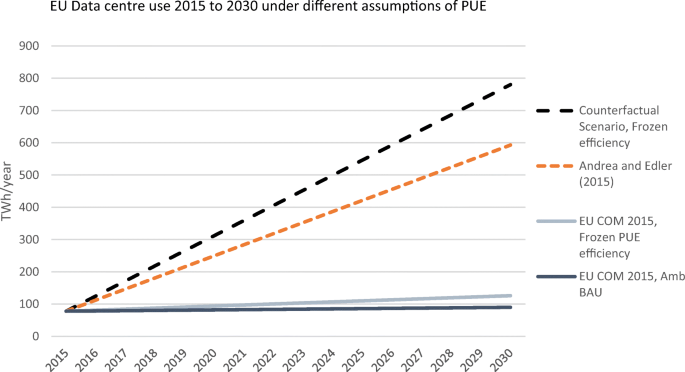
The rapid expansion of digital infrastructure has made data centres a focal point of European energy and climate policy. Under the recast Energy Efficiency Directive (EED), the European Union established a public Data Centre Registry and Dashboard to enforce unprecedented transparency on energy and environmental related performance. However, initial releases of these official datasets present substantial challenges regarding data completeness and reporting anomalies, limiting their immediate usability for empirical policy assessment. This paper presents a comprehensive analysis and systematic refinement of the initial published dataset. We developed an automated data-processing workstream to validate registry disclosures, filter statistical outliers, and resolve data gaps by recalculating core metrics, including calculated average Power Usage Effectiveness (PUE), utilization rates, and data centre capacity relative to national economic indicators. Our findings uncover significant regional variations in energy efficiency and infrastructure density and utilisation across Europe, characterized by a sharp geographic efficiency gradient favoring northern member states. Furthermore, evaluating the framework's effectiveness reveals structural data quality issues, yielding an estimated overall EU data centre coverage rate of just 38 % alongside critical reporting anomalies, such as theoretical utilization rates exceeding 100 % in select member states. Ultimately, this study establishes a highly curated baseline of the current European digital infrastructure landscape and provides a refined, reliable dataset to track the sector's trajectory toward net-zero goals.
Assessment of the energy performance and sustainability of data centres in EU: first technical report.
This document represents the deliverable ‘First Technical Report’ for the project Study on Technical Assistance in support of implementing Article 12(5) of Directive 2023/1791 on the energy performance and sustainability of data centres, and has been produced by EY, AIT and Borderstep for the European Commission. The technical report assesses data centre energy efficiency and sustainability, and the reporting scheme of the Delegated Regulation 2024/1364. It uses reported data, supplemented where necessary, and evaluates energy performance via sustainability and key performance indicators. The report also addresses data quality and completeness and proposes improvements for the reporting scheme, including in terms of the reported information and indicators and user experience.
Assessment of next steps to promote the energy performance and sustainability of data centres in EU, including the establishment of an EU-wide rating scheme
This document represents the deliverable 'Second Technical Report' for the project Study on Technical Assistance in support of implementing Article 12(5) of Directive 2023/1791 on the energy performance and sustainability of data centres, and has been produced by EY, AIT and Borderstep for the European Commission. The technical report assesses data centre energy efficiency and sustainability, and the reporting scheme of the Delegated Regulation 2024/1364. It uses reported data, supplemented where necessary, and evaluates energy performance via sustainability and key performance indicators. The report also addresses data quality/completeness and proposes reporting scheme improvements, including information/indicators and user experience.
Data centres in future European energy systems—energy efficiency, integration and policy
End-use efficiency, demand response and coupling of different energy vectors are important aspects of future renewable energy systems. Growth in the number of data centres is leading to an increase in electricity demand and the emergence of a new electricity-intensive industry. Studies on data centres and energy use have so far focused mainly on energy efficiency. This paper contributes with an assessment of the potential for energy system integration of data centres via demand response and waste heat utilization, and with a review of EU policies relevant to this. Waste heat utilization is mainly an option for data centres that are close to district heating systems. Flexible electricity demand can be achieved through temporal and spatial scheduling of data centre operations. This could provide more than 10 GW of demand response in the European electricity system in 2030. Most data centres also have auxiliary power systems employing batteries and stand-by diesel generators, which could potentially be used in power system balancing. These potentials have received little attention so far and have not yet been considered in policies concerning energy or data centres. Policies are needed to capture the potential societal benefits of energy system integration of data centres. In the EU, such policies are in their nascent phase and mainly focused on energy efficiency through the voluntary Code of Conduct and criteria under the EU Ecodesign Directive. Some research and development in the field of energy efficiency and integration is also supported through the EU Horizon 2020 programme. Our analysis shows that there is considerable potential for demand response and energy system integration. This motivates greater efforts in developing future policies, policy coordination, and changes in regulation, taxation and electricity market design.
Role of digitalization in environment, social and governance, and sustainability: Review-based study for implications
Digitalization gives people access to a vast network of untapped data, which has the potential to help society and the environment. Smart systems connected to the internet can systematically provide a unique opportunity to solve difficulties related to long-term sustainability. The goals are to create an egalitarian, ecologically sustainable, and healthy society. Technological resources are envisioned as game-changing instruments. Three key concerns integration benefits are highlighted here: (i) sustainable development goals, (ii) socio-economic development, and (iii) the role of digital technology in environmental sustainability. This viewpoint describes the potential that digitization can create a future sustainable society. The technological network would unite the urban and rural worlds under a shared banner of sustainable development, keeping all social elements in the loop. Nations that take a comprehensive strategy will be able to provide equitable growth and an efficient, sustainable, and digital existence for their citizens. As a result, digitization provides better living conditions, active public involvement, clean governance, and transparency in public welfare programs and processes. People who are well-informed, self-aware, and digitally equipped will be better learners, thinkers, reformers, participators, and change and growth agents, marching forward on sustainable progress. The advantages of digitization in hastening the transition to sustainable industrial processes and improving people's health and happiness are explored. Finally, the perspective encapsulates the advantages of digitization by offering a holistic vision of how technology could aid in addressing major challenges such as endangered world biodiversity and climate change.

Shaping Europe’s digital future
The Digital Strategy website provides updates and resources on EU policies key to the digital transformation.
Digitalisation in Europe – 2025 edition - Interactive publications - Eurostat
Digital technologies are transforming the world we live and work in. They touch many different aspects of our lives, from everyday tasks like making phone calls and shopping to how businesses and public services operate. Digital transformation is one of the key priorities for the EU. The digital decade initiative sets out the EU targets that will guide digital transformation until 2030.
Digitalisation in Europe – 2025 edition - Interactive publications - Eurostat
Digital technologies are transforming the world we live and work in. They touch many different aspects of our lives, from everyday tasks like making phone calls and shopping to how businesses and public services operate. Digital transformation is one of the key priorities for the EU. The digital decade initiative sets out the EU targets that will guide digital transformation until 2030.
The relationship between organizational culture, sustainability, and digitalization in SMEs: A systematic review
Organizational culture, environmental sustainability, and digitalization have an impact on the business development of Small and Medium-Sized Enterprises (SME). Dimensions associated with organizational culture (e.g., attitudes, norms, assumptions) give a sense of identity and determine behavior. The latter include general approaches concerning the organizational impact on the natural environment (environmental sustainability) or the adoption of digital technologies (digitalization), which can cause profound transformations of the business model. These three concepts have been investigated separately and scarce attention has been paid to their relationship. To enable SMEs to successfully manage this complex relationship, our study cumulates existing knowledge, offering the first integrative view on organizational culture, level of environmental sustainability, and level of digitalization and their interactions. Through a systematic literature review protocol supplemented where possible by meta-analysis we selected 80 significant papers out of 811 peer-reviewed papers analyzed. We developed a network map to display the relations between the three concepts. Quantitative path analysis was used on three bidirectional main paths. For qualitative analysis we developed a novel extension to the Belief-Action-Outcome (BAO) framework, presented for the first time in the paper. Our findings reveal thirteen key dimensions and identify ten links between the key constructs. Strategic orientation, internal capabilities, management, and attitudes are the most investigated cultural dimensions. Furthermore, we integrated interchangeably used terms (e.g. Green IT and Green IS) introducing the novel concept of green digitalization tools. The meta-analysis revealed trends in applied research methods, geographical locations of research, top journals, and a growing interest in the relationship. Finally, we identify gaps in existing research and challenges for future research.
EU-AI | Igor L.
The geopolitical landscape is shifting from physical borders to digital infrastructure. Here is a factual breakdown of how a $500 billion investment in "Sovereign AI" is changing global power dynamics. The Shift: From Land to "Substrate" Historically, a nation’s power was defined by its territory and legal systems (the Westphalian model). Today, power is increasingly tied to the compute substrate—the physical hardware and energy required to run AI. 1. Infrastructural Enclosure The "Sovereign Compute Coalition" (SCC) represents a massive consolidation of power. Major private entities are acquiring the three pillars of modern national strength: * Hardware: High-end AI chips (e.g., Nvidia). * Energy: The massive power grids needed to fuel them. * Data Centers: The physical "brains" of the digital economy. 2. The Rise of Technocracy As private companies own these essential tools, governments may find themselves in a position where they effectively "rent" their ability to govern. This moves decision-making power away from elected officials and toward those who control AI infrastructure. 3. Europe’s Strategic Response Europe is launching several initiatives to avoid becoming a "client state" of foreign tech providers. The strategy focuses on four main channels: * 8ra Initiative: Building a decentralized, multi-provider cloud-edge architecture to ensure data remains under European control and interoperable across borders. * ReArm Europe: A strategic defense package (presented in March 2025) aimed at boosting industrial competitiveness and reducing strategic dependencies in technology and defense. * Sovereign LLMs: Developing domestic models, such as Mistral, that are designed to align with European data privacy standards and cultural values. * Energy & Procurement: Using public procurement and new regulatory frameworks to create demand for homegrown, sustainable energy-efficient compute solutions. The goal of these moves is #DigitalSovereignty : the ability for a region to control its own digital destiny without relying exclusively on transnational monopolies. Data tells the real story. Are you following it? Follow #datanomics

Energy Production and Consumption
Explore data on how energy production and use varies across the world.
Energy performance of data centres
The Commission’s energy efficiency package for data centres will complement existing EU rules for data centres under the Energy Efficiency Directive.

AI’s climate impact is much smaller than many feared
New findings challenge the widespread belief that AI is an environmental villain. By analyzing U.S. economic data and AI usage across industries, researchers discovered that AI’s energy consumption—while significant locally—barely registers at national or global scales. Even more surprising, AI could help accelerate green technologies rather than hinder them.

US data centers’ energy use amid the artificial intelligence boom
Data centers accounted for 4% of total U.S. electricity use in 2024. Their energy demand is expected to more than double by 2030.

Digital Degrowth: Radically Rethinking our Digital Futures
We are fast approaching the point of “peak digital”, with the continued mass production and excessive consumption of digital technologies set to become a key driver of climate crisis, ecological breakdown and ongoing societal instability.<br /> <br /><i>Digital Degrowth</i> is a call to completely rethink our digital futures in these fast-changing times. It explores how degrowth thinking and alternate forms of “radically sustainable computing” might support ambitions of sustainable, scaled-down and equitable ways of living with digital technologies. Neil Selwyn proposes a rebalancing of digital technology use: digital degrowth is not a call for simply making reduced use of the digital technologies that we already have – rather it is an argument to reimagine digital practices that maximise societal benefits with minimal environmental and social impact. Drawing on illustrative examples from across computer science, hacker and environmental activist communities, this book examines how core degrowth principles of conviviality, autonomy and care are already being used to reimagine alternate forms of digital technology.<br /> <br />Original and stimulating, this is essential reading for students and scholars of media and communication, sustainability studies, political ecology, computer/data sciences, and across the social sciences.
