


an act or process of carefully looking at or examining the quality, condition, etc., of something or someone; revision… See the full definition
You can just review things: A digital ethnography of informal peer review
Across scholarly communities, manuscripts face similar evaluative rituals: editors invite experts to privately assess submissions through formal peer reviews. This closed, loosely structured, and...

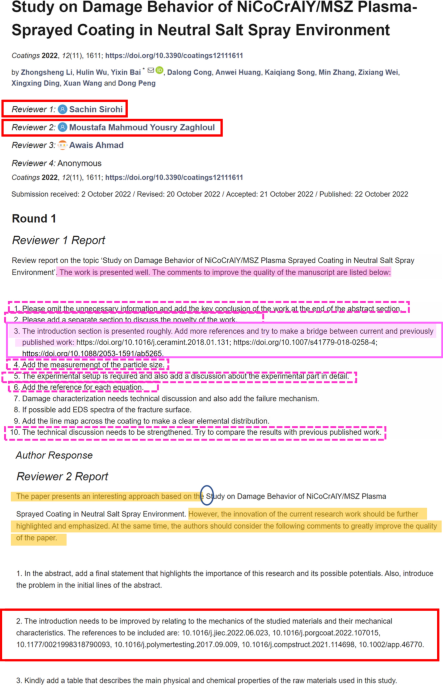
The review mills, not just (self-)plagiarism in review reports, but a step further
Review mills sum up a new category of reviewer misconduct that flies in the face of reviewer ethics and integrity. A pattern of generic, vague, and repeated affirmations (identical or very similar boilerplate phrasing) is noted in the analysis of 263 review reports, regardless of the scientific content of the papers under review, coupled with coercive citation (perhaps among the main reasons for such behavior), which when combined produce fake reviews. The misconduct associated with review mills is unlike mere plagiarism (self-plagiarism) of reviewer comments. It is important to quantify the problem and to take urgent measures: (a) to identify the review millers; (b) to rectify the published literature; and (c) to determine procedures for journals and publishers on procedures to counter this new type of misconduct.
Peer Review at the Crossroads
Peer review has long been regarded as a cornerstone of scholarly communication, ensuring high quality and credibility of published research. Although academic journals trace their origins back three centuries, the procedures for evaluating submissions, particularly peer review, have undergone continuous evolvement. Peer review’s formal institutionalization in the mid-20th century represents a significant, yet natural, phase in this ongoing transformation of scholarly communication. By the early 21st century, there emerged an opinion that the conventional model of peer review faces systematic challenges, including inefficiency, bias, and institutional inertia. The study aims to synthesize the evolution, practices, and outcomes of both conventional and innovative peer review models in scholarly publishing. Through a mixed-methods approach combining interpretative literature review and process modeling (Business Process Model and Notation –BPMN), it identifies four frameworks: pre-publication peer review, registered reports, modular publishing, and the Publish-Review-Curate (PRC) model. While the PRC model, which integrates preprints with post-publication review, demonstrates advantages in transparency and accessibility, no single approach emerges as universally ideal. The choice of model depends on disciplinary context, resource availability, and institutional priorities. The analysis underscores the need for adaptable platforms that enable hybrid workflows, balancing rigor with inclusivity. Future research must address empirical gaps in evaluating these innovations, particularly their long-term impact on equity and epistemic norms.
You can just review things: A digital ethnography of informal peer review
Across scholarly communities, manuscripts face similar evaluative rituals: editors invite experts to privately assess submissions through formal peer reviews. This closed, loosely structured, and publisher-mediated process is now being supplemented by critiques on open, distributed platforms. We call this practice, a blend of three open peer review variants, informal peer review as it is accessible to outsiders, unmediated by publishers, and conducted across public platforms. Informal peer reviewers range from occasional error detectors to experienced sleuths who identify plagiarism, fraud, errors, conflicts of interest, and conceptual flaws. They may interpret methods, clarify jargon, assess value, and connect to related work. Here, we asked four questions: (1) Who are informal peer reviewers? (2) Where do they work? (3) How do they evaluate research? and (4) What are their impacts? To answer these questions, we conducted a cross-platform digital ethnography with participant observation. We traced discourse across communities over four months and revisited cases after nine and twelve months. From 15 communities, we selected 12 case mentions (10 unique cases) and 8 meta-commentaries from 26 reviewers. Using open and axial coding, we generated 1,080 codes and four themes: reviewers are a motley crew, they self-organize across subpar digital spaces, use deep, uncommon strategies, and they face resistance from authors, publishers, and editors. Informal peer review, we concluded, is a fragile, minimally governed patchwork of people, platforms, and practices, as well as an emerging evidence infrastructure that can be scaled up. We advise advocates and tool-builders to evolve informal review tools, communities, training, and governance by connecting to scholars' values, reducing participation friction, and rewarding attempts to extend the scholarly dialogue.
Open Evaluation: A Vision for Entirely Transparent Post-Publication Peer Review and Rating for Science
The two major functions of a scientific publishing system are to provide access to and evaluation of scientific papers. While open access (OA) is becoming a reality, open evaluation (OE), the other side of coin, has received less attention. Evaluation steers the attention of the scientific community and thus the very course of science. It also influences the use of scientific findings in public policy. The current system of scientific publishing provides only journal prestige as an indication of the quality of new papers and relies on a non-transparent and noisy pre-publication peer review process, which delays publication by many months on average. Here I propose an OE system, in which papers are evaluated post-publication in an ongoing fashion by means of open peer review and rating. Through signed ratings and reviews, scientists steer the attention of their field and build their reputation. Reviewers are motivated to be objective, because low-quality or self-serving signed evaluations will negatively impact their reputation. A core feature of this proposal is a division of powers between the accumulation of evaluative evidence and the analysis of this evidence by paper evaluation functions (PEFs). PEFs can be freely defined by individuals or groups (e.g. scientific societies) and provide a plurality of perspectives on the scientific literature. Simple PEFs will use averages of ratings, weighting reviewers (e.g. by H-factor) and rating scales (e.g. by relevance to a decision process) in different ways. Complex PEFs will use advanced statistical techniques to infer the quality of a paper. Papers with initially promising ratings will be more deeply evaluated. The continual refinement of PEFs in response to attempts by individuals to influence evaluations in their own favor will make the system ungameable. OA and OE together have the power to revolutionize scientific publishing and usher in a new culture of transparency, constructive criticism, and collaboration.

Reviewing post-publication peer review
Post-publication peer review (PPPR) is transforming how the life sciences community evaluates published manuscripts and data. Unsurprisingly, however, PPPR is experiencing growing pains, and some elements of the process distinct from standard pre-publication review remain controversial. I discuss the rapid evolution of PPPR, its impact, and the challenges associated with it.

hunk — review-first terminal diff viewer
Hunk is a review-first terminal diff viewer for agent-authored changesets. Multi-file review stream, inline AI annotations, watch mode, and Git/Jujutsu integration.
The Peer Review Crisis Demands Radical Reform: Why Reviewers Should Become Paid Professional Referees
The peer review system, fundamental to scientific quality control, faces a significant crisis. As journal editors, we often need to send up to 35 invitations just to secure two reviewers, confronting daily the collapse of voluntary participation. This reflects a critical imbalance: while publication pressure intensifies, willingness to evaluate diminishes, creating "literature elephantiasis", i.e., an overwhelming proliferation of papers exceeding human processing capacity. Current compensation models, relying on token recognition and database access, fail to incentivize quality engagement and may encourage ethically problematic practices like excessive self-citation. The unchecked infiltration of artificial intelligence into peer review, with minimal enforcement, further undermines system integrity. We propose transforming peer reviewers into professional referees, modeled on sports officiating. This radical solution involves formal training and certification for reviewers, equipping them to assess scientific merit, methodology, and ethics comprehensively. Like sports referees supported by assistants, scientific referees would collaborate with specialists - including statisticians, methodology experts, and reference checkers - ensuring thorough evaluation while distributing workload effectively. Funding would come from publishers or research funders, recognizing peer review as an essential, compensated component of the research lifecycle. Implementation faces challenges including publisher resistance and funding allocation, which we address through phased transition strategies. This professionalization addresses current inequities where conscientious scientists shoulder disproportionate reviewing burdens while others contribute minimally. Professional reviewers would view evaluation as valued career development rather than unwelcome obligation. Critics citing independence concerns overlook the sports analogy: referees maintain impartiality through professional standards despite league compensation. Quality scientific evaluation requires dedicated expertise, adequate training, and fair remuneration. Science deserves better than a system dependent on goodwill and guilt - it needs professional referees now.

Trail of Crumbs
Peer review reduces a whole provenance trail — the observation, the evidence, the reasoning, the disagreement along the way — to a single opaque verdict. Breadcrumbs is infrastructure for making that trail legible again: from raw observation, through evidence and review, to attestation — for any contribution, not just a finished paper.
Better tools made Copilot code review worse. Here's how we actually improved it.
How migrating Copilot code review to shared Unix-style code exploration tools reduced review cost by reshaping agent workflows around pull request evidence.

AI-Assisted Peer Review at Scale: The AAAI-26 AI Review Pilot
Scientific peer review faces mounting strain as submission volumes surge, making it increasingly difficult to sustain review quality, consistency, and timeliness. Recent advances in AI have led the community to consider its use in peer review, yet a key unresolved question is whether AI can generate technically sound reviews at real-world conference scale. Here we report the first large-scale field deployment of AI-assisted peer review: every main-track submission at AAAI-26 received one clearly identified AI review from a state-of-the-art system. The system combined frontier models, tool use, and safeguards in a multi-stage process to generate reviews for all 22,977 full-review papers in less than a day. A large-scale survey of AAAI-26 authors and program committee members showed that participants not only found AI reviews useful, but actually preferred them to human reviews on key dimensions such as technical accuracy and research suggestions. We also introduce a novel benchmark and find that our system substantially outperforms a simple LLM-generated review baseline at detecting a variety of scientific weaknesses. Together, these results show that state-of-the-art AI methods can already make meaningful contributions to scientific peer review at conference scale, opening a path toward the next generation of synergistic human-AI teaming for evaluating research.
A Claude skill for pre-submission peer review
Open-source skill to use Claude + Consensus for pre-submission mock peer review backed by citations to published, peer-reviewed literature.

Something I keep thinking about is whether/how it would be possible to construct something like "trusted reviewing circles" without (1) destroying peer review's egalitarian goals, (2) accidentally enabling collusion rings, (3) recreating the same system with same issues over time.

Maria Antoniak
We are caught in such a trap. Asking good-faith community members to volunteer more when we can plainly see so much bad-faith behavior without consequences... IDK where it ends. Probably not central source of the problem, but NO ONE should be listed as an "author" on 20, let alone 40, submissions.
