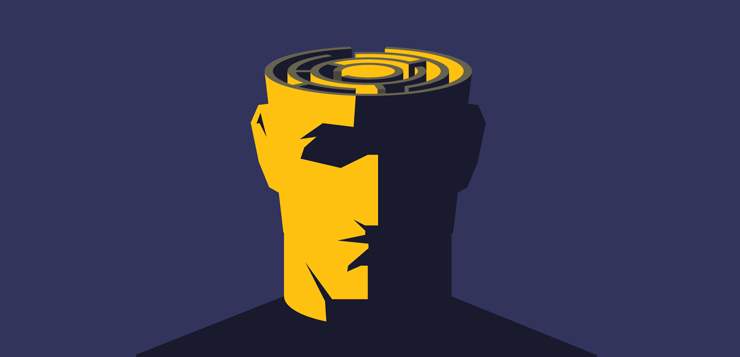
A slowly growing body of research suggests that our common aversion to failure is itself a failed strategy. Being curious about our mistakes is the royal road to learning. And mindful techniques can help.
How the Brain Changes When We Practice Knowing Our Minds
Practicing self-affirmation wires your brain to recognize your own brand of failure, reducing the defensiveness that can hinder performance improvement.
The mistake we all make... and the simple experiment that reveals it
Your answer reveals how you see the world – and the common error that hampers our decision making. In an extract from his new book, psychologist Richard Nisbett reveals the ‘mindware’ to help us think smarter

Common Causes of Very Bad Decisions
Italian psychologist Massimo Piattelli-Palmarini was once asked why people keep making the same mistakes.
Via Negativa: The Process of Making Good Decisions By Eliminating Bad Ones
When we set goals—both personal and professional—we tend to focus on what we should do, rather than focussing on what we should avoid. Humans naturally know more about what is wrong, what is bad, what is harmful, or what won’t work, more than they know about what is right and what would work.

How to rewire your brain for massive success, according to neuroscience
CEO Elle Kaplan shares the mental practices you can use to alter your brain for optimal function.

Resistance Is Futile. To Change Habits, Try Replacement Instead. (Published 2018)
An inconvenient bit of neuroscience: The more you try not to think about a bad habit, the harder it gets to resist. So think about something else.

Metacognitive Myopia: A Major Obstacle on the Way to Rationality
The notion of metacognitive myopia refers to a conspicuous weakness of the quality control of memory and reasoning processes. Although people are often remarkably sensitive even to complex samples of information when making evaluative judgments and decisions, their uncritical and naive tendency to take the validity of sampled information for granted constitutes a major obstacle to rational behavior. After illustrating this phenomenon with reference to prominent biases (base-rate neglect, misattribution, perseverance), we decompose metacognitive myopia into two distinct but intertwined functions, monitoring and control. We offer explanations for why effectively monitoring the biases resulting from information sampling in an uncertain world is so difficult and why the control function is severely restricted by the lack of volitional control over mental actions. Because of these and other difficulties, metacognitive myopia constitutes a major obstacle to rational judgment and decision making.


Keep Forgetting Things? Neuroscience Says This Memory-Fixing Brain Habit Works Best
'The results were incontrovertible ... regular, engaged reading strengthened older adults' memory skills.'

Explorable - Think Outside The Box - Research, Experiments, Psychology, Self-Help
"It is impossible to live without failing at something, unless you live so cautiously that you might as well not have lived at all - in which case, you fail by default." - J.K. Rowling
The Hole In Your Brain That Makes You Doomscroll
The Feedback Fallacy
For years managers have been encouraged to candidly praise and criticize just about everything workers do. But it turns out that feedback does not help employees thrive. First, research shows that people can’t reliably rate the performance of others: More than 50% of your rating of someone reflects your characteristics, not hers. Second, neuroscience reveals that criticism provokes the brain’s “fight or flight” response and inhibits learning. Last, excellence looks different for each individual, so it can’t be defined in advance and transferred from one person to another. It’s also not the opposite of failure. Managers will never produce great performance by identifying what they think is failure and telling people how to correct it. Instead, when managers see a great outcome, they should turn to the person who created it, say, “Yes! That!,” and share their impression of why it was a success. Neuroscience shows that we grow most when people focus on our strengths. Learning rests on our grasp of what we’re doing well, not what we’re doing poorly, and certainly not on someone else’s sense of what we’re doing poorly.

Mastering Success: Navigating Within Your Circle of Competence
Understanding where you have an edge and where you don't can help you prevent problems, spot opportunities others miss, and rapidly learn. We all have a circle of competence - an area in which we have a lot of earned knowledge.

Quality and effort
It seems as though the opposite of “careless” ought to be “careful.” That the best way to avoid avoidable errors is to try harder, to put more care into the work. This means…

Chesterton’s Fence: A Lesson in Thinking
A core component of making great decisions is understanding previous decisions. If we don’t understand how we got “here,” we run the risk of making things much worse.

People Spend Too Much Time On Decisions with Equally Satisfying Outcomes
The pitfalls of analysis paralysis