


Research shows us that we not only have the capacity to pay attention to and stop the chatter of our stories, but we can also reduce our stress, rewire our brains, and reinvent our relationships by responding to them differently.
Why Telling a Story is the Most Powerful Way to Activate Your Brain
A good story can make or break a presentation, article, or conversation. But why is that? When Buffer co-founder Leo Widrich started to market his product through stories instead of benefits and bullet points, sign-ups went through the roof. Here he shares the science of why storytelling is so uniquely powerful.

The Only Way to Stop Stressing About a Task Is to Finally Start It
Everyone struggles with procrastination now and then, sometimes because the stress about starting a task keeps us from acting. David Cain points out

Our fiction addiction: Why humans need stories
From fireside folk tales to Netflix dramas, narratives are essential to every society – and evolutionary theorists are now trying to figure out why, writes David Robson.

Narrative Techniques For DIY Research And Organizing
DIY research and focused narrative techniques give communities the power to collect and analyze the stories that matter most.

Quit Social Media. Your Career May Depend on It. (Published 2016)
Our increasing addiction to the constant stimulus of updates, likes and posts is damaging our ability to concentrate deeply and focus on work that matters.

The two kinds of stories we tell about ourselves
We’ve all created our own personal histories, marked by highs and lows, that we share with the world — and we can shape them to live with more meaning and purpose.

What Storytelling Does to Our Brains
Storytelling is one of the most overused and underused techniques at the same time. In this post, we are revealing what storytelling does to our brains.
How storytelling can help articulate emotions that evolve as the climate changes
Creative works can represent emotions emerging so fast that our brains can’t quite catch up with them.

Shh! Keep Your Big Goals to Yourself.
Sharing too much information apparently diminishes the likelihood you will follow through with your life-changing intentions, research shows. Here's what to do instead.

Scientists find there is something universal about what occurs in the brain when it processes stories
New brain research by USC scientists shows that reading stories is a universal experience that may result in people feeling greater empathy for each other, regardless of cultural origins and differences.

Why Procrastinators Procrastinate
The full story about why procrastinators routinely ruin their own lives.

Why Procrastinators Procrastinate
The full story about why procrastinators routinely ruin their own lives.
How to fight lies, tricks, and chaos online
A guide to slowing down and reading up on internet news

To Stop Procrastinating, Start by Understanding the Emotions Involved
New research suggests procrastination is a way some people cope with stress and avoid the feeling of anxiety before a new assignment or task.

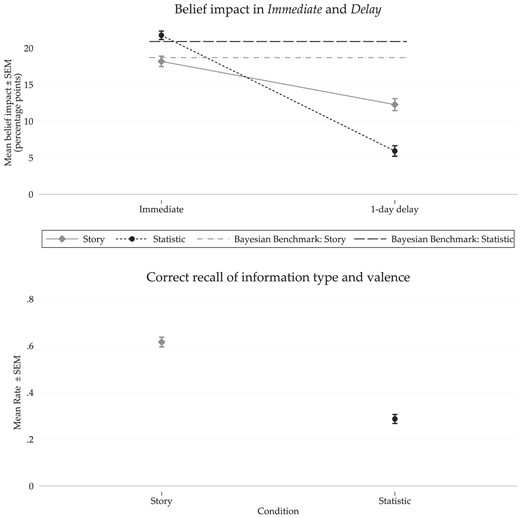
Stories, Statistics, and Memory
Abstract For many decisions, we encounter relevant information over the course of days, months, or years. We consume such information in various forms, including stories (qualitative content about individual instances) and statistics (quantitative data about collections of observations). This article proposes that information type—story versus statistic—shapes selective memory. In controlled experiments, we document a pronounced story-statistic gap in memory: the average impact of statistics on beliefs fades by 73% over the course of a day, but the impact of a story fades by only 32%. Guided by a model of selective memory, we disentangle different mechanisms and document that similarity relationships drive this gap. Recall of a story increases when its qualitative content is more similar to a memory prompt. Irrelevant information in memory that is similar to the prompt, on the other hand, competes for retrieval with relevant information, impeding successful recall.
One way to mitigate these effects is to move social discourse out of the high-velocity feed entirely—to use something like @skysquare.app where you can read conversation in context without subjecting yourself to the rapid novelty, constant switching, and algorithmic mechanisms of the feeds. 👀👇🤷

Skysquare — Public conversation, anchored to the web
skysquare.app
T.W. Simpson
I have an MA in broadcasting and early in my career worked in corporate filmmaking. One through-line from my studies through the industrial practice of audiovisual communications was that the shorter the asl, the easier it was to capture the viewer's attention. This effect is what is "addicting"...