


Regardless of specifics, however, the Income Sharing Agreement (ISA) structure is relatively consistent. To define it more explicitly, an Income Sharing Agreement funds a student’s tuition upfront in exchange for receiving a percentage of the student’s future earnings (hence “income-sharing”) based on a pre-defined formula. In this way, the funder can be thought of less as a debt investor and more as an equity investor, receiving “dividends” from the students future earnings.
World’s ONLY Fair Startup Equity Calculator for Startups // Slicing Pie
Get an accurate startup equity calculator that adjusts with real contributions. Implement a proven formula for fair and conflict-free equity sharing. Start now!

Commitment-pool route graphs for finance and mutual aid
This paper develops a bounded operationalization framework for selected financial and mutual-aid institutions. It models Commitment Pooling Protocol (CPP) as a

Stellar | Together We Can - A Decentralized Vision for Financial Inclusion
In this post, our contribution to Financial Inclusion Week organized by the Center For Financial Inclusion @ Accion, we’ll share SDF’s vision for achieving financial inclusion globally.We’ll do this by first outlining how we define financial inclusion, wh


The Algebra of Wealth: A Simple Formula for Financial Security by Scott Galloway
A must-have guide to optimizing your life for wealth and success, from bestselling author, NYU p...


If-This-Then-AT Blueprint: Payment-Proof Access Gates - Nick's Blog


Revenue-based financing
Revenue-based financing (also known as royalty financing[1] or royalty-based financing[2]) is a type of financial capital provided to growing businesses in which investors inject capital (sometimes called an advance) into a business in return for a fixed percentage of ongoing gross revenues (called royalties), with payment increases and decreases based on business revenues, typically measured as monthly revenue.[1][3]
Opinion | Michael Bloomberg: Why I’m Giving $1.8 Billion for College Financial Aid (Published 2018)
Let’s eliminate money problems from the admissions equation for qualified students.

Educating Investors about Dividends
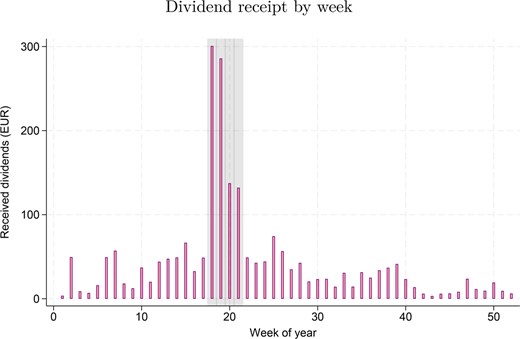
Abstract We educate investors about the benefits of dividend reinvestment and costs of misperceiving dividends as free income. The intervention increases planned dividend reinvestment in survey responses. Using trading records, we observe a causal increase in dividend reinvestment in the field of roughly 50 cents for every euro received. This holds relative to investors’ prior behavior and various control samples. Investors who learned the most from the intervention update their trading the most. The results suggest the free dividends fallacy is a significant source of dividend demand. Our study demonstrates that simple, targeted, and focused educational interventions can affect investment behavior.
LearnCard - The Lifelong Learning Passport
5 verbs: Issue, Earn, Store, Share, Spend. A universal, open source digital & physical learner wallet that can connect to any system. The Metamask for digital credentials, education, and employment.

The Routledge Handbook of Cooperative Economics and Management
Cooperatives have spread across virtually all continents. Today, the International Cooperative Alliance (ICA) recognises over 3 million cooperatives with 1 billion cooperative members or about 12% of the human population and serving many more members of the public, collectively owning trillions in assets. This handbook provides a comprehensive introduction to the subject and the current state of affairs with regard to the study of cooperation in the economy generally and of the cooperative and related sectors particularly. It highlights the essential issues and debates; provides a future research agenda, outlining the distinctions and similarities between individual and (inter)organisational cooperation; and explores the connections of cooperative economics and management to fundamental ethical principles. This book examines coopetition and the similarities and differences between competitive economics and cooperative economics, identifying to what extent and how cooperative economics and management are more capable of addressing the problems of global neoliberalism, such as ecological collapse, wealth inequity, value capture, and distribution, including via online platforms and social/relational problems. This book offers a variety of new research and theory‑building from various disciplines, particularly focusing on the fields of economics and management but extending beyond these disciplines to domains such as sociology, psychology, anthropology, and political science. It will become the standard reference work for not only a broad and large audience of scholars, researchers, and students but also interested professionals, policymakers, regulators, and cooperators in the field wishing to orient themselves in a global, rapidly developing movement and field of study with reference to issues of producing and allocating resources and focusing on the impact of cooperation on issues like risk, trust, the development of preferences, institutional governance, networks, and inequity. The Open Access version of this book, available at https://www.taylorfrancis.com, has been made available under a Creative Commons Attribution-Non Commercial-No Derivatives (CC-BY-NC-ND) 4.0 license. The handbook has received an Honorable Mention for the Joyce Rothschild book prize.
Slocan Statement
The following is intended as a starting point, a first draft towards establishing a shared charter that would serve to protect, support, and enrich the nascent Fediverse.
And I did an episode where I explain what I'm interested in -- orgs that have some 1) form of sharing, 2) some transparency about their finances, 3) a non-growth goal in the form of knowing when they are sufficient, and 4) #multisolving. buzzsprout.com/2396702/episodes/16595444-the…

The Four Factors for Organizations - Future Mending Radio
www.buzzsprout.com