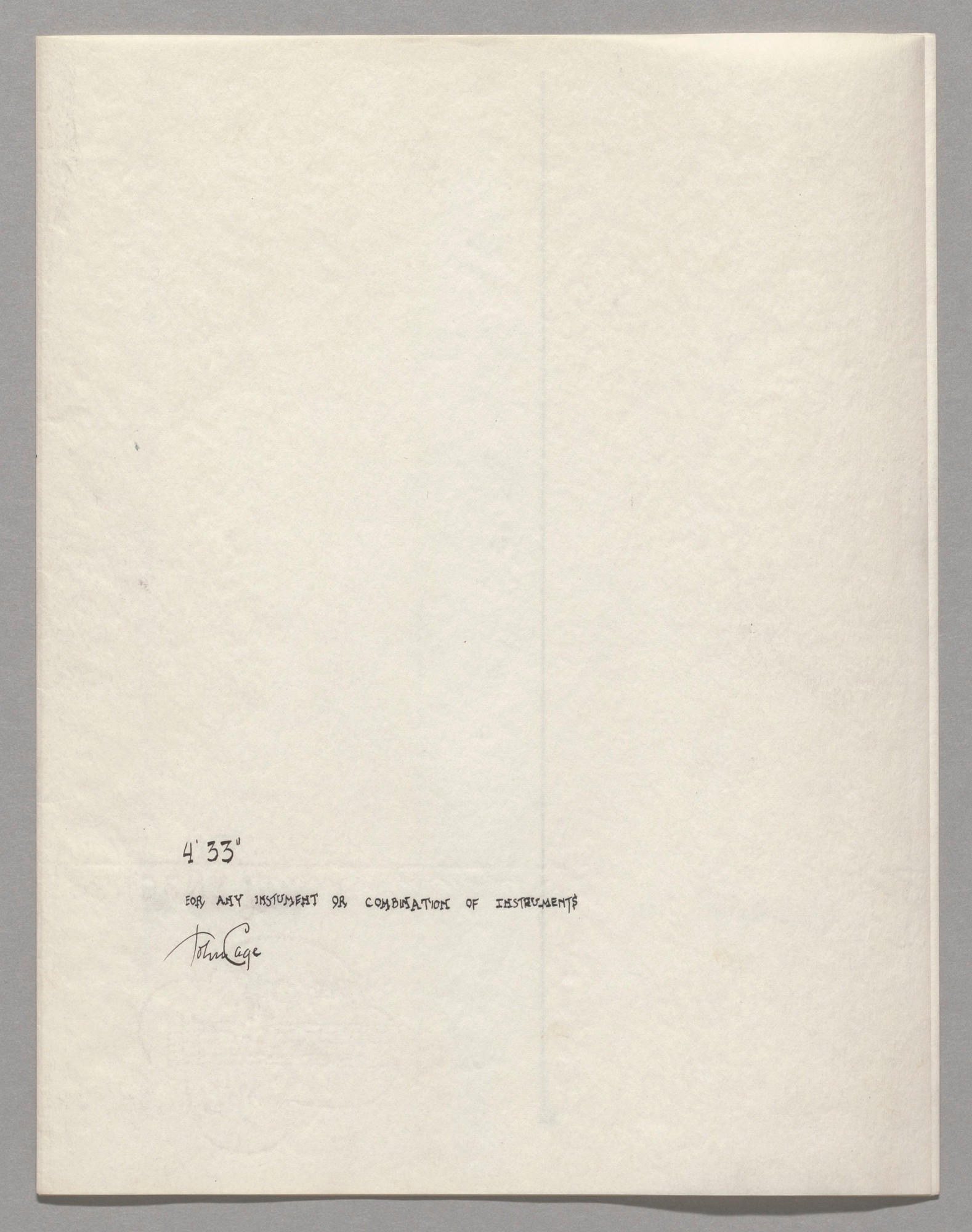
Exhibition. Oct 12, 2013–Jun 22, 2014. On a warm summer evening in August 1952 pianist David Tudor approached a piano on stage at the Maverick Concert Hall in Woodstock, New York. Stopwatch in hand, Tudor sat before the piano and, without striking a note, premiered John Cage’s composition 4′33″. Commonly known as Cage's “silent” piece, 4′33″ comprises three movements during which a performer—or performers—are instructed to produce no intentional sounds for four minutes and 33 seconds. This radical gesture upended the conventional structure of music, shifting attention from the performer to the audience, and allowing for endless possibilities of ambient sounds to fill the space. Today, 4′33″ is recognized as a groundbreaking work that synthesizes Cage’s interests in chance operations, experimental music, and visual arts. When discussing the work over his lifetime, Cage emphasized that, rather than intending to simply shock his audience, he hoped to attune listeners to silence as a structure within musical notation. In the visual arts, Cage’s contemporaries were similarly using chance, “negative space,” and physically dematerialized works that encourage open presentations or interpretations of scripted experiences. This exhibition introduces the Museum’s recently acquired score for 4′33″ and examines it, and Cage’s influence, as a critical pivot around which a diverse array of artists working throughout the 20th century can be united. Taking its title from a letter written by Cage in 1954, There Will Never Be Silence features prints, drawings, artists’ books, photographs, paintings, sculptures, and films by such artists as Marcel Duchamp, Kurt Schwitters, Robert Rauschenberg, Robert Morris, Lawrence Weiner, Yoko Ono, Andy Warhol, and other artists associated with Fluxus, Minimalism, and Conceptual art who pushed preconceived boundaries of space, time, and physicality to new ends.
Art of Noise
A multi-sensory exploration of how design has changed the way we’ve experienced music over the past 100 years.

The challenges of constitutional silence: Doctrine, theory, and applications
Abstract. In this introduction to our symposium on “Constitutional Silence,” we situate the articles in this collection and explore the significance of the

The silences of constitutions
Abstract. Glossing a passage from Benjamin Constant’s Reflections on Constitutions, this article first assesses the roles performed by silences, gaps, and

A B O U T - E X P E R I M A N C E
Experimentelle Musik, Klangkunst & Performance in Saarbrücken Experimental Music, Sound Art & Performance in Saarbrücken [Experi]ence: das Hörerlebnis als akustische Erfahrung // the listening experience as an acoustic experience Experi[m]ental: das Unkonventionelle und Fremdwirkende // the unconventional and foreign Perform[ance]: die vergängliche künstlerische Darbietung – the ephemeral artistic performance Seit 2016 bietet die Veranstaltung Experimance ... Read moreA B O U T
Soundings and Silences
In studying existing constitutions or in assisting with drafting a new one, it is impossible not to notice that formative decisions about what to say and what not to say as a constitution is being created bear heavily on later decisions about how to interpret what a constitution says or fails to say, including whether to construe any given silence or gap only as a source of insight or as a kind of performative utterance. Among the features of the United States Constitution that have been crucial to its success has been the widespread recognition of its connected structure that, despite its gaps—some deliberate and others unintended—invites understanding as a coherent, if at times internally inconsistent, whole. Constitutional silences, like silences of other kinds, are everywhere and come in many varieties. There are as many reasons to be silent as there are to speak and as many ways to hear meaning in the sounds of silence as there are to attribute meaning to statements. The first section of this essay distinguishes silences that open a constitutional conversation by leaving options on the table from those that shut conversation down by limiting the options to one. The second section separates silences that bear on the structure created by the Constitution from those that bear on the individual rights the Constitution protects against government infringement. The third section turns to the special case of silences in the Constitution’s rules of interpretation and asks whether the Supreme Court should be silent on a particular constitutional matter or should address it squarely, recognizing that whatever an authoritative interpreter says about what the Constitution itself says or omits can be evaluated only against the background alternative of somehow contriving to remain silent.
Dismantling the Master's Clock: On Race, Space, and Tim…
Afrofuturist artist Rasheedah Phillips of Black Quantum…

Getting Started Making Music | Notion
There are four elements of formula you need to make music.

Music Chat: Classical Music's Ten Dirtiest Secrets
Speaking of Music
“Can anyone explain in mere prose the wonder of one note following or coinciding with another so that we feel that it is exactly how those notes had to be? Of course not.”
Article 09: Performance: Instancing, LOD, Draw Calls — Three.js From Zero · MasterAllArts
Performance: Instancing, LOD, Draw Calls is Article 09 of Three.js From Zero, a MasterAllArts free interactive lesson for artists learning creative 3D on the web.

How to be more creative in seconds!
Cantora
Fortuna’s musical trajectory is over 30 years long, throughout which he has built bridges connecting her music, Jewish roots, and several religions and cultures. Diversity is very present in the music of Fortuna.
#783: The end of spoken conversation
Plus: Pandora Radio, birthday mania and the “perimenopause industrial complex”

Do You Hear "Yanny" or "Laurel"? (SOLVED with SCIENCE)
How Steely Dan Composes A Song
Design Must Learn to Decompose
A meditation on the quiet death of digital things.