


Automatically create bibliographies, references, and citations in APA, MLA, Chicago, Harvard, and more with our fast and accurate citation generator.
Jim Nielsen (@jim-nielsen.com)
If you haven’t seen it yet the new @aworkinglibrary.com website is dope aworkinglibrary.com Lots of things to love. A few that stand out to me: - It's _fast_ - Every page has a “footer” that’s essentially just the home page — enthralled by this idea. - ❤️ the treatment for citations on post pag…

Attribution, Provenance, Reference, Citation, and AI for Research Applications – Understanding the Differences - The Scholarly Kitchen
Building robust citation and attribution into generative AI systems are foundational to usage, credit and trust. We need to expect more from AI.


doi2bib
Easy generation of citations in BibTeX format from digital object identifiers (DOIs).
JabRef — Reference manager
JabRef is a free, open-source reference manager for collecting, organizing, and citing research.
Anthropic’s new Citations API
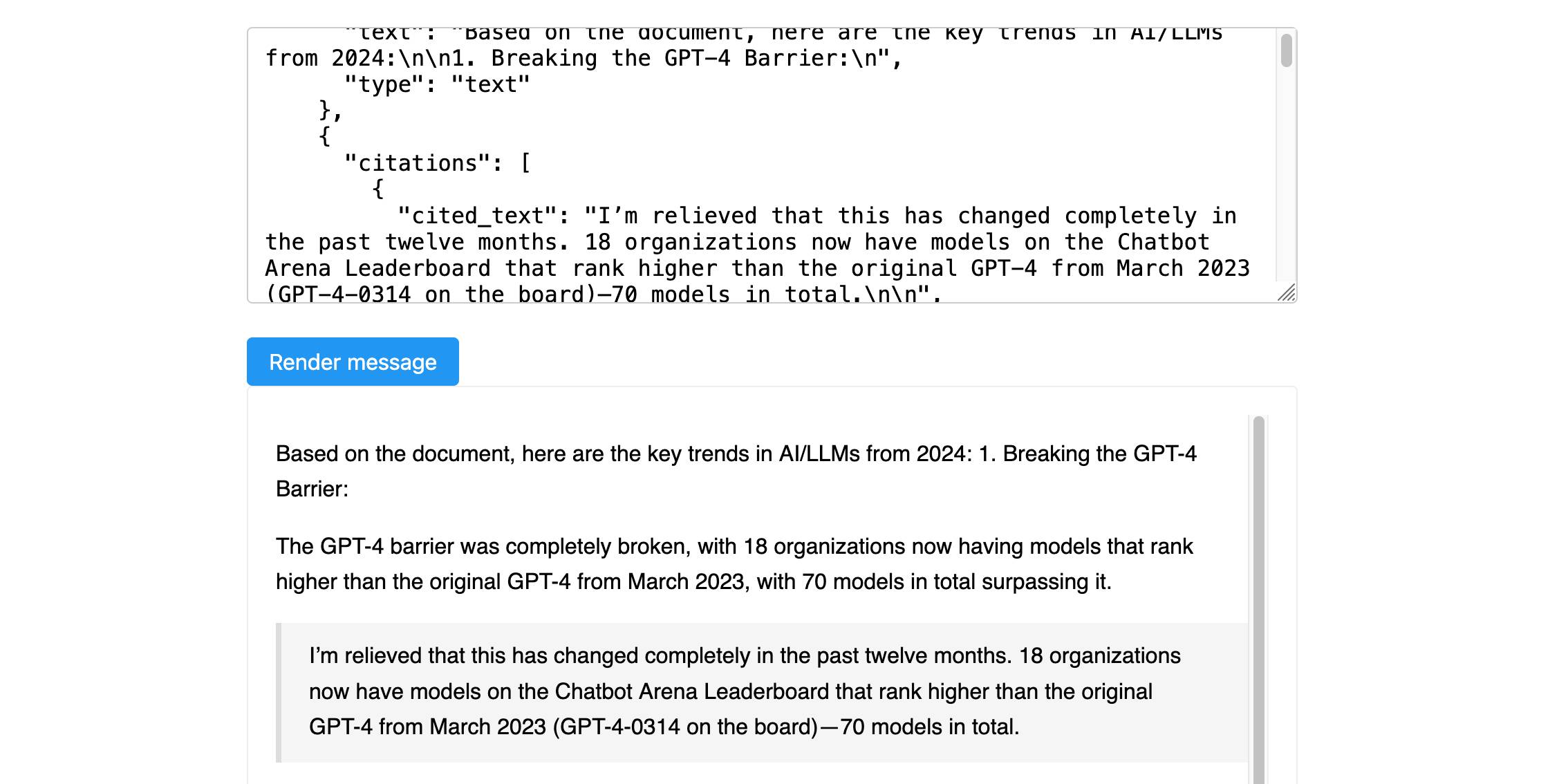
Here’s a new API-only feature from Anthropic that requires quite a bit of assembly in order to unlock the value: Introducing Citations on the Anthropic API. Let’s talk about what …
How Grobid uses Crossref metadata to enrich bibliographic information - Crossref
Crossref members register around 37,000 records daily. All this metadata is openly shared with the global scholarly community through our free APIs. We receive over two billion calls to our API each month, signalling its use by hundreds of tools and services worldwide, supporting the discovery and assessment of scholarly metadata. As part of a new series in our blog, we will spotlight the diversity of tools and integrations that rely on Crossref metadata to serve the scholarly community. In this initial post, we chat to Luca Foppiano, the developer and maintainer of Grobid1, to learn about how Grobid uses Crossref metadata to improve the extraction and enrichment of bibliographic information from scholarly PDFs.

Two billion citation links in Crossref help research travel further - Crossref
We’ve recently reached an important milestone for the research nexus: the works in our metadata corpus are now connected with over 2 billion citation links! This is a great opportunity to share a dedicated dataset and discuss why these are important for science.

HalluCiteChecker: A Lightweight Toolkit for Hallucinated Citation Detection and Verification in the Era of AI Scientists
We introduce HalluCiteChecker, a toolkit for detecting and verifying hallucinated citations in scientific papers. While AI assistant technologies have transformed the academic writing process, including citation recommendation, they have also led to the emergence of hallucinated citations that do not correspond to any existing work. Such citations not only undermine the credibility of scientific papers but also impose an additional burden on reviewers and authors, who must manually verify their validity during the review process. In this study, we formalize hallucinated citation detection as an NLP task and provide a corresponding toolkit as a practical foundation for addressing this problem. Our package is lightweight and can perform verification in seconds on a standard laptop. It can also be executed entirely offline and runs efficiently using only CPUs. We hope that HalluCiteChecker will help reduce reviewer workload and support organizers by enabling systematic pre-review and publication checks. Our code is released under the Apache 2.0 license on GitHub and is distributed as an installable package via PyPI. A demonstration video is available on YouTube.

Hyperlink Academy
It's a lightweight collaborative publishing tool for quick tiny docs that can grow into rich creative surfaces ✨🌱
Created a @standard.site aggregator for biblical studies publications. So far, @joelwerner.me and I are the only active authors I've found using compatible platforms. More are welcome! longform.sermon.garden
Atmospheric Exegesis
longform.sermon.gardenI made a little social bibliography atproto app. You can post papers you read and see what your friends are reading. Paper info autofills from links, and it exports to bibtex. There's chronological and following only feeds, maybe more to come, and you can organize papers into lists for your own use.
papers.club
papers.clubWould you like an easy personal research website generator backed by @sifa.id and other atmosphere apps/data? ( @semble.so for library, @standard.site for blog, etc ) Inspired by the academicpages.github.io template all of us researchers use 😅

Sifa ID
Here's an early POC for a "personal website" run entirely on Sifa (and more atproto) data: sifa.id/p/gui.do/site (just append /site to your own profile to see it in action) You can also self-host it: github.com/singi-labs/sifa-academicpages
This is the summer of micro-papers: small ideas, shared freely, archived for posterity. I've had 2 separate emails and multiple new citations based on my micro-paper I wrote for micro-papers back in 2023.

The Micro-Paper: Towards cheaper, citable research ideas and conversations
arxiv.orgNext stop, allow users to follow @standard.site publications directly from Glean. Atproto is great!
Scholarly APIs ⚗️

Commonly used scholarly resources API
Elsevier Developer Portal
Elsevier Developer Portal
Elsevier Developer Portal
About the Indicators API Documentation – World Bank Data Help Desk
API
developer.nytimes.com


