Are scientists publishing more duplicate papers? An automated search of seven million biomedical abstracts suggests that they are, report Mounir Errami and Harold Garner.
Fabricated Citations — CITADEL
4,046 fabricated citations in the biomedical literature. A more than 12× rise in three years. Verified across PubMed, Crossref, OpenAlex, Google Scholar.
Fabricated citations: an audit across 2·5 million biomedical papers
Scientific literature depends on the integrity of its references. Each reference implicitly asserts that a verifiable source exists and supports the claims being made. When references point to non-existent studies, readers, reviewers, and policy makers are unable to evaluate the evidence.
Duplicate and fake publications in the scientific literature: how many SCIgen papers in computer science?
Two kinds of bibliographic tools are used to retrieve scientific publications and make them available online. For one kind, access is free as they store information made publicly available online. For the other kind, access fees are required as they are compiled on information provided by the major publishers of scientific literature. The former can easily be interfered with, but it is generally assumed that the latter guarantee the integrity of the data they sell. Unfortunately, duplicate and fake publications are appearing in scientific conferences and, as a result, in the bibliographic services. We demonstrate a software method of detecting these duplicate and fake publications. Both the free services (such as Google Scholar and DBLP) and the charged-for services (such as IEEE Xplore) accept and index these publications.

Fraudulent citations, blamed on AI hallucinations, are becoming more common in research papers
“Fabricated” citations that do not reference real academic papers are spreading in the literature, polluting the public record of science, a new study found

Incorrect Citation Association for Articles in Online-Only Springer Nature Journals
We show that citation metrics of journal articles in many of the online-only Springer Nature journals and associated ones are distorted, going back to articles from 2001. We find that most likely due to an API response error, there are many incorrect references which typically lead to Article Number 1 of a given Volume. Among others, the issue affects journals such as Scientific Reports, Nature Communications, Communications journals, Cell Death & Disease, Light: Science & Applications, as well as many BMC, Discovery and npj journals. Beyond the negative effect of introducing incorrect reference information, this distorts the citation statistics of articles in these journals, with a few articles being massively over-cited compared to their peers, while many lose citations; e.g. both in Scientific Reports and in Nature Communications, 5 of the 10 top cited articles have article numbers of 1. We validate the distorted statistics by assessing data from multiple scientific literature databases: Crossref, OpenCitations, Semantic Scholar, and the journals' websites. The issue primarily arises from the inconsistent transition from page-based referencing of articles to article number-based referencing, as well as the improper handling of the change in the publisher's article metadata API. It seems that the most pressing problem has been present since approximately 2011, which we estimate affects the citation count of millions of authors.

Meet this super-spotter of duplicated images in science papers
Elisabeth Bik quit her job to spot errors in research papers — and has become the public face of image sleuthing.

White House Health Report Included Fake Citations (Published 2025)
A report on children’s health released by the Make America Healthy Again Commission referred to scientific papers that did not exist.

From Replication Rates to Replication Evidence: A Guest Editorial
Repeating original studies using existing data (reproducibility) or new data (replicability) is key to improving the credibility of scientific results. Here, we focus on replications, which can be…
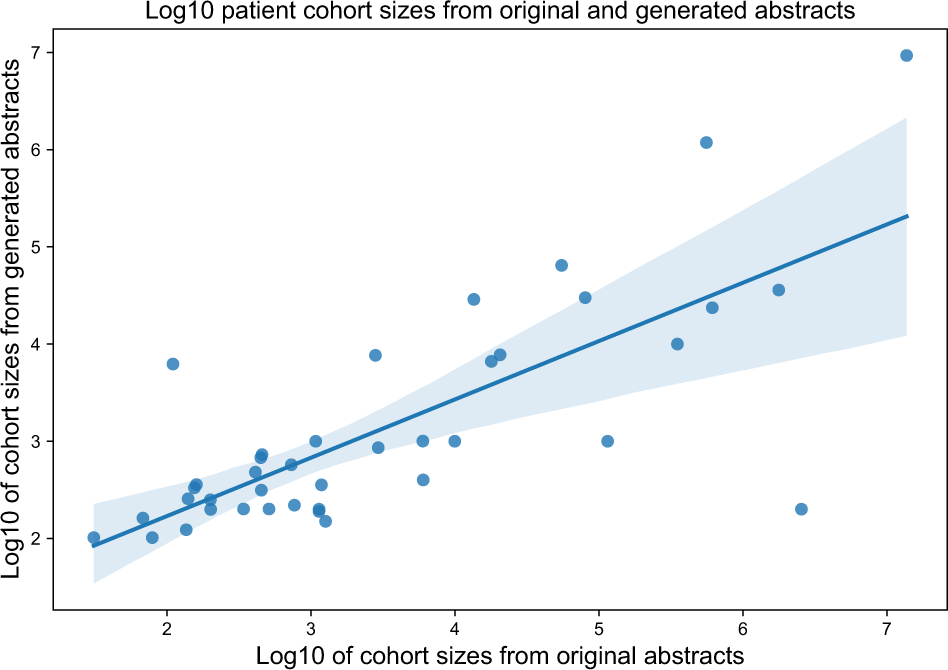
Comparing scientific abstracts generated by ChatGPT to real abstracts with detectors and blinded human reviewers
Large language models such as ChatGPT can produce increasingly realistic text, with unknown information on the accuracy and integrity of using these models in scientific writing. We gathered fifth research abstracts from five high-impact factor medical journals and asked ChatGPT to generate research abstracts based on their titles and journals. Most generated abstracts were detected using an AI output detector, ‘GPT-2 Output Detector’, with % ‘fake’ scores (higher meaning more likely to be generated) of median [interquartile range] of 99.98% ‘fake’ [12.73%, 99.98%] compared with median 0.02% [IQR 0.02%, 0.09%] for the original abstracts. The AUROC of the AI output detector was 0.94. Generated abstracts scored lower than original abstracts when run through a plagiarism detector website and iThenticate (higher scores meaning more matching text found). When given a mixture of original and general abstracts, blinded human reviewers correctly identified 68% of generated abstracts as being generated by ChatGPT, but incorrectly identified 14% of original abstracts as being generated. Reviewers indicated that it was surprisingly difficult to differentiate between the two, though abstracts they suspected were generated were vaguer and more formulaic. ChatGPT writes believable scientific abstracts, though with completely generated data. Depending on publisher-specific guidelines, AI output detectors may serve as an editorial tool to help maintain scientific standards. The boundaries of ethical and acceptable use of large language models to help scientific writing are still being discussed, and different journals and conferences are adopting varying policies.
Quotation errors in general science journals
Abstract. Due to the incremental nature of scientific discovery, scientific writing requires extensive referencing to the writings of others. The accuracy
Quotation errors in general science journals
Due to the incremental nature of scientific discovery, scientific writing requires extensive referencing to the writings of others. The accuracy of this referencing is vital, yet errors do occur. These errors are called ‘quotation errors’. This paper presents the first assessment of quotation errors in high-impact general science journals. A total of 250 random citations were examined. The propositions being cited were compared with the referenced materials to verify whether the propositions could be substantiated by those materials. The study found a total error rate of 25%. This result tracks well with error rates found in similar studies in other academic fields. Additionally, several suggestions are offered that may help to decrease these errors and make similar studies more feasible in the future.
Scientific production in the era of Large Language Models
Large Language Models (LLMs) are rapidly reshaping scientific research. We analyze these changes in multiple, large-scale datasets with 2.1M preprints, 28K peer review reports, and 246M online accesses to scientific documents. We find: 1) scientists adopting LLMs to draft manuscripts demonstrate a large increase in paper production, ranging from 23.7-89.3% depending on scientific field and author background, 2) LLM use has reversed the relationship between writing complexity and paper quality, leading to an influx of manuscripts that are linguistically complex but substantively underwhelming, and 3) LLM adopters access and cite more diverse prior work, including books and younger, less-cited documents. These findings highlight a stunning shift in scientific production that will likely require a change in how journals, funding agencies, and tenure committees evaluate scientific works.
Papers and patents are becoming less disruptive over time
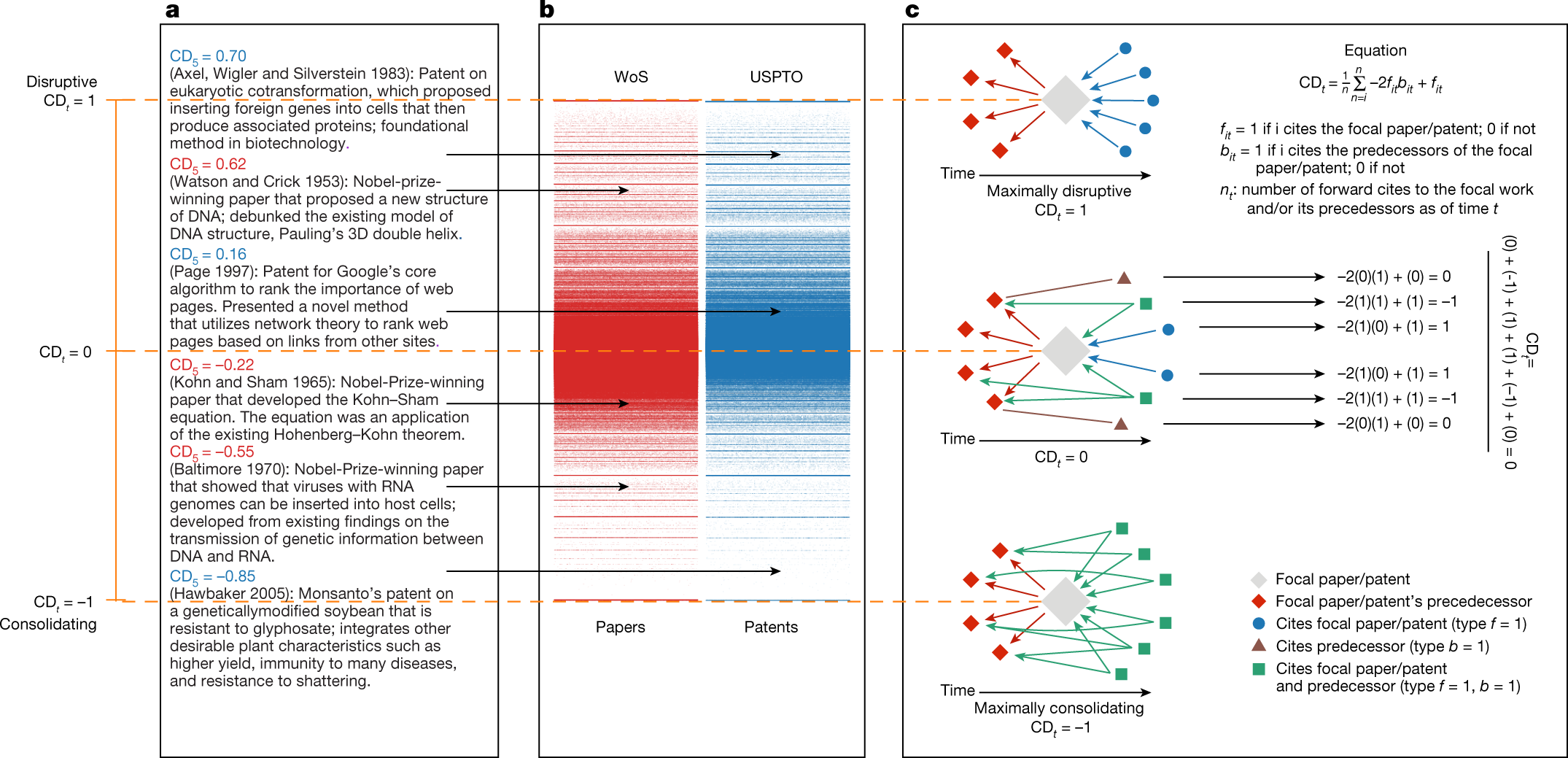
Theories of scientific and technological change view discovery and invention as endogenous processes1,2, wherein previous accumulated knowledge enables future progress by allowing researchers to, in Newton’s words, ‘stand on the shoulders of giants’3–7. Recent decades have witnessed exponential growth in the volume of new scientific and technological knowledge, thereby creating conditions that should be ripe for major advances8,9. Yet contrary to this view, studies suggest that progress is slowing in several major fields10,11. Here, we analyse these claims at scale across six decades, using data on 45 million papers and 3.9 million patents from six large-scale datasets, together with a new quantitative metric—the CD index12—that characterizes how papers and patents change networks of citations in science and technology. We find that papers and patents are increasingly less likely to break with the past in ways that push science and technology in new directions. This pattern holds universally across fields and is robust across multiple different citation- and text-based metrics1,13–17. Subsequently, we link this decline in disruptiveness to a narrowing in the use of previous knowledge, allowing us to reconcile the patterns we observe with the ‘shoulders of giants’ view. We find that the observed declines are unlikely to be driven by changes in the quality of published science, citation practices or field-specific factors. Overall, our results suggest that slowing rates of disruption may reflect a fundamental shift in the nature of science and technology.
Plaudit — How to Give More Than One Like to a Scientific Article | Challenges and Issues of Modern Science
Is it possible to give more than one like on Facebook, Instagram, LinkedIn, and other social networks? Have you ever wanted, just once, to “like with both hands”? If so — your wish has come true on the platform of our journal Challenges and Issues of Modern Science.
Some Wikipedia citations to retracted papers persist for years, study finds
Retracted scientific papers cited on Wikipedia tend to linger on the popular website for years, according to a study examining nearly 1,200 citations. The study’s authors, led by Ph.D. candid…