


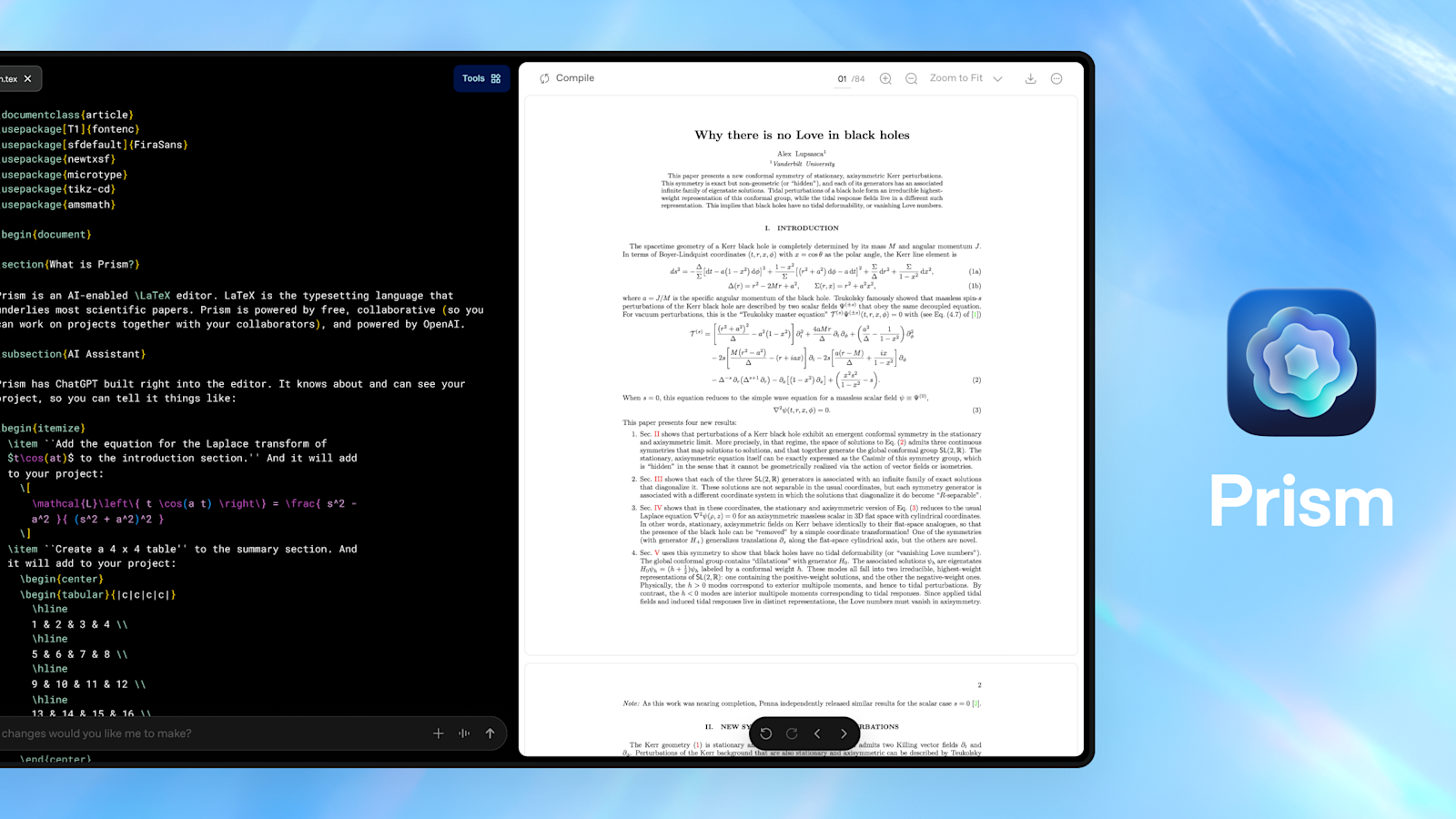
A growing suite of tools allows teams of researchers to work collectively to edit scientific documents.
Lies I was Told About Collaborative Editing, Part 2: Why we don't use Yjs / Moment devlog
In part 1 of this series, we found that users generally view the most popular collaborative text editing algorithms (including the most popular library, Yjs) as silently corrupting their documents when the algorithms resolve direct editing conflicts. We argued that, while this is potentially ok for live collaborative editing (since presence cursors help users to avoid direct editing conflicts), this property makes them generally wholly inappropriate for the offline case, as users will have no ability to avoid such conflicts.

FOSDEM 2026 - Teamtype: multiplayer mode for your text editor – towards a Collaborative Editing Protocol
Files on your hard drive are the ultimate local-first storage. But to allow real-time collaboration from within text editors, developers currently have to reinvent the wheel each time: Figure out how to hook into buffer changes correctly, implement displaying remote cursors, finding a way to get the required events in and out of the editor.

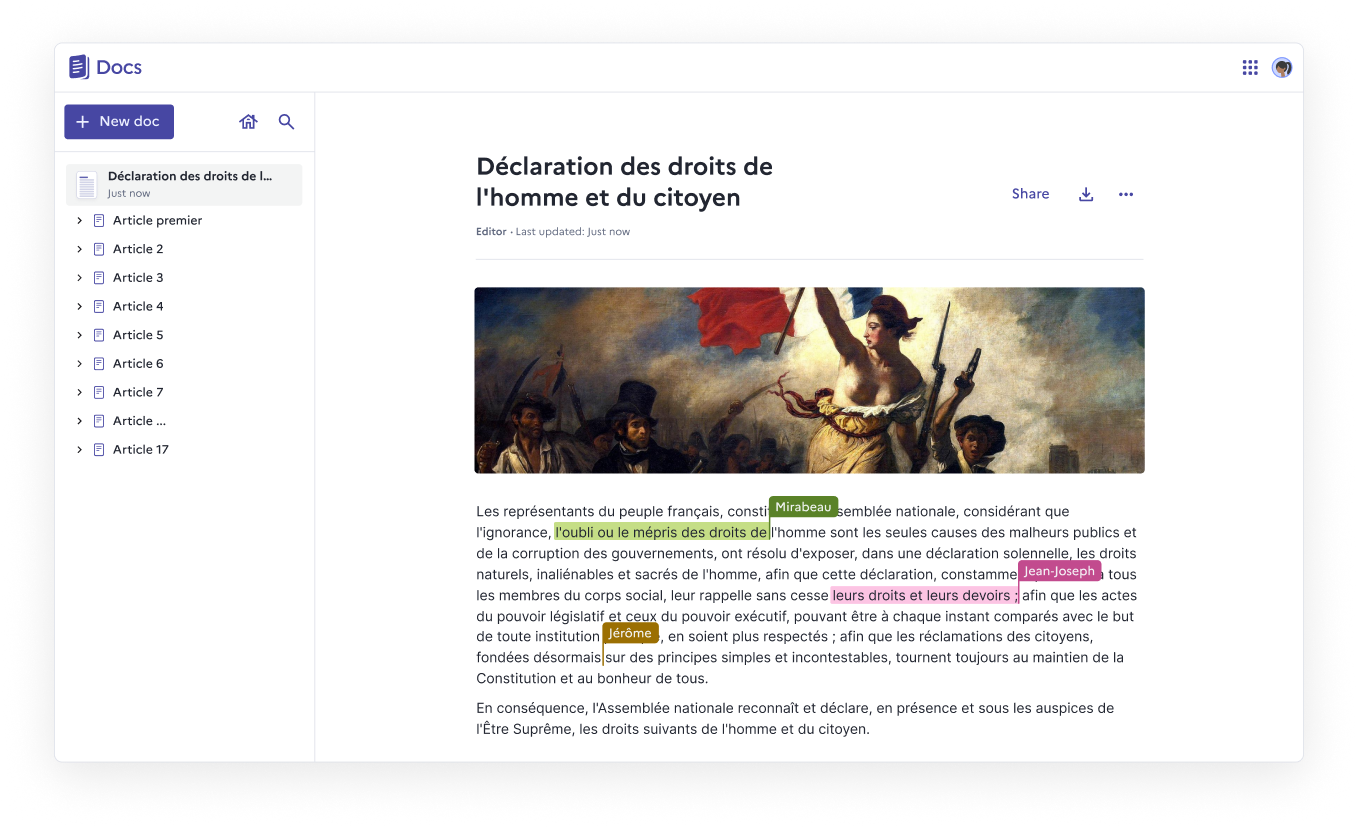
Docs — Turn your team's content into knowledge
Docs is the open-source document editor that turns your team's content into knowledge: real-time collaboration, structured knowledge, and full data ownership. Self-host it anywhere, or try a public instance in seconds.
Staying on the right side: Best practices in editing
Join for three days of talks, discussions and workshops around the free and open map of the world.
Collaborative Editor Demo App
Single-Source Publishing Community
Join the Single-Source Publishing Community for open, interoperable, and sustainable scholarly publishing workflows.
Peritext: A CRDT for Rich-Text Collaboration
Collaboration on rich text is hard to model with plain-text approaches. We review the challenges and how to construct a CRDT for rich text.

Authorea: multi-disciplinary research preprints
Authorea is the leading collaborative platform to read, write, and publish research.
v2 Editor Manifesto
The manifesto for our brand new rich text editor with version control capabilities, v2. In this post, we describe the basic principles, design decisions and our vision for v2, alongside reflecting on the current state and potential future of knowledge production in society.

From Albums to Streams: How Modularity Changes Systems
Scientific publishing is breaking under document-centric formats designed for a physical world. Borrowing from music’s shift from albums to streaming, we make the case that open access alone cannot deliver reuse, trust, or scale. The future of science depends on modular, interoperable research components that move across tools, enabling new workflows, tools, and ecosystems.
Universal Version Control
Building tools to help people explore alternatives, keep track of history, and collaborate better, across all kinds of media.

Leaflet Together: cursors, comments, group publications! - Leaflet Lab Notes
Lab Notes 028: a new suite of features to make Leaflet great for collaborative writing and collaborative publishing!
Metagov x Future of Science Seminar - Discourse Graphs with Matt Akamatsu
Steps Towards an Infrastructure for Scholarly Synthesis
Sharing, reusing, and synthesizing knowledge is central to the research process, both individually, and with others. These core functions are not supported by our formal scholarly publishing infrastructure: instead of the smooth functioning of functional infrastructure, researchers resort to laborious "hacks" and workarounds to "mine" publications for what they need, and struggle to efficiently share the resulting information with others. Information scientists have proposed an alternative infrastructure based on the more appropriately granular model of a discourse graph of claims, and evidence, along with key rhetorical relationships between them. However, despite significant technical progress on standards and platforms, the predominant infrastructure remains steadfastly document-based. Drawing from infrastructure studies, we locate the current infrastructural bottlenecks in the lack of local systems that integrate discourse-centric models to augment synthesis work, from which an infrastructure for synthesis can be grown. Through 3 years of research through design and field deployment in a distributed community of hypertext notebook users, we elaborate a design vision of what can and should be built in order to grow a discourse-centric synthesis infrastructure: a thriving "installed base" of researchers authoring local, shareable discourse graphs to improve synthesis work, enhance primary research and research training, and augment collaborative research. We discuss how this design vision -- and our empirical work -- contributes steps towards a new infrastructure for synthesis, and increases HCI's capacity to advance collective intelligence and solve infrastructure-level problems.
