

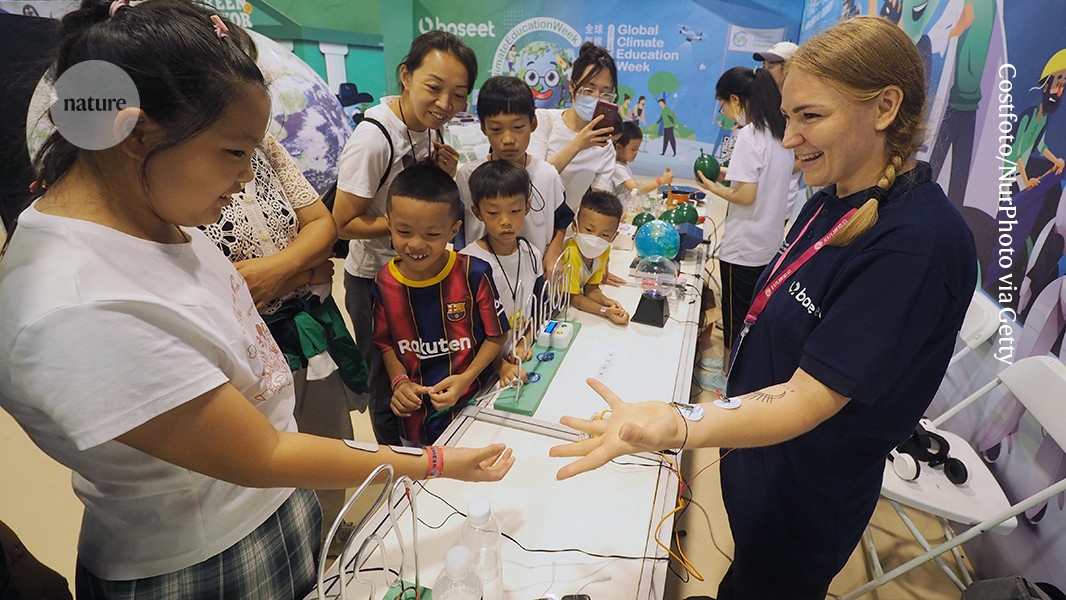
Measuring trust isn’t enough. Furthering knowledge about the institutions and norms of science is the best way to build credibility.
Have people stopped trusting science? The data tell a surprising story
Some say there’s a global crisis of trust — but research reveals where the real problems lie.
Can we measure trust in scientific publications? - LSE Impact
Jonathon Alexis Coates outlines how a constellation of static and dynamic indicators could provide a means for assessing the trustworthiness of published research

Sciences perceived as precise and consensual are more trusted
Research focused on the United States shows that people’s trust in science varies considerably between disciplines. Existing explanations of these trust gaps stress the role of ideology: when people perceive scientists of a particular discipline to be ideologically like-minded, they tend to trust them more. Here, we report two findings: first, trust gaps between disciplines also exist in France—a representative sample of the French population (N = 1012) trusted researchers in biology and physics more than researchers studying climate science, economics, or sociology. Second, the more precise and consensual participants perceive scientific findings to be, the more they tend to trust the scientists (across and within disciplines). While these findings are correlational, they align with a non-ideological explanation of trust in science: the rational impression account. This account proposes that people can come to trust scientists by relying on basic cognitive inference processes, which tend to be generally rational.

A Data Utopia for Science-of-Science
Here I want to briefly sketch out a vision for how to solve a key set of problems facing science-of-science researchers, using the relatively new idea of a ‘data trust.’ In my ideal wor…

The Problem With Promoting ‘Gold Standard Science’
Opinion | Branding scientific research with a simplified label risks misleading the public and harming scientific literacy.
Guest Post — Restoring Trust in Science: What Would Make a Difference? - The Scholarly Kitchen
Today's guest post asserts that trust won’t be restored by "better messaging" alone, but via better incentives, more disciplined public communication, and really listening to the people who have walked away from us.
Why Should I Trust You?
News Commentary Podcast · Updated Weekly · Bold, unfiltered, and uncompromisingly honest, Why Should I Trust You? is a weekly podcast that looks at the breakdown in trust for science and public health. It drops every Thursday, with occasional…

Why Science Can't Settle Political Disputes
Attempts to scientifically “rationalize” policy, based on the belief that science is purified of politics, may be damaging democracy
Science Must Decentralize
Knowledge production doesn’t happen in a vacuum. Every great scientific breakthrough is built on prior work, and an ongoing exchange with peers in the field. That’s why we need to address the threat
An epistemology for democratic citizen science
Abstract. More than ever, humanity relies on robust scientific knowledge of the world and our place within it. Unfortunately, our contemporary view of scie
Breaking the silence
Research on science communication has largely focused on teaching scientists how to describe their studies in ways that interest the public while deepening their understanding of scientific exploration. However, there is another, often overlooked side to science communication—how scientists respond when questions arise about the integrity of their research. Often, the tendency has been to stay silent and wait for any controversy to pass or be resolved in professional forums. But in an age of growing, intense attacks on science, silence can be detrimental to both public trust and the careers of scientists who are under scrutiny. For better or worse, journalists, social media professionals, and the public may take a response of “no comment” as a concession that the critics are correct, so forthright communication about research questions is more urgent than ever.

Who Can You Trust?
Reprint: R1403K Success in business unquestionably requires some willingness to cooperate through having faith in others. The question is how much faith and in whom? Decades of scientific research show that people’s accuracy in deciding if another can be trusted tends to be only slightly better than chance. But this isn’t because trustworthiness is completely unpredictable. It’s because the guidelines most of us use to make these predictions are flawed. We place too much emphasis on reputation and perceived confidence, ignoring the fact that human behavior is always sensitive to context and can often be better assessed by our own intuition. So when your company’s money and resources are on the line, how can you do a better job of gauging trustworthiness and thereby improve your likelihood of success? This article draws on emerging research to show how trustworthiness works and offers four points to keep in mind the next time you’re deciding whether or not to do business with a new partner: Integrity can vary, power does corrupt, confidence often masks incompetence, and it’s OK to trust your gut.
Why do people trust physicists and biologists more than economists or sociologists? In a new paper out in Public Understanding of Science, @hugoreasoning.bsky.social and I argue that it has to do with perceived precision and consensus. doi.org/10.1177/09636625261471051

Sciences perceived as precise and consensual are more trusted - Jan Pfänder, Hugo Mercier, 2026
doi.orgNew study finds that when people help collect data or contribute to research it can build public trust by making scientists feel personally familiar and approachable, and that trust then spreads to how local and tangible the research feels. jcom.sissa.it/article/pubid/JCOM_2506_2026_…

How can citizen science reduce psychological distance to science? Insights from three projects in contested environmental contexts
jcom.sissa.itI am disappointed by the fact that so many seem tempted to share a "nonrigorous", unserious attempt at quantifying fraud in science because it passes some silly vibe check ("I asked others and they agree"). So in the name of good science, we're ready to produce bad science as a rhetorical tool.


