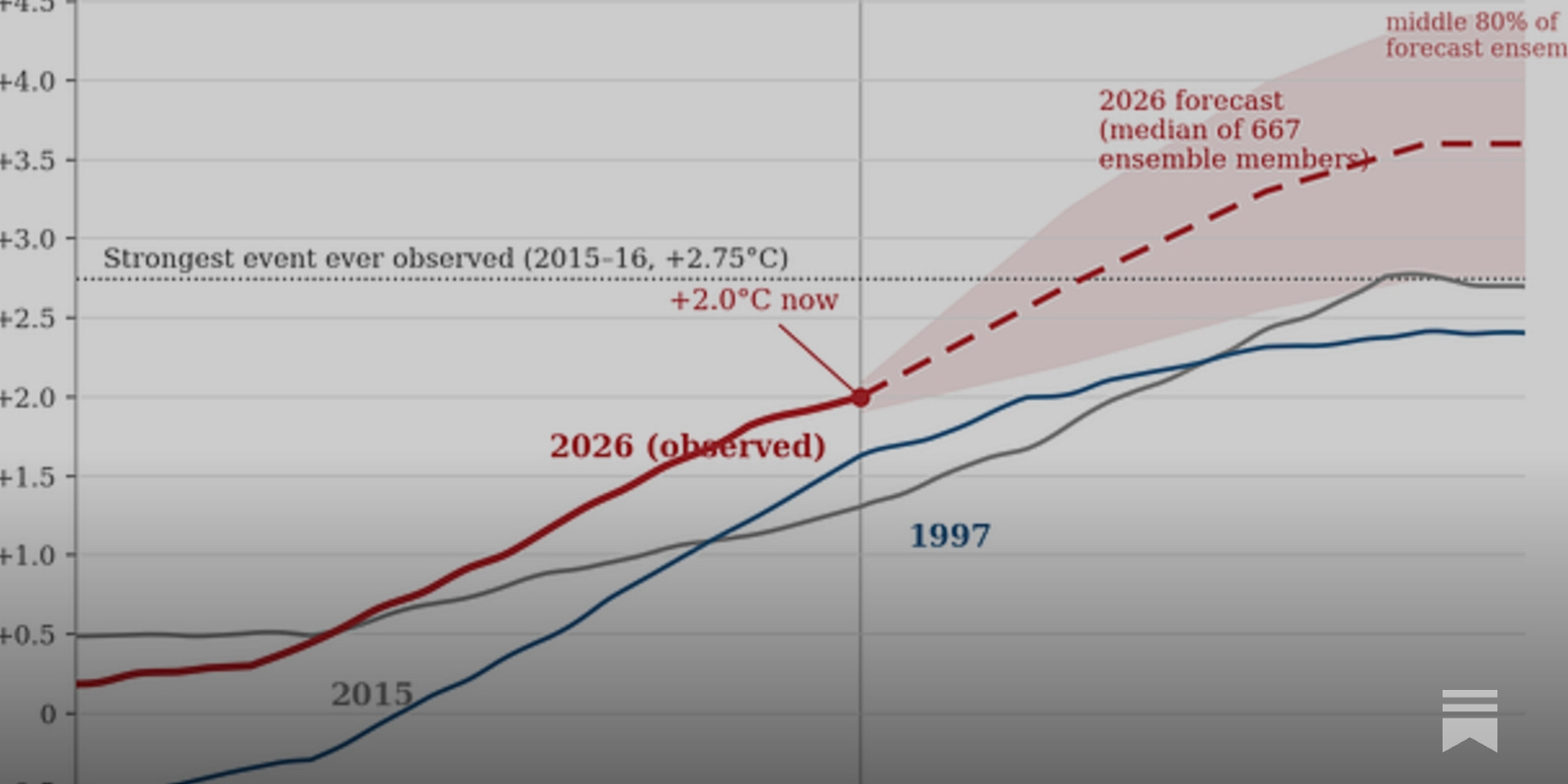
Forecasters predict that the monster climate pattern will combine with global warming to push global temperatures in 2027 to new heights.
The Strongest El Niño Ever
With all the July runs in, dynamical models give a ~90% chance of a record-setting event
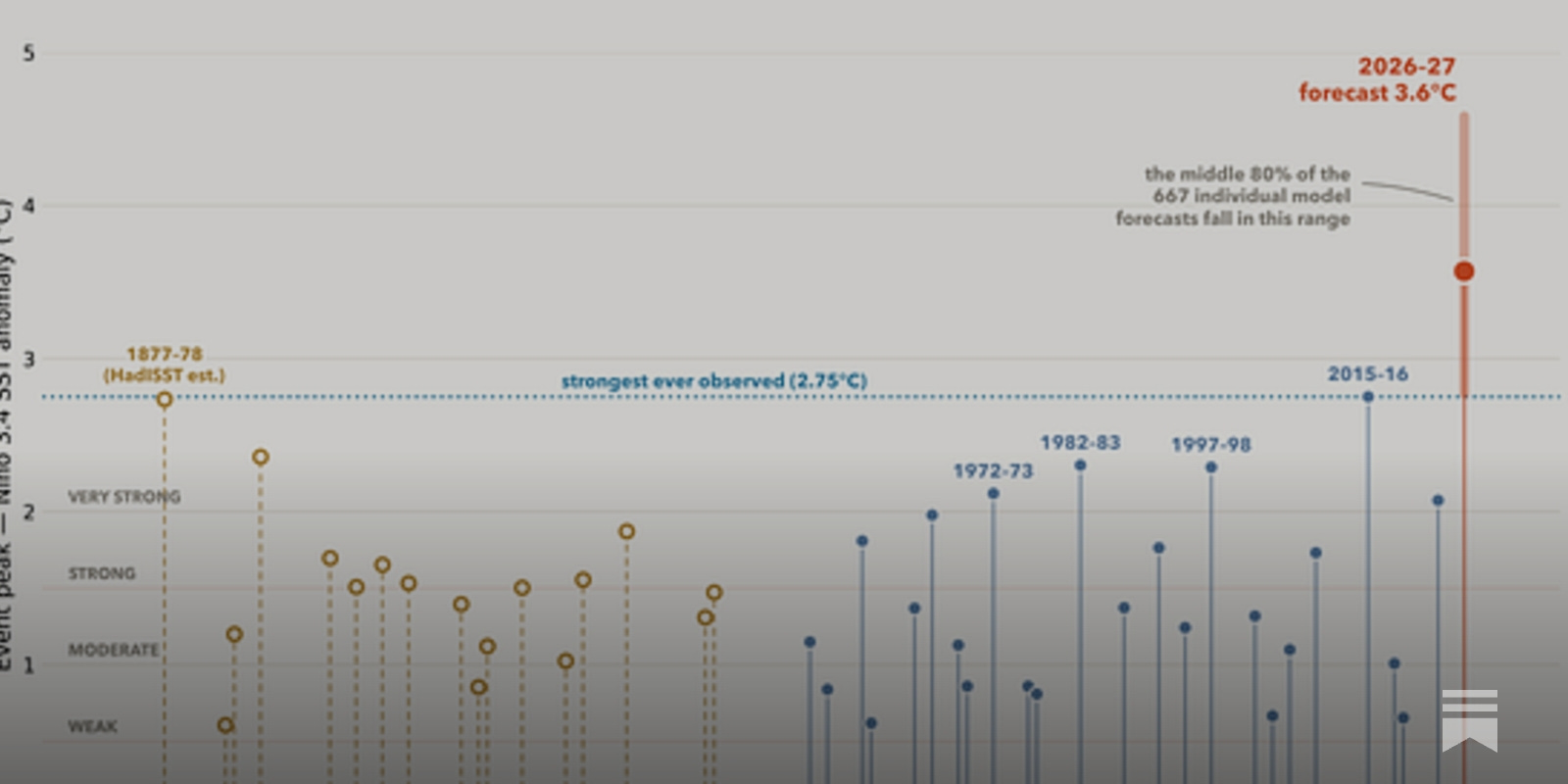
The Latest Data on El Niño Is a Looming Nightmare
The planet hasn't seen a historic El Niño since the 1870s. With one on the horizon, experts are already bracing for impact.
Scorched Harvest: The Strongest El Niño Ever Forecast, the Crops in Its Path, and the Hunger It Will Leave Behind
How 3.6 degrees of warm water in the tropical Pacific is about to redraw the map of global hunger and why, this time, no one in power can claim they were not warned.
Global Warming Is Rapidly Accelerating, New Paper Finds
A new study found the first statistically significant evidence that global warming is ramping up at a horrifying rate.

The Gargantuan Lie That is Collapsing The World’s Climate
Thinking we have time left to address climate change, or that “Net Zero by 2050” will save us, is driving us toward full social collapse in ways that become more obvious with every new broken temperature record.

RETRACTED ARTICLE: The economic commitment of climate change
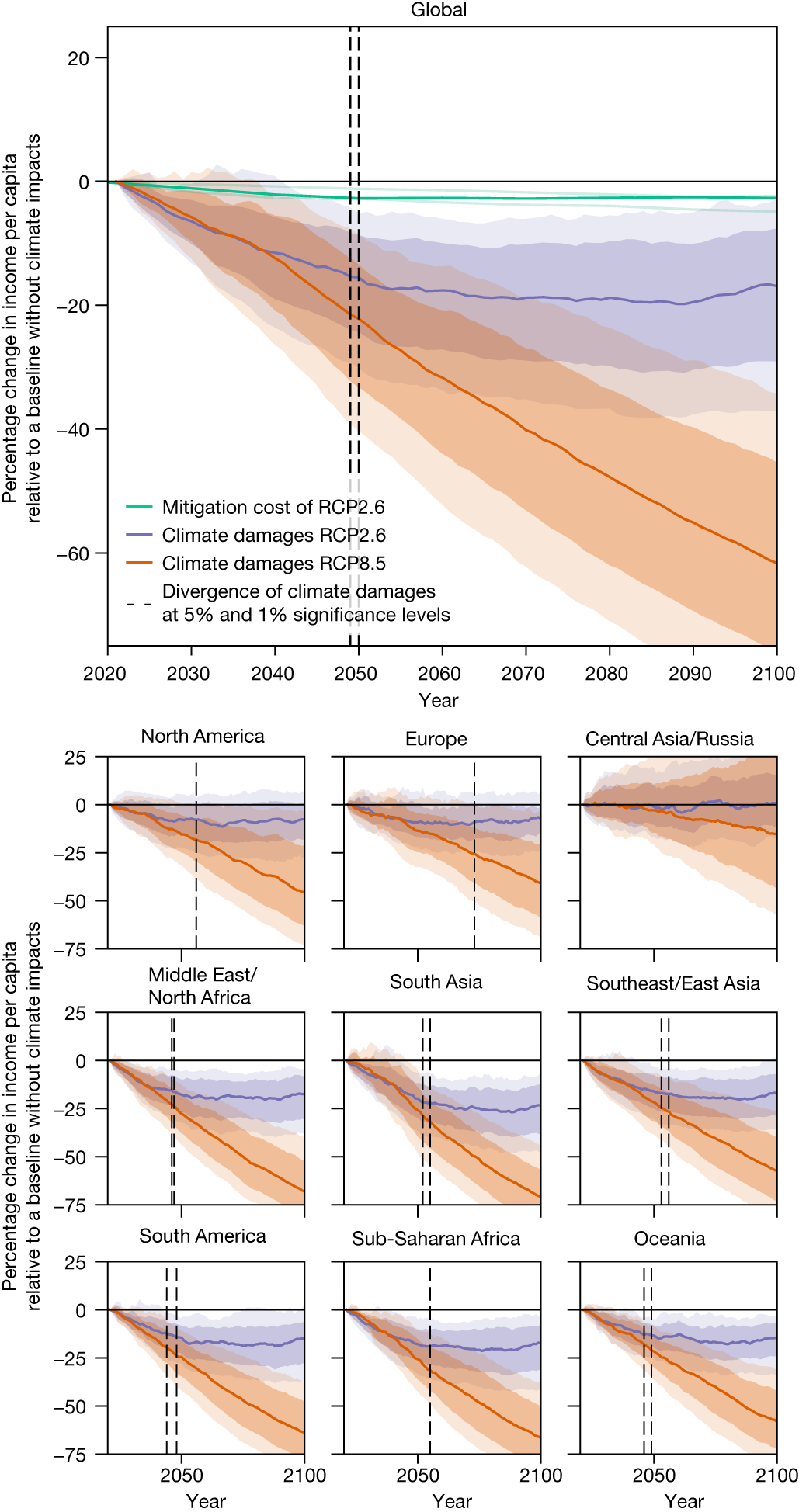
Global projections of macroeconomic climate-change damages typically consider impacts from average annual and national temperatures over long time horizons1–6. Here we use recent empirical findings from more than 1,600 regions worldwide over the past 40 years to project sub-national damages from temperature and precipitation, including daily variability and extremes7,8. Using an empirical approach that provides a robust lower bound on the persistence of impacts on economic growth, we find that the world economy is committed to an income reduction of 19% within the next 26 years independent of future emission choices (relative to a baseline without climate impacts, likely range of 11–29% accounting for physical climate and empirical uncertainty). These damages already outweigh the mitigation costs required to limit global warming to 2 °C by sixfold over this near-term time frame and thereafter diverge strongly dependent on emission choices. Committed damages arise predominantly through changes in average temperature, but accounting for further climatic components raises estimates by approximately 50% and leads to stronger regional heterogeneity. Committed losses are projected for all regions except those at very high latitudes, at which reductions in temperature variability bring benefits. The largest losses are committed at lower latitudes in regions with lower cumulative historical emissions and lower present-day income.

'Hotter and hotter and hotter' - Europe's new climate in seven charts
Temperature records were smashed in June - and scientists warn this is a sign of things to come.

The Arctic Is in Dire Straits, 20 Years of Reporting Show
The Arctic has changed dramatically in the past 20 years, a new report shows, as temperatures skyrocket and ice rapidly melts
El Niño : le prochain pic du phénomène climatique devrait « se classer parmi les plus importants », selon les prévisionnistes américains
L’Agence d’observation océanique et atmosphérique américaine estime à 81 % les risques que l’actuel épisode d’El Niño soit « très fort ».

Research Paper Warns That There’s a Massive Experiment at Work to Geoengineer the Earth’s Climate
While scientists debate the risks of tampering with our climate, scientists say there's already a huge geoengineering experiment unfolding.
Public LLM exceeds superforecaster on Forecast bench by EOY 2026?
41% chance. Resolves to YES if any LLM released in 2026 exceeds the superforecaster baseline on ForecastBench by July 2027. Resolves to NO if this does not happen, or if after January 1, 2027 we have results from enough LLMs (e.g. the leading models from the major AI labs at the time) to be confident this will not occur. If The Forecasting Research Institute tells us how this market should resolve, then we will go with what they say.

World’s seas have hit hottest temperature on record for July, say scientists
Average sea surface temperature outside polar regions was highest on record for July, beating previous high in 2023

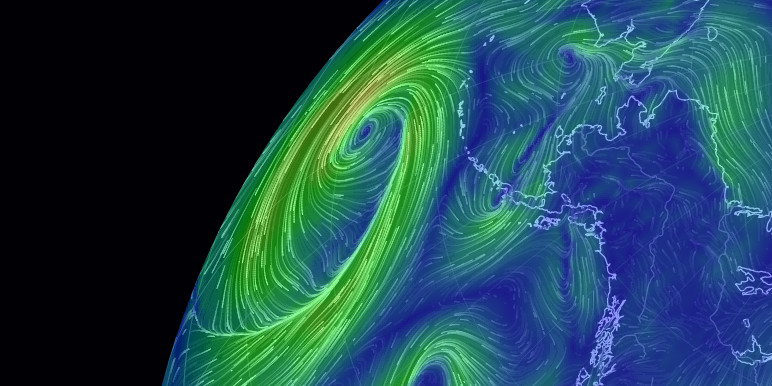
earth :: a global map of wind, weather, and ocean conditions
See current wind, weather, ocean, and pollution conditions, as forecast by supercomputers, on an interactive animated map. Updated every three hours.