

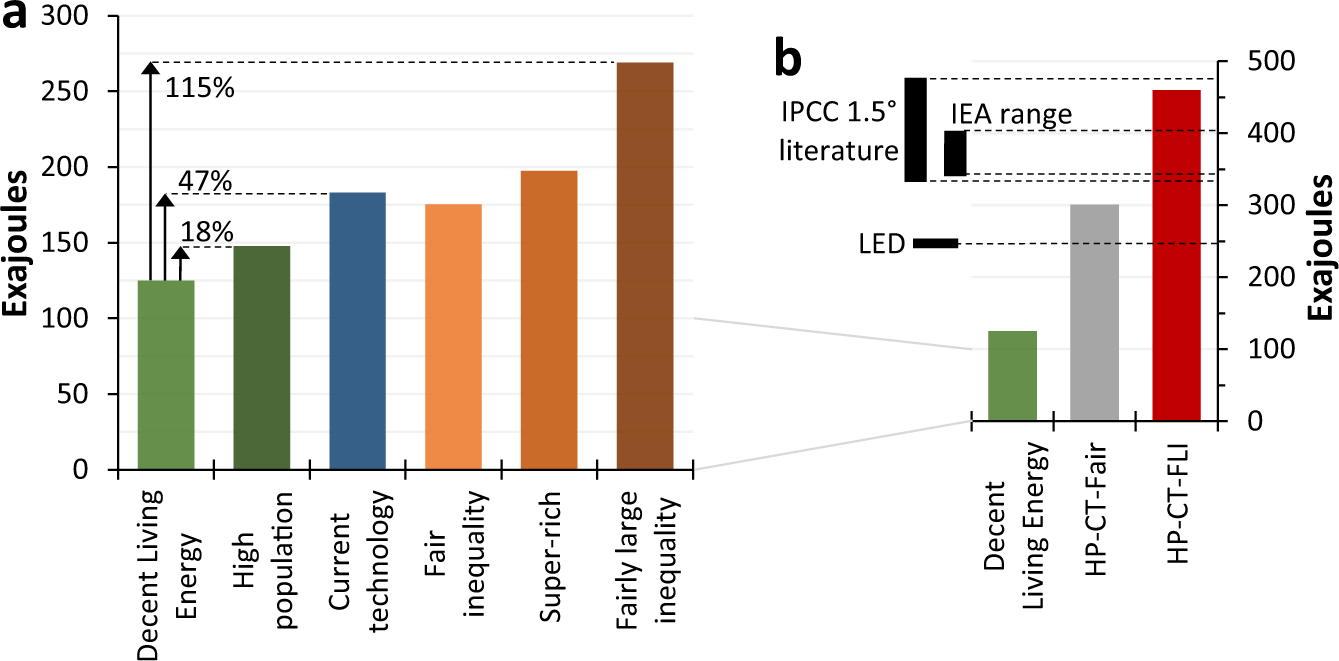
Ecological breakdown and economic inequality are among the largest contemporary global challenges, and the issues are thoroughly entangled – as they have been throughout the history of civilisations. Yet, the global economy continues toward ecological crises, and inequalities remain far higher than citizens believe to be fair. Here, we explore the role of inequality, alongside traditional drivers of ecological impacts, in determining global energy requirements for providing universal decent living. We consider scenarios from fair inequality – where inequalities mirror public ideals – through a fairly unequal world, to one with a super-rich global elite. The energy-costs of inequality appear far more significant than population: even fair levels increase the energy required to provide universal decent living by 40%, and a super-rich global 1% could consume as much energy as would providing decent living to 1.7 billion. We finish by arguing that total population remains important nonetheless, but for reasons beyond ecological impacts.
Doughnut of social and planetary boundaries monitors a world out of balance
The doughnut-shaped framework of social and planetary boundaries (the ‘Doughnut’) provides a concise visual assessment of progress towards the goal of meeting the needs of all people within the means of the living planet1–3. Here we present a renewed Doughnut framework with a revised set of 35 indicators that monitor trends in social deprivation and ecological overshoot over the 2000–2022 period. Although global gross domestic product (GDP) has more than doubled, our median results show a modest achievement in reducing human deprivation that would have to accelerate fivefold to meet the needs of all people by 2030. Meanwhile, the increase in ecological overshoot would have to stop immediately and accelerate nearly two times faster towards planetary boundaries to safeguard Earth-system stability by 2050. Disaggregating these global findings shows that the richest 20% of nations, with 15% of the global population, contribute more than 40% of annual ecological overshoot, whereas the poorest 40% of countries, with 42% of the global population, experience more than 60% of the social shortfall. These trends and inequalities reaffirm the case for overcoming the dependence of nations on perpetual GDP growth4,5 and reorienting towards regenerative and distributive economic activity—within and between nations—that assigns priority to human needs and planetary integrity.

The Divide — Jason Hickel
The Divide: A Brief Guide to Global Inequality and its Solutions Penguin Random House UK, 2017

Post-growth: the science of wellbeing within planetary boundaries
There are increasing concerns that continued economic growth in high-income countries might not be environmentally sustainable, socially beneficial, or economically achievable. In this Review, we explore the rapidly advancing field of post-growth research, which has evolved in response to these concerns. The central idea of post-growth is to replace the goal of increasing GDP with the goal of improving human wellbeing within planetary boundaries. Key advances discussed in this Review include: the development of ecological macroeconomic models that test policies for managing without growth; understanding and reducing the growth dependencies that tie social welfare to increasing GDP in the current economy; and characterising the policies and provisioning systems that would allow resource use to be reduced while improving human wellbeing.

Imperialist appropriation in the world economy: Drain from the global South through unequal exchange, 1990–2015
Unequal exchange theory posits that economic growth in the “advanced economies” of the global North relies on a large net appropriation of resources and labour from the global South, extracted through price differentials in international trade. Past attempts to estimate the scale and value of this drain have faced a number of conceptual and empirical limitations, and have been unable to capture the upstream resources and labour embodied in traded goods. Here we use environmental input-output data and footprint analysis to quantify the physical scale of net appropriation from the South in terms of embodied resources and labour over the period 1990 to 2015. We then represent the value of appropriated resources in terms of prevailing market prices. Our results show that in 2015 the North net appropriated from the South 12 billion tons of embodied raw material equivalents, 822 million hectares of embodied land, 21 exajoules of embodied energy, and 188 million person-years of embodied labour, worth $10.8 trillion in Northern prices – enough to end extreme poverty 70 times over. Over the whole period, drain from the South totalled $242 trillion (constant 2010 USD). This drain represents a significant windfall for the global North, equivalent to a quarter of Northern GDP. For comparison, we also report drain in global average prices. Using this method, we find that the South’s losses due to unequal exchange outstrip their total aid receipts over the period by a factor of 30. Our analysis confirms that unequal exchange is a significant driver of global inequality, uneven development, and ecological breakdown.
Population panic lets rich people off the hook for the climate crisis they are causing | George Monbiot
Rising consumption by the affluent has a far greater environmental impact than the birth rate in poorer nations, says Guardian columnist George Monbiot
Daniel Christian Wahl: “Bioregional Futures: Reconnecting to Place for Planetary Health” - The Great Simplification
In the past century of abundant energy surplus, humanity’s globalized, large-scale approach to problem-solving

Is Inequality Inevitable?
Wealth naturally trickles up in free-market economies, model suggests

Maximum power in evolution, ecology and economics
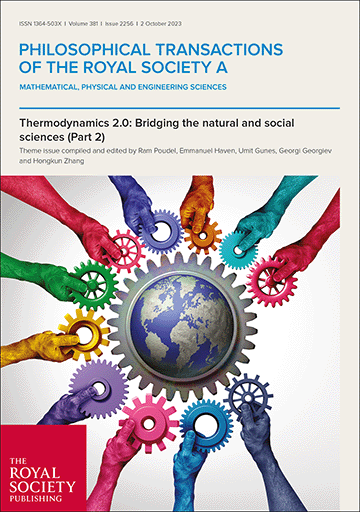
Ludwig Boltzmann suggested that natural selection was fundamentally a struggle among organisms for available energy. Alfred Lotka argued that organisms that capture and use more energy than their competition will have a selective advantage in the evolutionary process, i.e. the Darwinian notion of evolution was based on a fundamental, generalized energy principle. He extended this general principle from the energetics of a single organism or species to the energetics of entire energy pathways through ecosystems. Howard Odum and Richard Pinkerton, building on Lotka, extended this concept to ‘The maximum power principle’ and applied it to many biological and physical systems including human economies. We examine this history and how these ideas relate to concepts from other disciplines including philosophy. But there has been considerable confusion in understanding and applying these concepts which we attempt to resolve while providing various examples from routine life and discussing some unresolved issues. This article is part of the theme issue ‘Thermodynamics 2.0: Bridging the natural and social sciences (Part 2)’.
Ecocivilization: making a world that works for all
""One of the greatest thinkers of our age" (The Guardian) presents a new way of living-one modeled on nature's design instead of capitalism's-for fans of Guns, Germs, and Steel and Doughnut Economics It has often been said that it is easier to imagine the end of the world than it is to imagine the end of capitalism-and yet that is what the historical moment urgently calls for. Climate change has reached an emergency state, inequality continues to grow, and, for many, the future has never seemed more bleak. Incremental policy improvements are no longer enough-we need a deep transformation of our current civilization to continue to survive. In Ecocivilization, leading thinker Jeremy Lent reimagines the basis of our civilization, and argues for a new global system of living, one based on life-affirming principles modeled after nature's own design. What enfolds is a robust framework incorporating Lent's own expertise, and the lived experiences of those on the ground already putting ecological civilization's core tenants into practice-justice, mutuality, diversity, and symbiosis. From the global economy to universal housing and income, from infrastructure to agriculture, every major aspect of our society could be redesigned to work together as a coherent whole, setting the conditions for all people to flourish. Ecocivilization shows how this future on a regenerated Earth is not only desirable, but entirely feasible"--

The Profit Paradox
Reflect nature’s ‘true value’ in economic policies and decisions, UN chief urges
Nations must start weighing up the cost of economic profit against damage to the environment if they are to have a chance at a sustainable future, UN Secretary-General António Guterres said on Tuesday.
Global Inequality — Harvard University Press
Winner of the Bruno Kreisky Prize, Karl Renner InstitutA Financial Times Best Economics Book of the Year An Economist Best Book of the Year A Livemint Best Book of the YearOne of the world’s leading economists of inequality, Branko Milanovic presents a bold new account of the dynamics that drive inequality on a global scale. Drawing on vast data sets and cutting-edge research, he explains the benign and malign forces that make inequality rise and fall within and among nations. He also reveals who has been helped the most by globalization, who has been held back, and what policies might tilt the balance toward economic justice.“The data [Milanovic] provides offer a clearer picture of great economic puzzles, and his bold theorizing chips away at tired economic orthodoxies.”—The Economist“Milanovic has written an outstanding book…Informative, wide-ranging, scholarly, imaginative and commendably brief. As you would expect from one of the world’s leading experts on this topic, Milanovic has added significantly to important recent works by Thomas Piketty, Anthony Atkinson and François Bourguignon…Ever-rising inequality looks a highly unlikely combination with any genuine democracy. It is to the credit of Milanovic’s book that it brings out these dangers so clearly, along with the important global successes of the past few decades.—Martin Wolf, Financial Times
The Political Psychology of Economic Inequality
The high level of inequality of income and wealth across individuals, groups, and nations is widely regarded as among the most fundamental problems facing humanity. Yet democracies often elect and reelect politicians who deliver policies that exacerbate rather than reduce inequality. We argue that this disconnect arises from three basic features of human social cognition that evolved for interpersonal interactions in small groups rather than for navigating the vast political, economic, and technological systems that shape contemporary life: a focus on local notions of equality and equity between socially connected individuals rather than across society at large; group identification, which directs attention to inequality between groups rather than “pure” inequality across the broader population; and what we call the “i-frame bias”—a tendency to explain social outcomes, including inequality, as the product of individual behaviors, taking the system within which those individuals operate as a given. We extend our analysis to examine how economic elites exploit these features of social cognition to shape the political and policy landscape and examine the role psychology can play in reducing inequality.

IDS Annual Lecture 2026 with Jason Hickel
IDS Annual Lecture 2026 with Jason Hickel
Unequal exchange of labour in the world economy
Researchers have argued that wealthy nations rely on a large net appropriation of labour and resources from the rest of the world through unequal exchange in international trade and global commodity chains. Here we assess this empirically by measuring flows of embodied labour in the world economy from 1995–2021, accounting for skill levels, sectors and wages. We find that, in 2021, the economies of the global North net-appropriated 826 billion hours of embodied labour from the global South, across all skill levels and sectors. The wage value of this net-appropriated labour was equivalent to €16.9 trillion in Northern prices, accounting for skill level. This appropriation roughly doubles the labour that is available for Northern consumption but drains the South of productive capacity that could be used instead for local human needs and development. Unequal exchange is understood to be driven in part by systematic wage inequalities. We find Southern wages are 87–95% lower than Northern wages for work of equal skill. While Southern workers contribute 90% of the labour that powers the world economy, they receive only 21% of global income.
