Inevitable missing values in observational time series often hinder reliable data-driven modeling of complex systems across diverse domains. Recovery is essential yet challenging, particularly in high-dimensional systems where most variables can exhibit extensive intra-series missingness and widespread inter-variable missingness simultaneously. In this study, we introduce a dynamics-informed imputation framework, termed Full-Partial Reconstruction Mapping (FPRM). In contrast to traditional approaches that directly fit time series interdependences, the FPRM embeds intrinsic dynamical priors via state-space reconstruction and recovers multiple incomplete series by learning diffeomorphic topology between attractors from complete and incomplete data. We validate the FPRM on paradigmatic model systems (e.g., an ecology system, the ordinary Lorenz system, a coupled 120-dimensional (120D) Lorenz system, and a coupled 120D Rössler system and real-world datasets (e.g., road occupancy rate from transportation system, electroencephalogram (EEG) signals from neuroscience, exchange rates from finance, and wind speed from climate systems). Even in high-dimensional systems where only one variable is fully observed and all others suffer from extreme missingness (e.g., 90%), the FPRM enables reliable imputation of multiple incomplete variables—a task that challenges most existing approaches. This dynamics-guided framework outperforms traditional approaches, alleviating substantial data gaps and enabling robust data-driven paradigms for complex dynamical systems.
Dynamical independence: Discovering emergent macroscopic processes in complex dynamical systems
We introduce a notion of emergence for macroscopic variables associated with highly multivariate microscopic dynamical processes. Dynamical independence instantiates the intuition of an emergent macroscopic process as one possessing the characteristics of a dynamical system ``in its own right,'' with its own dynamical laws distinct from those of the underlying microscopic dynamics. We quantify (departure from) dynamical independence by a transformation-invariant Shannon information-based measure of dynamical dependence. We emphasize the data-driven discovery of dynamically independent macroscopic variables, and introduce the idea of a multiscale ``emergence portrait'' for complex systems. We show how dynamical dependence may be computed explicitly for linear systems in both time and frequency domains, facilitating discovery of emergent phenomena across spatiotemporal scales, and outline application of the linear operationalization to inference of emergence portraits for neural systems from neurophysiological time-series data. We discuss dynamical independence for discrete- and continuous-time deterministic dynamics, with potential application to Hamiltonian mechanics and classical complex systems such as flocking and cellular automata.
Self-Consuming Generative Models Go MAD
Seismic advances in generative AI algorithms for imagery, text, and other data types has led to the temptation to use synthetic data to train next-generation models. Repeating this process creates an autophagous (self-consuming) loop whose properties are poorly understood. We conduct a thorough analytical and empirical analysis using state-of-the-art generative image models of three families of autophagous loops that differ in how fixed or fresh real training data is available through the generations of training and in whether the samples from previous generation models have been biased to trade off data quality versus diversity. Our primary conclusion across all scenarios is that without enough fresh real data in each generation of an autophagous loop, future generative models are doomed to have their quality (precision) or diversity (recall) progressively decrease. We term this condition Model Autophagy Disorder (MAD), making analogy to mad cow disease.

Selecting synthetic data for successful simulation-based transfer learning in dynamical biological systems
Accurate prediction of the temporal dynamics of biological systems is crucial for informing timely and effective interventions, e.g., in ecological or epidemiological contexts, or for treatment adjustments in therapy. While machine learning has proven its capabilities in generalizing the underlying non-linear dynamics of such systems, unlocking its predictive power is often restrained by the limited availability of large, curated datasets. To supplement real-world data, informing machine learning by transfer learning with synthetic data derived from simulations using ordinary differential equations has emerged as a promising solution. However, the success of this approach highly depends on the designed characteristics of the synthetic data.

Approaching an unknown communication system by latent space exploration and causal inference | Royal Society Open Science | The Royal Society
Abstract. We propose a methodology for discovering meaningful properties in data without ground truth by combining manipulation of the latent variables of
Model Collapse Ends AI Hype
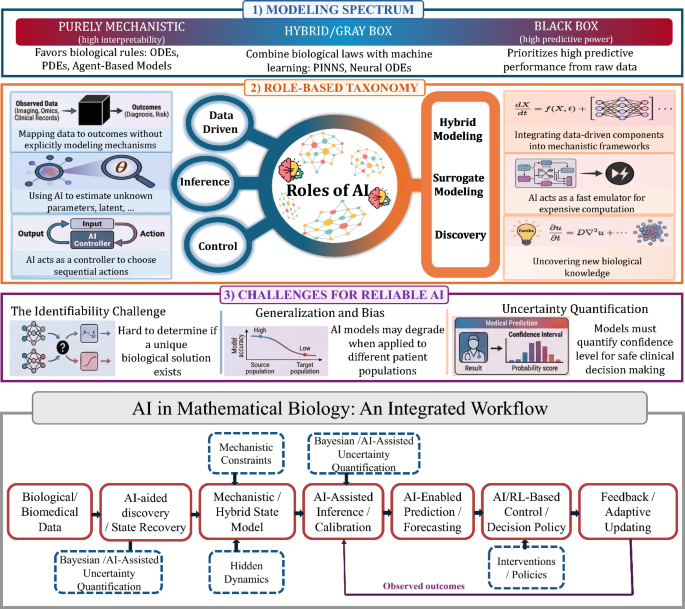
How AI Can Advance Mathematical Biology: Opportunities, Challenges, and Future Directions
Mathematical biology has long relied on mechanistic models, including ordinary and partial differential equations, stochastic systems, and agent-based models, to study biological processes across scales. These approaches remain central because they provide structure, interpretability, and biological insight. However, modern biological and biomedical data, including longitudinal clinical records, medical imaging, and multi-omics measurements, are often high-dimensional, noisy, heterogeneous, and incomplete. These features make model calibration, simulation, and uncertainty quantification increasingly difficult. As a result, artificial intelligence (AI) and machine learning (ML) are playing a growing role in mathematical biology, not as replacements for mechanistic modeling, but as complementary tools that can support prediction, hybrid modeling, inference, and control. In this review, we organize these uses of AI from a mathematical biology perspective and examine how data-driven and mechanistic approaches interact across different modeling tasks. The selected examples span biomedical, epidemiological, ecological, evolutionary, biochemical, and population-level systems, while the review is intended to be representative rather than exhaustive. We emphasize recurring challenges that strongly affect biological credibility and practical usefulness, including interpretability, identifiability, generalization, and uncertainty quantification. Our goal is to clarify the roles AI can play in mathematical biology and to highlight the opportunities and limitations that arise when flexible learning methods are integrated with biologically grounded modeling.
The GenAI Future of Consumer Research
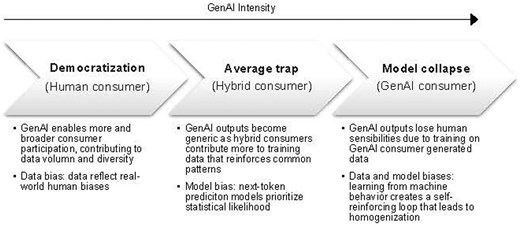
Abstract We develop a novel generative AI (GenAI) trajectory, “democratization-average trap-model collapse,” to identify data and model challenges posed by GenAI, from which we project the GenAI future of consumer research. This trajectory consists of three key phenomena: democratization broadens consumer participation, the average trap produces generic responses, and model collapse occurs when GenAI outputs lose human sensibilities. Data and model challenges arise as democratization enhances data representation while also embedding real-world biases. The average trap, caused by next-token prediction models, leads to generic outputs that lack individuality. Additionally, model collapse occurs when GenAI increasingly learns from its own outputs, amplifying machine bias and diverging from human behavior. To address these challenges, researchers can leverage democratization to study marginalized consumers and prioritize human-centered research over purely data-driven methods. The average trap can be mitigated by fine-tuning models with task-specific and marginalized consumption data while engineering responses for uniqueness. Preventing model collapse requires integrating human–machine hybrid data and applying theories of mind to realign AI with human-centric consumption. Finally, we outline three future research directions: preserving data distribution tails to support consumption democratization, countering the average trap in next-token prediction, and reversing the trajectory from democratization to model collapse.
Are biological systems poised at criticality?
Many of life's most fascinating phenomena emerge from interactions among many elements--many amino acids determine the structure of a single protein, many genes determine the fate of a cell, many neurons are involved in shaping our thoughts and memories. Physicists have long hoped that these collective behaviors could be described using the ideas and methods of statistical mechanics. In the past few years, new, larger scale experiments have made it possible to construct statistical mechanics models of biological systems directly from real data. We review the surprising successes of this "inverse" approach, using examples form families of proteins, networks of neurons, and flocks of birds. Remarkably, in all these cases the models that emerge from the data are poised at a very special point in their parameter space--a critical point. This suggests there may be some deeper theoretical principle behind the behavior of these diverse systems.
Non-equilibrium active noise enhances generative memory in diffusion models
Generative diffusion models have emerged as powerful tools for sampling high-dimensional distributions, yet they typically rely on white gaussian noise and noise schedules to destroy and reconstruct information. Here, we demonstrate that driving the generative process out of equilibrium using active, temporally correlated noise sources fundamentally alters the information thermodynamics of the system. We show that coupling the data to an active non-Markovian bath creates a `memory effect' where high-level semantic information (such as class identity or molecular metastability) is stored in the temporal correlations of auxiliary degrees of freedom. Using Fisher information analysis, we prove that this active mechanism significantly retards the rate of information decay compared to passive Brownian motion. Crucially, this memory effect facilitates an earlier and more robust symmetry breaking (speciation) during the reverse generative process, allowing the system to resolve multi-scale structures, reminiscent of metastable states in molecular configurations that are washed out in the typical noising processes. Our results suggest that non-equilibrium protocols, inspired by active matter physics, offer a thermodynamically distinct and potentially advantageous pathway for recovering high-dimensional energy landscapes using generative diffusion.
Manifold hypothesis
The manifold hypothesis posits that many high-dimensional data sets that occur in the real world actually lie along low-dimensional latent manifolds inside that high-dimensional space.[1][2][3][4] As a consequence of the manifold hypothesis, many data sets that appear to initially require many variables to describe, can actually be described by a comparatively small number of variables, linked to the local coordinate system of the underlying manifold. It is suggested that this principle underpins the effectiveness of machine learning algorithms in describing high-dimensional data sets by considering a few common features.
An Empirical Study of Example Forgetting during Deep Neural Network Learning
Inspired by the phenomenon of catastrophic forgetting, we investigate the learning dynamics of neural networks as they train on single classification tasks. Our goal is to understand whether a related phenomenon occurs when data does not undergo a clear distributional shift. We define a “forgetting event” to have occurred when an individual training example transitions […]
Benchmarking gene expression reconstruction from single-cell latent representations
Single-cell transcriptomics is typically modeled in low-dimensional latent representations that improve the signal-to-noise ratio of the data. Such representations underpin data integration, cell state discovery, and perturbation prediction, with applications ranging from large-scale organ atlases to latent trajectory modeling. Recent virtual cell approaches further leverage these representations to predict cellular responses as distributional shifts in latent space. Each of these applications ultimately requires faithful gene expression reconstruction from latent spaces for biological interpretation, enabling gene-level analysis of predicted perturbed or batch-corrected cells. Yet representation choice is typically treated as an implementation detail rather than a primary modeling decision, with no systematic evaluation of how well latent representations support gene expression reconstruction. Here, we introduce ReconEval, a benchmark for evaluating gene expression reconstruction from single-cell latent spaces. We benchmark two classes of latent representations: end-to-end trained models such as PCA, autoencoders, and variational autoencoders, and pretrained single-cell foundation model embeddings coupled to newly trained decoders. Reconstruction is evaluated both directly and after latent-space perturbation prediction. Across perturbational and observational datasets totaling over 100 million cells, our metric suite quantifies statistical fidelity; biological signal preservation, including differential expression, coexpression, cell-cycle structure, cytokine response and pathway activity; and perturbation-specific effects. We find that autoencoders achieve the strongest stand-alone reconstruction at low dimensionality, while variational regularization does not improve generalization in reconstruction. Frozen foundation model embeddings retain recoverable gene-level information, with reconstruction quality depending strongly on decoder architecture and pretraining objective. In latent perturbation modeling, high-dimensional PCA matches foundation model embeddings, while low-dimensional AE embeddings are optimal for flow-based generative models. Overall, reconstruction depends critically on the interplay between representation and downstream model, and simpler representations can outperform complex alternatives given appropriate capacity. Our benchmark establishes reconstruction as a critical evaluation axis for single-cell foundation models. We envision it improving the biological interpretability of latent-space modeling, a prerequisite for future virtual cell models to be validated by domain experts and grounded in biology. ### Competing Interest Statement F.J.T. consults for Immunai, CytoReason, Valinor Industries, Bioturing and Phylo Inc., and has ownership interest in RN.AI Therapeutics, Dermagnostix, and Cellarity. The remaining authors declare no competing interests.

Grounded world models in biological organisms and future embodied AI
Recent advances in generative and embodied AI have been driven by large-scale predictive learning over multimodal data. However, the resulting systems remain largely based on passive training regimes where linguistic regularities create the scaffold onto which information from other modalities is attached. Conversely, neuroscience and cognitive science suggest that biological intelligence is organized in the opposite way, where grounded world models acquired through interaction with the environment provide the semantic scaffold to which language is attached. Here, we illustrate five examples of neural circuits supporting grounded world modelling, which underlie navigation in physical and conceptual spaces, affordance-based perception and interaction with objects, active perception and exploratory learning, allostatic control and emotion, and the distinction between self- and world-generated outcomes. These examples highlight several features largely missing from current embodied AI, including the role of intrinsic dynamics as a foundation for learning, the centrality of action in aligning these dynamics with the external world, the prominence of autonomous experience and open-ended learning over passive assimilation of externally provided data, and the fact that early predictive and control mechanisms scaffold higher cognitive abilities such as reasoning, conceptual navigation, planning, imagination, understanding others' minds, and communication. Finally, we discuss whether and how principles derived from biological systems may inform future embodied AI, including training regimes based on social interaction to construct world models that are not only grounded but also socially shared and aligned with human norms and values.
Towards Principled Representation Learning from Videos for Reinforcement Learning
We study pre-training representations for decision-making using video data, which is abundantly available for tasks such as game agents and software testing. Even though significant empirical advances have been made on this problem, a theoretical understanding remains absent. We initiate the theoretical investigation into principled approaches for representation learning and focus on learning the latent state representations of the underlying MDP using video data. We study two types of settings: one where there is iid noise in the observation, and a more challenging setting where there is also the presence of exogenous noise, which is non-iid noise that is temporally correlated, such as the motion of people or cars in the background. We study three commonly used approaches: autoencoding, temporal contrastive learning, and forward modeling. We prove upper bounds for temporal contrastive learning and forward modeling in the presence of only iid noise. We show that these approaches can learn the latent state and use it to do efficient downstream RL with polynomial sample complexity. When exogenous noise is also present, we establish a lower bound result showing that the sample complexity of learning from video data can be exponentially worse than learning from action-labeled trajectory data. This partially explains why reinforcement learning with video pre-training is hard. We evaluate these representational learning methods in two visual domains, yielding results that are consistent with our theoretical findings.
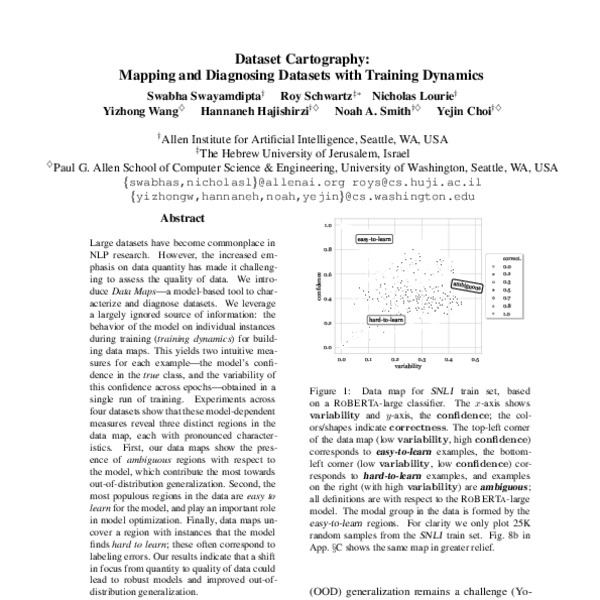
Dataset Cartography: Mapping and Diagnosing Datasets with Training Dynamics
Large datasets have become commonplace in NLP research. However, the increased emphasis on data quantity has made it challenging to assess the quality of data. We introduce Data Maps—a model-based tool to characterize and diagnose datasets. We leverage a largely ignored source of information: the behavior of the model on individual instances during training (training dynamics) for building data maps. This yields two intuitive measures for each example—the model's confidence in the true class, and the variability of this confidence across epochs—obtained in a single run of training. Experiments on four datasets show that these model-dependent measures reveal three distinct regions in the data map, each with pronounced characteristics. First, our data maps show the presence of “ambiguous” regions with respect to the model, which contribute the most towards out-of-distribution generalization. Second, the most populous regions in the data are “easy to learn” for the model, and play an important role in model optimization. Finally, data maps uncover a region with instances that the model finds “hard to learn”; these often correspond to labeling errors. Our results indicate that a shift in focus from quantity to quality of data could lead to robust models and improved out-of-distribution generalization.