


Education is central to the acquisition of knowledge, such as when children learn new concepts. It is unknown, however, whether educational differences impact not only what concepts children learn, but how those concepts come to be represented in semantic memory—a system that supports higher cognitive functions, such as creative thinking. Here we leverage computational network science tools to study hidden knowledge structures of 67 Swiss schoolchildren from two distinct educational backgrounds—Montessori and traditional, matched on socioeconomic factors and nonverbal intelligence—to examine how educational experience shape semantic memory and creative thinking. We find that children experiencing Montessori education show a more flexible semantic network structure (high connectivity/short paths between concepts, less modularity) alongside higher scores on creative thinking tests. The findings indicate that education impacts how children represent concepts in semantic memory and suggest that different educational experiences can affect higher cognitive functions, including creative thinking.
Montessori students exhibit a more richly connected semantic memory network
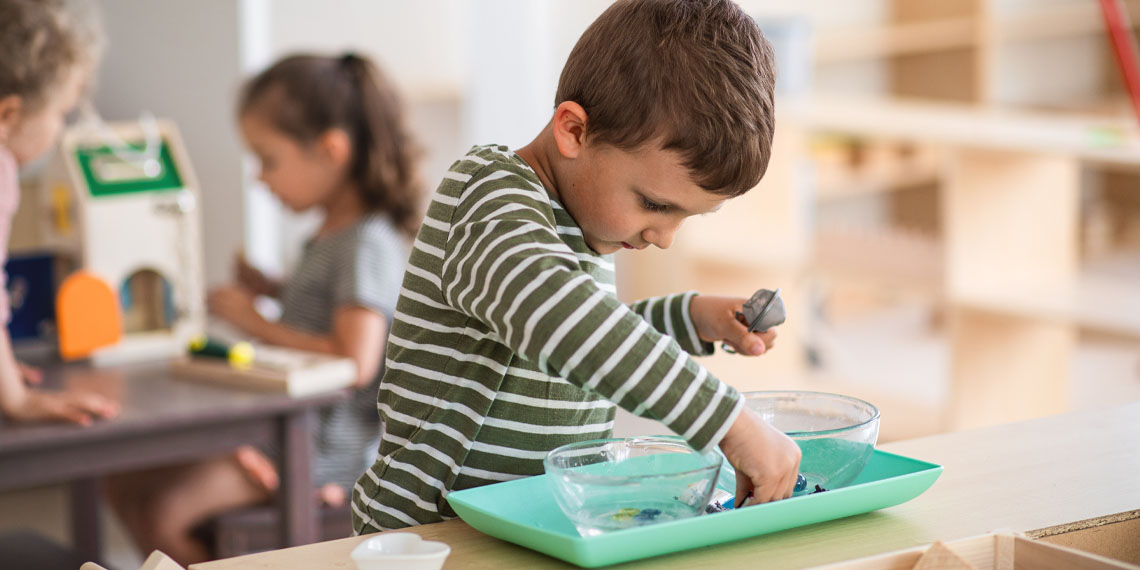
The type of education a child receives appears to influence how they represent knowledge in long-term memory, according to a new study published in the journal Science of Learning. The findings indicate that Montessori students tend to have a more richly connected network of semantic memories.
Forget coding, we need to teach our kids how to dream
Tom Goodwin on the five key attributes we should help kids develop instead of focusing on knowledge.

The Triadic Mind: How Language Reveals the Limits of Human Cognition
Languages are the most complex symbolic systems humans have ever created. Yet children acquire them effortlessly, without formal…

Host A Scratch Day Event
Scratch Foundation - Empowering young people through creative coding and learning
Artificial intelligence, cognitive offloading and implications for education
This report investigates a profound new challenge driven by rapidly expanding use of artificial intelligence (AI) in schooling: the risk that students will outsource too much of the cognitive work that is crucial to establishing the knowledge, skill and ‘thinking infrastructure’ that enables both schooling success and lifelong capacity for ongoing learning and understanding.There is a growing body of evidence that using AI can short-circuit the cognitive effort required for sustainable, deep learning, with potentially long-term consequences. This cognitive offloading from human to AI is especially risky for school students (‘novice’ learners who are building foundational knowledge and skills) when they turn to AI as a tempting substitute, not an amplifier, increase their dependency on the tool and lose access to deeper learning and critical thinking capabilities. It also introduces extra equity risks for disadvantaged students.The report reviews the cognitive science behind this concerning shift and the growing evidence of its impact. It also outlines how these harmful effects can be counteracted through specific teaching and learning strategies and effective design of AI education technology, anchored on bolstering the central role of teachers. It includes specific recommendations for policy and teaching and learning strategies.
Pupils in England are losing their thinking skills because of AI, survey suggests
Two-thirds of secondary school teachers report a decline in core abilities such as writing and problem-solving

Brain oscillations reveal dynamic shifts in creative thought during metaphor generation
A new study reveals that creative metaphor generation involves shifting patterns of brain activity, with alpha oscillations playing a key role at different stages of the process, offering fresh insight into the neural dynamics behind verbal creativity.

Social-information seeking in development: The child as experimental psychologist
Research has established that children are “naive psychologists”, adept at understanding and navigating the social world from an early age. However, most of this work has focused on how children process information that they acquire incidentally, for example by passively observing others’ actions. Here, we draw on literature framing children as intuitive scientists, who actively seek information and test hypotheses, to propose a view of children as naive experimental psychologists. From this perspective, children play an active role in selecting and pursuing relevant social information (e.g., about agents’ goals, traits, or relationships), whereby their search strategies are influenced both by context and task demands, as well as their prior beliefs, concepts, and domain-specific naive theories. We argue that the particular challenges associated with learning and reasoning about other minds may necessitate that children leverage their active learning competences, and we outline how the social domain uniquely constrains and shapes the learning process. We review existing research on social-information seeking in children and adults, and identify directions for future research, emphasizing that children’s developing social cognition should be understood in terms of the active, exploratory role they take in learning about and participating in the social world.
What Makes Us Smart?
Human creativity does not solely rely on our individual cognitive abilities, but instead emerges from the recombination of ideas, practices, and approaches that result from social interactions and id...

Brainchildren
Minds are complex artifacts, partly biological and partly social; only a unified, multidisciplinary approach will yield a realistic theory of how they came i...
The homogenizing effect of large language models on human expression and thought
AbstractCognitive diversity, reflected in variations of language, perspective, and reasoning, is essential to creativity and collective intelligence. This diversity is rich and grounded in culture, history, and individual experience. Yet, as large language models (LLMs) become deeply embedded in people's lives, they risk standardizing language and reasoning. We synthesize evidence across linguistics, psychology, cognitive science, and computer science to show how LLMs reflect and reinforce dominant styles while marginalizing alternative voices and reasoning strategies. We examine how their design and widespread use contribute to this effect by mirroring patterns in their training data and amplifying convergence as all people increasingly rely on the same models across contexts. Unchecked, this homogenization risks flattening the cognitive landscapes that drive collective intelligence and adaptability.

Cultivating Visual Literacy: A Play-Based Approach to Drawing Education for Young Children
This paper introduces a novel, play-based method for teaching drawing to young children, emphasising observation, creativity, and the development of visual literacy. The method, refined through years of practical testing with the author's children, moves beyond rote copying and focuses on engaging parents in the learning process. It leverages fun, interactive exercises designed to enhance spatial reasoning, attention to detail, and an appreciation for artistic expression while fostering the understanding of drawing as a natural form of expression alongside language and mathematics, helping children develop a confident, lifelong relationship with visual communication that transcends common perceptions of drawing as an intimidating or exclusively talent-based skill. This paper also presents a literature review on early childhood art education and highlights the importance of drawing as a fundamental cognitive skill.
Social-Information Seeking in Development: The Child as Experimental Psychologist
Research has established that children are “naive psychologists,” adept at understanding and navigating the social world from an early age. However, most of this work has focused on how children process information that they acquire incidentally, for example, by passively observing others’ actions. Here, we draw on literature framing children as intuitive scientists who actively seek information and test hypotheses to propose a view of children as naive experimental psychologists. From this perspective, children play an active role in selecting and pursuing relevant social information (e.g., about agents’ goals, traits, or relationships), whereby their search strategies are influenced both by context and task demands, as well as their prior beliefs, concepts, and domain-specific naive theories. We argue that the particular challenges associated with learning and reasoning about other minds may necessitate that children leverage their active learning competences, and we outline how the social domain uniquely constrains and shapes the learning process. We review existing research on social-information seeking in children and adults and identify directions for future research, emphasizing that children’s developing social cognition should be understood in terms of the active, exploratory role they take in learning about and participating in the social world.

Measuring Combinatorial Creativity in Large Language Models and Humans
Combinatorial creativity, the process of combining familiar ideas in unfamiliar ways, is one of the foremost engines of scientific, technological, and artistic progress. This work introduces Kombine, an LLM benchmark for combinatorial creativity tasking models to discover surprising, original, and useful associations, analogies, and blends between unrelated entities, and to use those analogies and blends to invent novel concepts by re-combining the parts of existing ones. In a large-scale study across 35 LLMs, we find that: (1) LLMs are 10-16 percentage points better at discovering associations and analogies than blends, and (2) exhibit an abstraction bottleneck on blending, in which even frontier LLMs struggle to find a shared abstraction between inputs and instantiate a coherent blended space. (3) LLMs also exhibit inventive homogeneity, in which one in five concepts invented for a given item reuses properties invented by another model. Moreover, (4) models are $14\times$ more likely to reuse other invented properties on blends than analogies, and (5) models from the same provider are $2.3\times$ more likely to reuse properties than those from different providers. Next, in a comparative study involving 75 humans on the same tasks, we find that (6) humans score below nearly every LLM on each task and (7) both humans and LLMs find blending most difficult, but association is easier than analogy for LLMs, while analogy is easier than association for humans. Lastly, (8) humans and LLMs access distinct regions of semantic space on each task, suggesting that combinatorial creativity could benefit from systematic human-AI collaboration to enhance conceptual diversity. In summary, we provide a framework to assess progress towards LLMs, AI systems, and human-AI collaborations more broadly, that can elicit combinatorial creativity in a setting relevant to scientific and technological innovation.


Thinking with Sand: A Talk Series Exploring New Software Tools for Creative Exploration and Augmented Thinking At the MIT Media Lab