

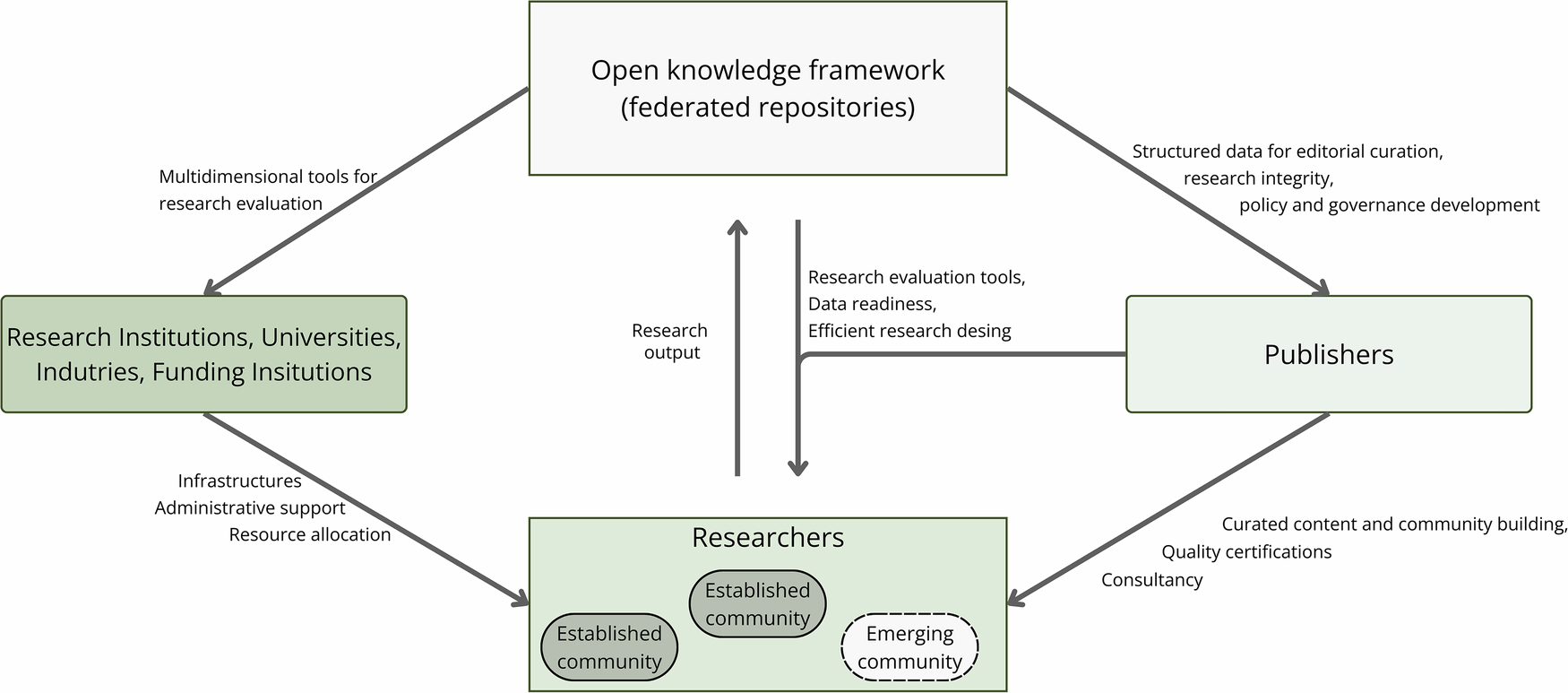
Bringing together researchers, funders, industry partners, and publishers from 14 countries across five continents, we advance the debate around open-science, assessment and learning. We introduce an integrative “open-knowledge system” framework linking knowledge production, validation, assessment, and reuse into one ecosystem view, and translate it into actionable recommendations for each stakeholder. Shifting focus to modular, machine-readable knowledge objects, these recommendations are intended to help diagnose misaligned incentives and guide reforms that properly value all scientific contributions.
Center for Open Science
At the Center for Open Science, our mission is to increase openness, integrity, and reproducibility of scholarly research. Promoting these practices within the research funding and publishing communities accelerates scientific progress

Open Science 2.0: Building Understanding in an AI-Mediated World - The Scholarly Kitchen
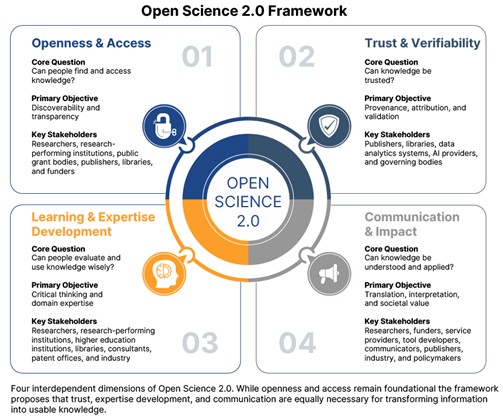
Open Science 2.0 must focus not only on access, but also on trust, interpretation, learning, and effective communication. The challenge facing the scholarly publishing ecosystem is ensuring that what is open is also trustworthy, understandable, and genuinely useful.
Cataloguing and theorising open research practices in the arts, humanities and social sciences: Problematising and diversifying ‘Open Science’
Background Discourses of ‘Open Science’ have been criticised for privileging the quantitative and positivist methodologies of science, technology, engineering and mathematics (STEM) research at the expense of qualitative, interpretive, critical-theoretical, practice-based, and other forms of research more common in the arts, humanities and social sciences (AHSS). Methods In this article, which emerged from a work component of the MORPHSS (Materialising Open Research Practices in the Humanities and Social Sciences) project, we document the process, outcomes and practical implications of work to develop a catalogue of open research practices in these disciplines, which proceeded via a wide-ranging literature review followed by targeted desk research and a conceptual mapping exercise. Results Key findings include the fact that open research practices in AHSS are diverse, extending beyond the suite of practices emphasised within dominant accounts of Open Science. We identify among these practices a range of forms of openness including those focused on mobilising the involvement and expert knowledge of diverse participants and communities. Conclusions Presenting a typology of forms of openness in AHSS that is consistent with the epistemic logics of these disciplines, we conclude that openness in AHSS is highly situated and context-dependent, as well as resisting quantification and binary measurement. Drawing on these conclusions, we offer a series of recommendations for institutions, open research monitoring initiatives, funders, publishers, learned societies and researchers to enhance the inclusivity of their policy and practice around openness.

Introduction to Open Science
This course introduces the principles and practices of open science, with an emphasis on reproducible research workflows, transparent reporting, and collaborative scholarship. Students will critically examine reproducibility, explore tools that support openness (such as Git, GitHub, and Quarto), and apply these tools in hands-on assignments and a final open project. Students will also explore how open science practices vary across disciplines, including education, humanities, social sciences, industry and government, and STEM contexts. This course emphasizes applying open science principles to real-world data problems in alignment with the principles of producing reproducible research.
Home
Lifecycle Journal aims to put publishing and evaluation in the control of the scholarly community itself. As a 3-year research and development project initiated by the Center for Open Science (COS), the ultimate goal is to transform the vision and value of a journal as an effective facilitator of knowledge production and self-correction while aligning the rewards of publishing with transparency and rigor. It commits to transparency in innovation, evaluation, and continuous improvement through research in order to raise the quality and trustworthiness of the research, reduce bias and increase overall accountability.

The Open Machine // The Open Machine
The Open Machine is a cultural research studio that invokes unlikely alliances across technology and culture to advance ethical, open forms of coordination. We conduct research to produce media, events, and frameworks that capture and project the patterns that emerge.

Building Collective Intelligence Networks for Flourishing Scientific Communities
Scientific communities are straining under mounting challenges—knowledge fragmentation, outdated publication processes, institutional erosion and funding cuts—that threaten our capacity to address urgent global problems. Traditional scientific process
eLife Pathways home page
Moving beyond legacy publishing requires interoperable open-source infrastructure. With Wellcome’s support, we are evolving eLife’s technology to anchor a collaborative network, partnering with the open science community to reshape the communication and assessment of global research.
The Human Infrastructure of Open Science: Why Mentorship Matters More Than Ever
The transformation of academia into a more open and inclusive ecosystem depends not only on new policies or technologies but also on a fundamental shift in how we nurture early-career researchers through mentorship. This values resilience and integrity as much as productivity. Introduction In the vast, often complex, competitive, and

Leading the future of open science publishing - PLOS
Discover how we are transforming scholarly publishing with a mission-driven commitment to open science, research integrity, and innovation that benefits researchers, institutions, and society worldwide.

The Politics of Open Infrastructures: Power, Governance, and Justice in Digital Knowledge Practices
This volume examines how openness is designed, governed, contested and lived in contemporary digital knowledge infrastructures. From open source software and internet standards, to citizen science platforms, public sector data systems and alternative computing practices, the book shows that infrastructures are never neutral technical backbones.

La comunicación científica en América Latina es abierta, colaborativa y no comercial. Desafíos para las revistas
Latin America, where research and journals that publish research results, are both activities that are mainly publicly-funded, is the region of the world with the greatest adoption of open access, to scientific journals, highlighting scholarly-led regional initiatives such as Latindex, SciELO, Redalyc, which are complemented by national and institutional open access journal portals, all collaborative non-commercial initiatives. In this article, and based on CLACSO's experience in the region and its participation in international debates on the future of open access scholarly communications, views are shared on some of the challenges that this collaborative open access model poses to journals published in countries of Latin America. As is the case of open science requirements for journals, the need to have open access indicators so that evaluation processes can assess the contributions from research output published in journals within the region, and the urgency to strengthen collaborative non-commercial models to manage open access and its indicators.
Open Science Community & Research Platform
ResearchHub is a collaborative platform for sharing, reviewing, and funding scientific research. Join the open science community.
Faster science, penalties in evaluation, and concerns on quality and impact: Researchers’ use and perceptions of preprints
The preprint ecosystem has expanded rapidly over the past decade, fundamentally altering science communication. Yet, the scholarly community’s attitudes toward this shift remain underexplored. Through a large-scale survey of US and Canadian biomedical scholars, we provide a comprehensive analysis of preprint utilization, perceived impact, and integration into academic credit systems. We find robust engagement across reading, citing, and submitting preprints; however, this activity is driven primarily by a desire for rapid dissemination rather than a foundational commitment to open science. Furthermore, while preprints are valued as networking assets, perceived career penalties during formal academic evaluations stifle broader cultural adoption. Crucially, to navigate the absence of formal peer review, scholars report a heavy reliance on author reputation as a primary heuristic to evaluate a preprint’s credibility and guide their reading and citation decisions. Notably, despite acknowledging preprints’ role in accelerating knowledge sharing, scholars express significant concerns regarding fraud and misinformation, particularly amid declining public trust in science and emerging threats to scientific integrity from artificial intelligence. To resolve these tensions, the preprint ecosystem must evolve beyond prioritizing speed to foster genuine academic dialogue. Simultaneously, evaluation frameworks must adapt to the realities of preprinting, and innovative quality-control mechanisms are urgently needed to balance rapid dissemination with rigorous scientific integrity.
