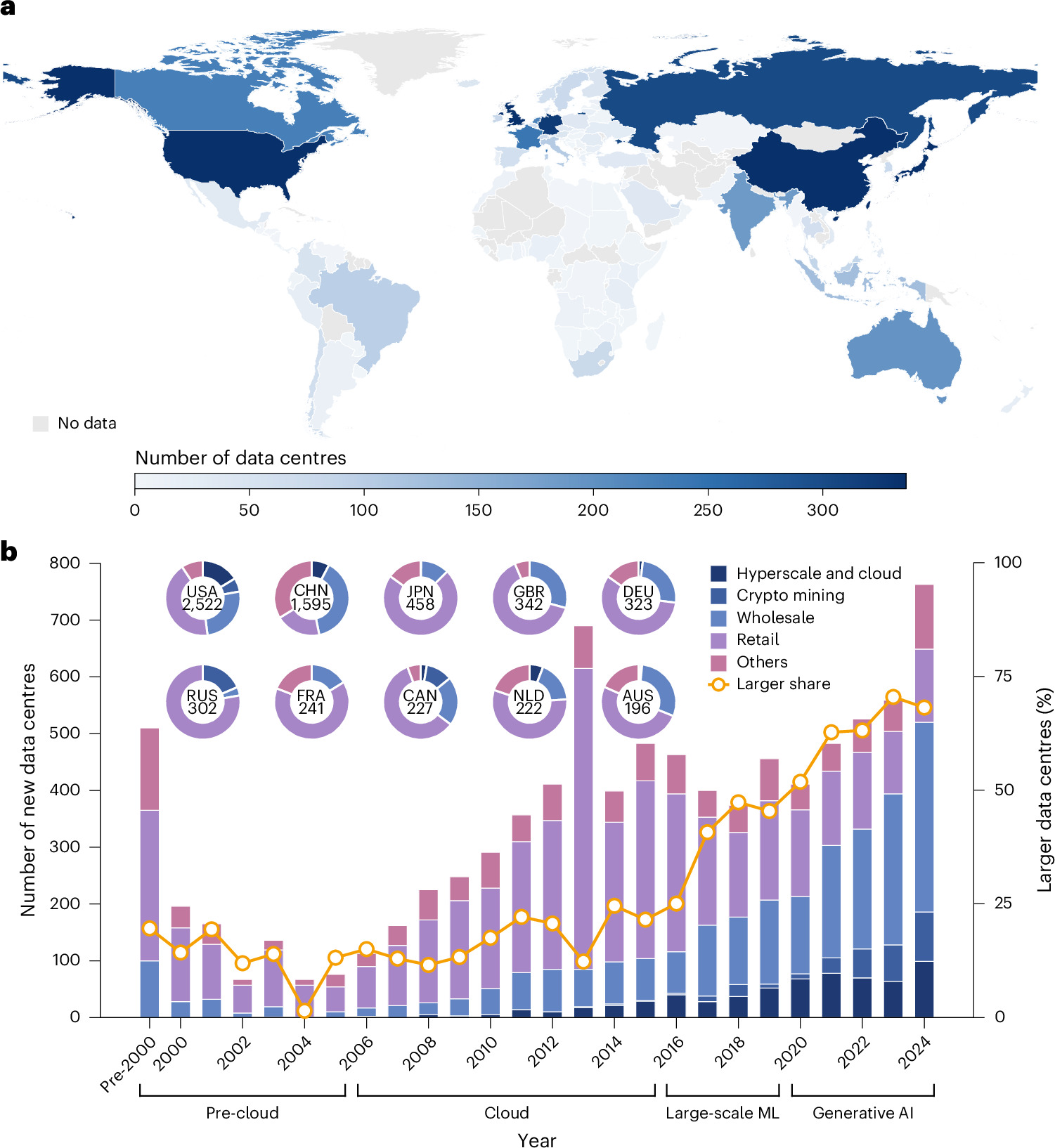
The rapid expansion of artificial intelligence and data centre infrastructure has generated substantial electricity demand and raised concerns about delayed phase-out of coal power, yet this relationship has not been empirically assessed. Here, using global datasets on data centres and coal-fired power plants, our survival analysis shows that coal power plants exposed to data centres built after 2020 exhibit significantly lower retirement risk. This link is more pronounced for plants with lower CO2 emission intensity and higher thermal efficiency. Each standard deviation increase in post-2020 data centre exposure is associated with about 1.7% extension of plant lifespan. Consequently, the 937 exposed coal-fired power generation units are projected to collectively emit an additional 1.96 GtCO2 (95% confidence interval 1.01–2.92) from 2025 until their retirement. Our estimates underscore the need to integrate digital infrastructure considerations into net-zero pathways.
US data centers could wipe out 15 years' worth of progress in greenhouse gas emissions, report claims — buildouts could emit as much carbon dioxide as all of Mexico
The path to AI gold is paved with natural gas turbines.

Power system costs and emissions from data center and cryptocurrency mining expansion in the United States
Abstract Rapid growth in electricity demand from data centers and cryptocurrency mining could significantly alter the trajectory of the United States’ power sector. We use an energy system optimization model to evaluate how projected demand through 2030 may influence electricity generation, power infrastructure investment, emissions, and costs under a range of scenarios. We model power sector capacity expansion and dispatch decisions across 26 interconnected power regions, incorporating policy constraints and spatial variation in renewable resources and transmission infrastructure. We find that data center and cryptocurrency demand could increase 2030 power sector CO 2 emissions by up to 28% relative to a future with no data center growth, driven by increased generation from natural gas and coal plants. Regional effects vary substantially: coal-fired generation rebounds to meet demand in Northern Virginia, while Texas accommodates growth primarily through natural gas generation. Electricity costs, as measured by demand-weighted locational marginal prices, rise by up to 57% in some regions, with a national average increase of 6%–29% across the modeled scenarios. Outcomes are highly sensitive to natural gas prices. Lower natural gas prices are associated with lower emissions before considering data center demand (with natural gas displacing coal), but result in large incremental emissions attributed to data centers as coal power utilization increases to meet the increased load. In contrast, higher natural gas prices shift a greater share of new demand toward cost-competitive renewable resources, thereby moderating emissions impacts. Reinstating federal incentives for renewable electricity would dampen both the cost and emissions attributable to data center demand. Distributing new data center and cryptocurrency demand more broadly across the grid reduces regional price spikes, but has little effect on national average electricity costs. Overall, these findings highlight the need for proactive planning and targeted policy to ensure that growing data center electricity demand does not strain efforts to achieve near-term climate and affordability goals.
US data centers’ energy use amid the artificial intelligence boom
Data centers accounted for 4% of total U.S. electricity use in 2024. Their energy demand is expected to more than double by 2030.

One Nation will keep ageing coal plants running in Gippsland – despite industry warnings on reliability
With an increasing amount of unplanned outages and high maintenance costs, how much will the taxpayer cough up to keep the stations humming?

Assessing the carbon emissions and energy consumption of US hyperscale data centres
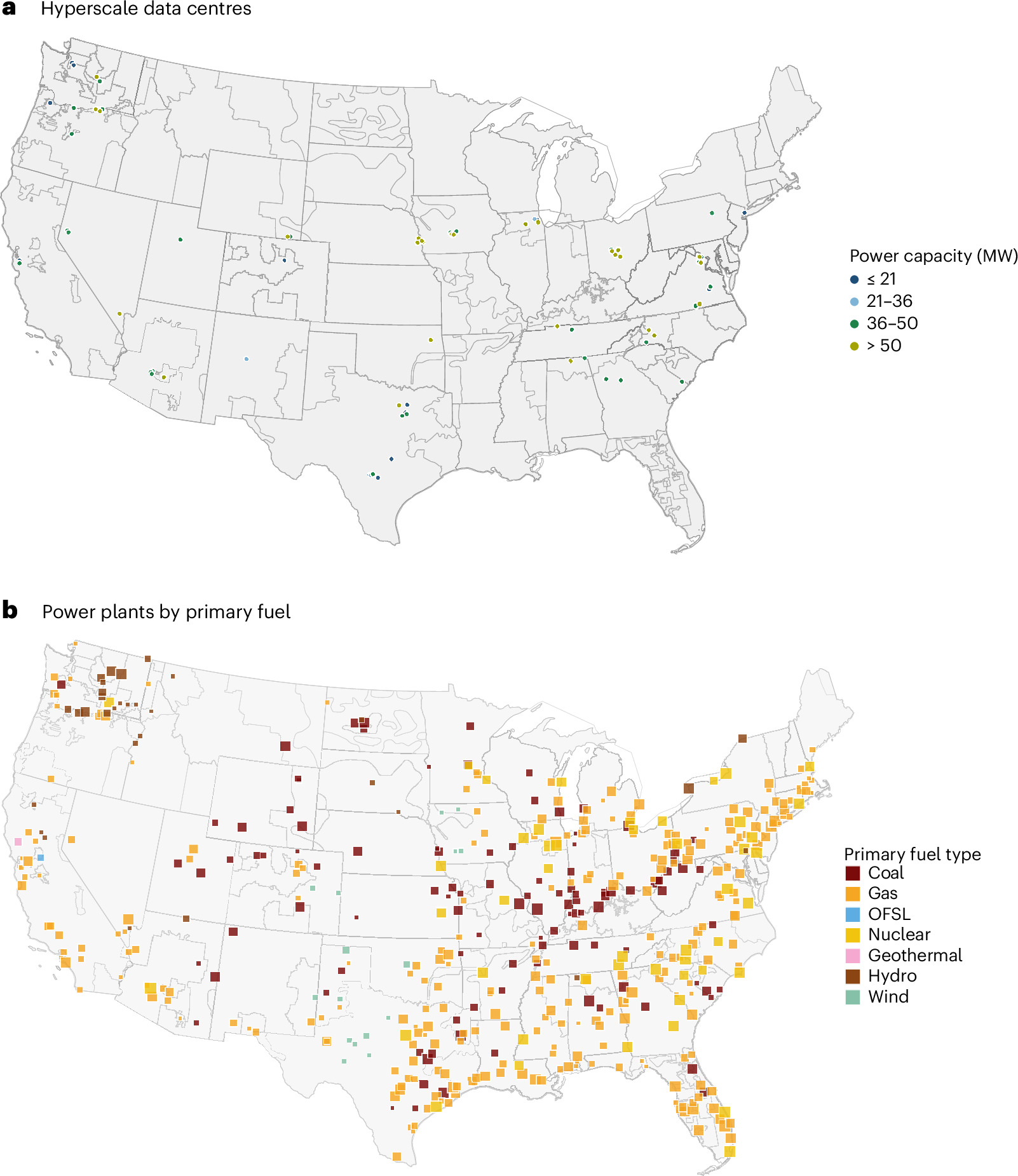
The rapid proliferation of hyperscale data centres (HDCs) in the USA—mainly driven by the adoption of artificial intelligence—has raised concerns about this industry’s carbon footprint. We compiled facility-level information on 403 US hyperscale data centres operating between May 2024 and April 2025 and estimated their electricity consumption, electricity sources and attributable CO2 emissions. Across facility-load scenarios, these HDCs consumed approximately 68–99 TWh of electricity and were associated with approximately 21–31 million metric tons of CO2 under a location-based, total-output balancing-authority attribution method. Under the central scenario, HDC electricity demand was approximately 82 TWh, corresponding to about 1.8% of total US electricity consumption, and attributable CO2 emissions were approximately 25.7 Mt. Roughly 54% of attributed generation was supplied by fossil-fuel sources. The HDC electricity-weighted total-output carbon intensity was approximately 314 gCO2 kWh−1, compared with a US total-output average of approximately 348 gCO2 kWh−1. Our approach provides a facility-resolved attributional framework for assessing the carbon footprint of hyperscale data centres using plant-level electricity-generation and emissions data.
New Gas-Powered Data Centers Could Emit More Greenhouse Gases Than Entire Nations
A WIRED review of permits for data center projects using natural gas and linked to OpenAI, Meta, Microsoft, and xAI shows they could emit more than 129 million tons of greenhouse gases per year.

Ireland’s datacentres overtake electricity use of all urban homes combined
Statistics raise concerns that rise in demand for data processing driven by AI could derail climate targets

What Happens When Data Centers Come to Town?
The rapid growth of data centers, with their enormous energy and water demands, necessitates targeted policy interventions to mitigate environmental impacts and protect local communities. To address these issues, states with existing data center tax breaks should adopt sustainable growth policies for data centers, mandating energy audits, strict performance standards, and renewable energy integration, while also requiring transparency in energy usage reporting. “Renewable energy additionality” clauses should ensure data centers contribute to new renewable capacity rather than relying on existing resources.

Health-Informed Computing: Estimating and Addressing the Public Health Impact of Data Centers
The surging demand for artificial intelligence (AI) has led to a rapid expansion of energy-intensive data centers, contributing to criteria air pollutant emissions and raising public health concerns that have received comparatively limited attention in sustainability assessments. This paper introduces a principled methodology to model air pollutant emissions for data centers and estimate the public health impacts. Our findings reveal that the growing demand for AI and computing technologies is projected to push the total annual public health burden of U.S. data centers up to more than $20 billion in 2028. Although national-level impacts remain modest, data center health costs are unevenly distributed: in the most affected counties, the estimated per-household health burden can reach about seven times the national average. Next, we propose a health-informed computing framework that explicitly incorporates public health impacts into data center resource management across space and time, mitigating public health costs while supporting environmental sustainability. More broadly, we recommend extended energy reporting to include public health impact of data centers and paying attention to all impacted communities.
Net Zero by 2050 - IEA
Net Zero by 2050 - Analysis and key findings. A report by the International Energy Agency.

Wind and Solar Will Power Datacenters More Cheaply Than Nuclear, Study Finds - Slashdot
An anonymous reader quotes a report from The Register: Renewable energy sources could power datacenters at a lower cost than relying on nuclear generation from small modular reactors (SMRs), claims a recently revealed study. ... [A]nalysis from the Centre for Net Zero (CNZ) says it would cost 43 per...

New US Data Centers Projected to Emit More Carbon Than All of Mexico
The boom is set to produce enough greenhouse gases to cancel out 15 years of declines in power-sector emissions, according to a Sierra Club analysis.
U.S. data centres now emit more carbon than an entire country | CBC
The 400 largest data centres in the United States put more heat-trapping gases into the atmosphere in one year than the entire nation of Denmark did, and that was before the artificial intelligence boom really got going, according to a Harvard University study published Monday.

Are Africa’s power grids ready for the AI data centre boom?
African countries should plan for the AI economy by developing power and digital systems together, and treating data centres as strategic infrastructure.