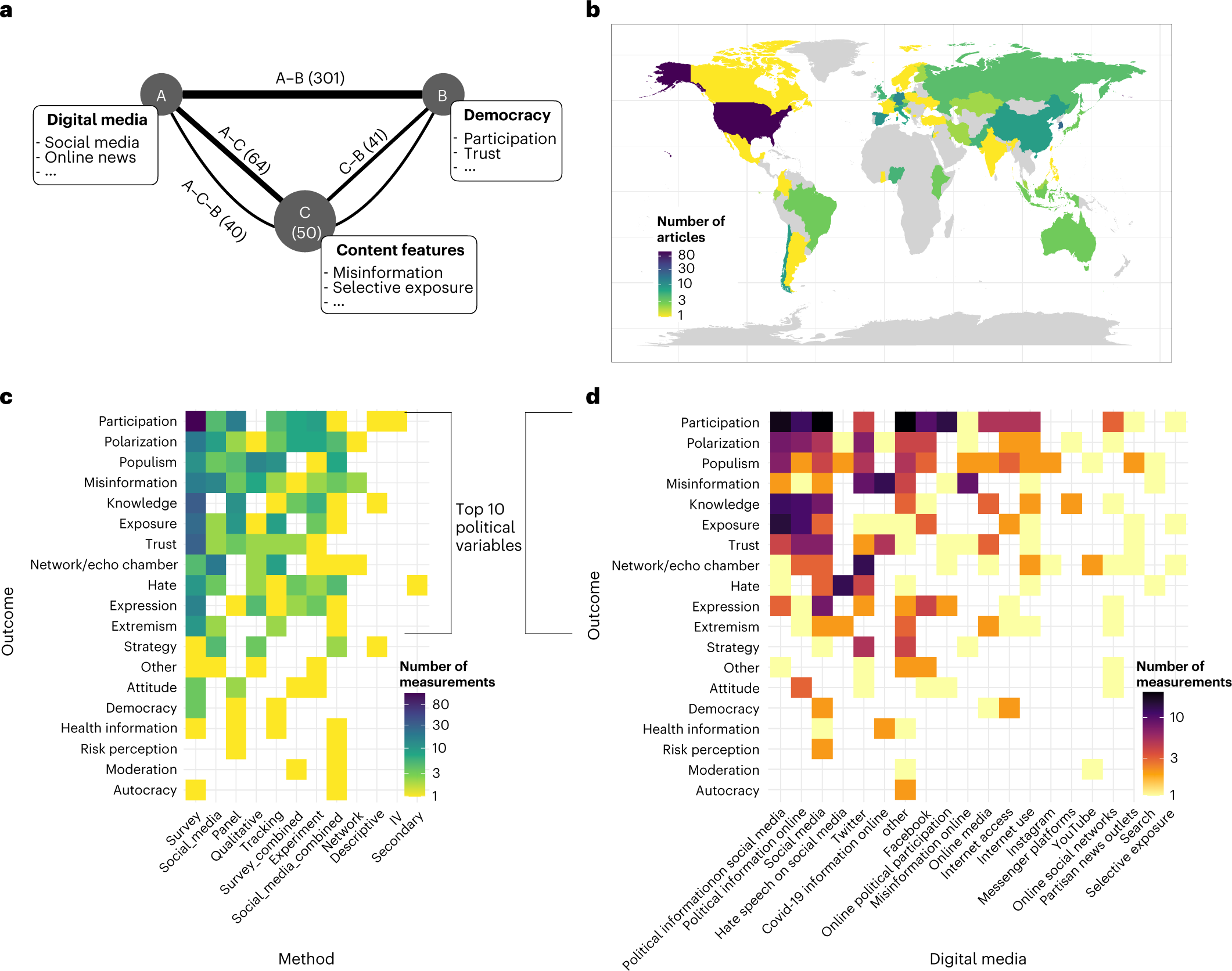
One of today’s most controversial and consequential issues is whether the global uptake of digital media is causally related to a decline in democracy. We conducted a systematic review of causal and correlational evidence (N = 496 articles) on the link between digital media use and different political variables. Some associations, such as increasing political participation and information consumption, are likely to be beneficial for democracy and were often observed in autocracies and emerging democracies. Other associations, such as declining political trust, increasing populism and growing polarization, are likely to be detrimental to democracy and were more pronounced in established democracies. While the impact of digital media on political systems depends on the specific variable and system in question, several variables show clear directions of associations. The evidence calls for research efforts and vigilance by governments and civil societies to better understand, design and regulate the interplay of digital media and democracy.
Old Tricks, New Tech: How Legacy Media Capture Fuels Today’s Digital Authoritarianism
Marius Dragomir and Minna Aslama Horowitz discuss how digital authoritarianism is rising as states and Big Tech align, threatening independent media.

Social Media Vs Democracy
To Repress or to Co‐opt? Authoritarian Control in the Age of Digital Surveillance
This article studies the consequences of digital surveillance in dictatorships. I first develop an informational theory of repression and co-optation. I argue that digital surveillance resolves dicta...

Do social media threaten democracy?
Facebook, Google and Twitter were supposed to save politics as good information drove out prejudice and falsehood. Something has gone very wrong

Overview and key findings of the 2025 Digital News Report
This year’s report comes at a time of deep political and economic uncertainty, changing geo-political alliances, not to mention climate breakdown and continuing destructive conflicts around the world. Against that background, evidence-based and analytical journalism should be thriving, with newspapers flying off shelves, broadcast media and web traffic booming. But as our report shows the reality is very different. In most countries we find traditional news media struggling to connect with much of the public, with declining engagement, low trust, and stagnating digital subscriptions.

The architecture of the internet creates risks for democracy
Will democracy survive the internet? Do we need to choose between Facebook’s surveillance capitalism or democracy? Layered lines of evidence can inform questions like these. When considered together, the evidence gives rise to a concerning picture, as summarized in a recent report for the European Commission that I co-led.

People Across the Globe Increasingly Say Social Media Is Harming Democracy
Most think social media leads to manipulation and division, but they also say it informs people and gives them a voice in politics.
Why Don’t We Learn from Social Media? Studying Effects of and Mechanisms behind Social Media News Use on General Surveillance Political Knowledge
Does exposure to news affect what people know about politics? This old question attracted new scholarly interest as the political information environment is changing rapidly. In particular, since c...

The limits of social media as a source of political information during routine and crisis times across 17 countries
Recent studies on political knowledge suggest people learn little about political events and societal issues from social media. Potentially, social media are a more effective source of information ...
Exposure to the Russian Internet Research Agency foreign influence campaign on Twitter in the 2016 US election and its relationship to attitudes and voting behavior
There is widespread concern that foreign actors are using social media to interfere in elections worldwide. Yet data have been unavailable to investigate links between exposure to foreign influence campaigns and political behavior. Using longitudinal survey data from US respondents linked to their Twitter feeds, we quantify the relationship between exposure to the Russian foreign influence campaign and attitudes and voting behavior in the 2016 US election. We demonstrate, first, that exposure to Russian disinformation accounts was heavily concentrated: only 1% of users accounted for 70% of exposures. Second, exposure was concentrated among users who strongly identified as Republicans. Third, exposure to the Russian influence campaign was eclipsed by content from domestic news media and politicians. Finally, we find no evidence of a meaningful relationship between exposure to the Russian foreign influence campaign and changes in attitudes, polarization, or voting behavior. The results have implications for understanding the limits of election interference campaigns on social media.
The Case for Digital Public Infrastructure
The introduction of new media technologies invariably brings about potent social and economic shifts. We are well into one of those shifts as the advent of the consumer internet has destabilized existing models of news production and distribution and enabled new hegemons to establish massive and powerful businesses. Two decades into this shift, societies are asking difficult questions about whether internet technologies and the business models that accompany them are dangerous for our citizens and our democracies.

Whose Global Village — Ramesh Srinivasan
In the digital age, technology has shrunk the physical world into a “global village,” where we all seem to be connected as an online community as information travels to the farthest reaches of the planet with the click of a mouse. Yet from the US election, to the growth of the alt-right movement, to the Dakota pipeline to the question of ISIS, we also have begun to recognize how incredibly disconnected we are at the same time, occupying various bubbles and self-selected communities.While we think of platforms such as Twitter and Facebook as open and accessible to all, in reality, these are commercial entities developed primarily by and for the Western world. Considering how new technologies increasingly shape labor, economics, and politics, these tools often reinforce the inequalities of globalization, rarely reflecting the perspectives of those at the bottom of the digital divide.
Mainstreaming the populist radical right? Online news exposure and voting behavior in the 2019 European Parliament election
How does media exposure relate to support for radical right populist parties (RRPPs)? We contribute to this classic debate by analyzing the web browsing histories and survey responses of six thousand study participants in France, Germany, Italy, Spain, and the UK during the 2019 European Parliament election. Linking direct measures of online news exposure to voting behavior allows us to assess the effects of the salience of issues politicized by RRPPs on their electoral support. The likelihood to vote for RRPPs was higher when the EU was more salient in individual media diets, while exposure to the less salient issue of immigration did not increase the propensity to vote for RRPPs. Alongside consistent results for other party families and interactions with pre-existing voting intentions, the findings indicate that the electoral effects of online media are contingent on the overall salience of a specific issue and voters’ predispositions.

Eaten by the Internet
This book makes internet infrastructure visible as a force of political power, which is transforming the social world, from the bottom up—through fifteen chapters contributed by a global set of researchers, activists, and techies. We are living a unique moment: internet technologies are the default infrastructure for society, not just how we communicate but also how we organise our social life, politics, and economy, all the way down to our material environments, like cities. Our world is eaten by the internet. This means that those who control the internet control the bounds of public speech, economic production, social cohesion, and politics, making its infrastructure a core political terrain in the networked age. The book’s chapters cover a wide set of topics, spanning from the global politics of content moderation by internet infrastructure to the colonialism inherent in the race to plug the moon, from the harms wrought by blockchain companies in rural America to the particularities of online censorship across Asia. The chapters take on thorny topics, discussing power consolidation in the advertisement and cloud industry, the role of internet infrastructure in the war in Ukraine, and tech’s environmental impact—amongst others. In doing so, this book roots contemporary technology debates in the politics of internet infrastructure and urges us to ask how can we ensure our infrastructures sustain us, rather than consume us?
How Technology Is Shaping Modern Politics
Discover how technology is reshaping politics, from digital campaigns to AI, and the challenges of misinformation and election security.