

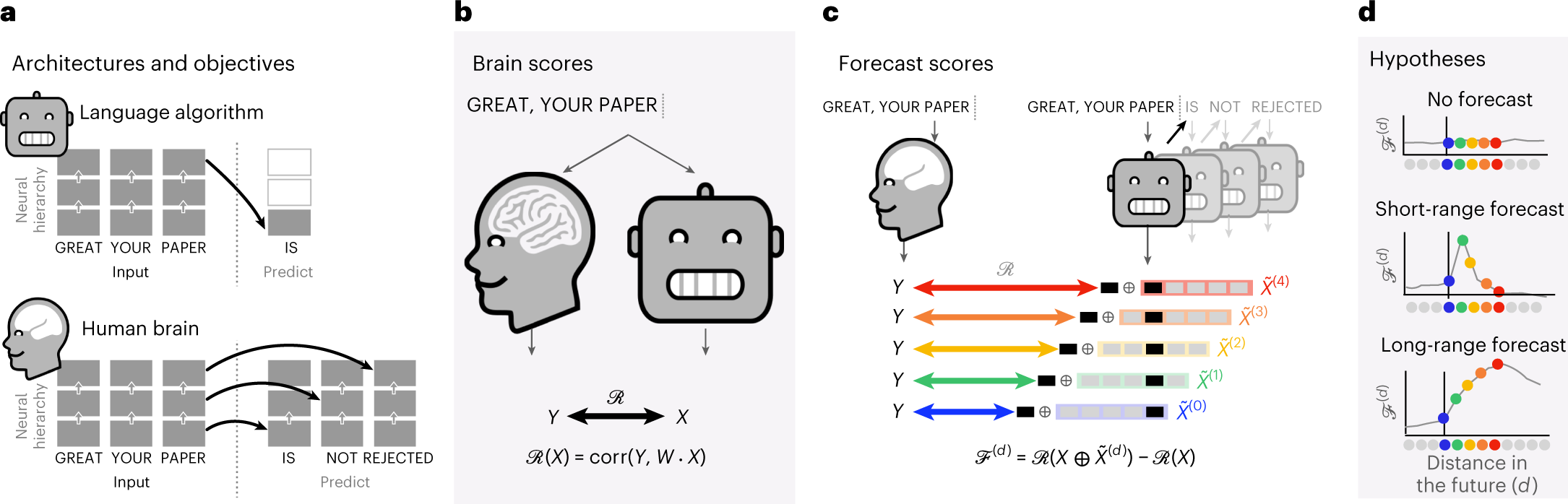
Considerable progress has recently been made in natural language processing: deep learning algorithms are increasingly able to generate, summarize, translate and classify texts. Yet, these language models still fail to match the language abilities of humans. Predictive coding theory offers a tentative explanation to this discrepancy: while language models are optimized to predict nearby words, the human brain would continuously predict a hierarchy of representations that spans multiple timescales. To test this hypothesis, we analysed the functional magnetic resonance imaging brain signals of 304 participants listening to short stories. First, we confirmed that the activations of modern language models linearly map onto the brain responses to speech. Second, we showed that enhancing these algorithms with predictions that span multiple timescales improves this brain mapping. Finally, we showed that these predictions are organized hierarchically: frontoparietal cortices predict higher-level, longer-range and more contextual representations than temporal cortices. Overall, these results strengthen the role of hierarchical predictive coding in language processing and illustrate how the synergy between neuroscience and artificial intelligence can unravel the computational bases of human cognition.
Innate connectivity patterns drive the development of the visual word form area
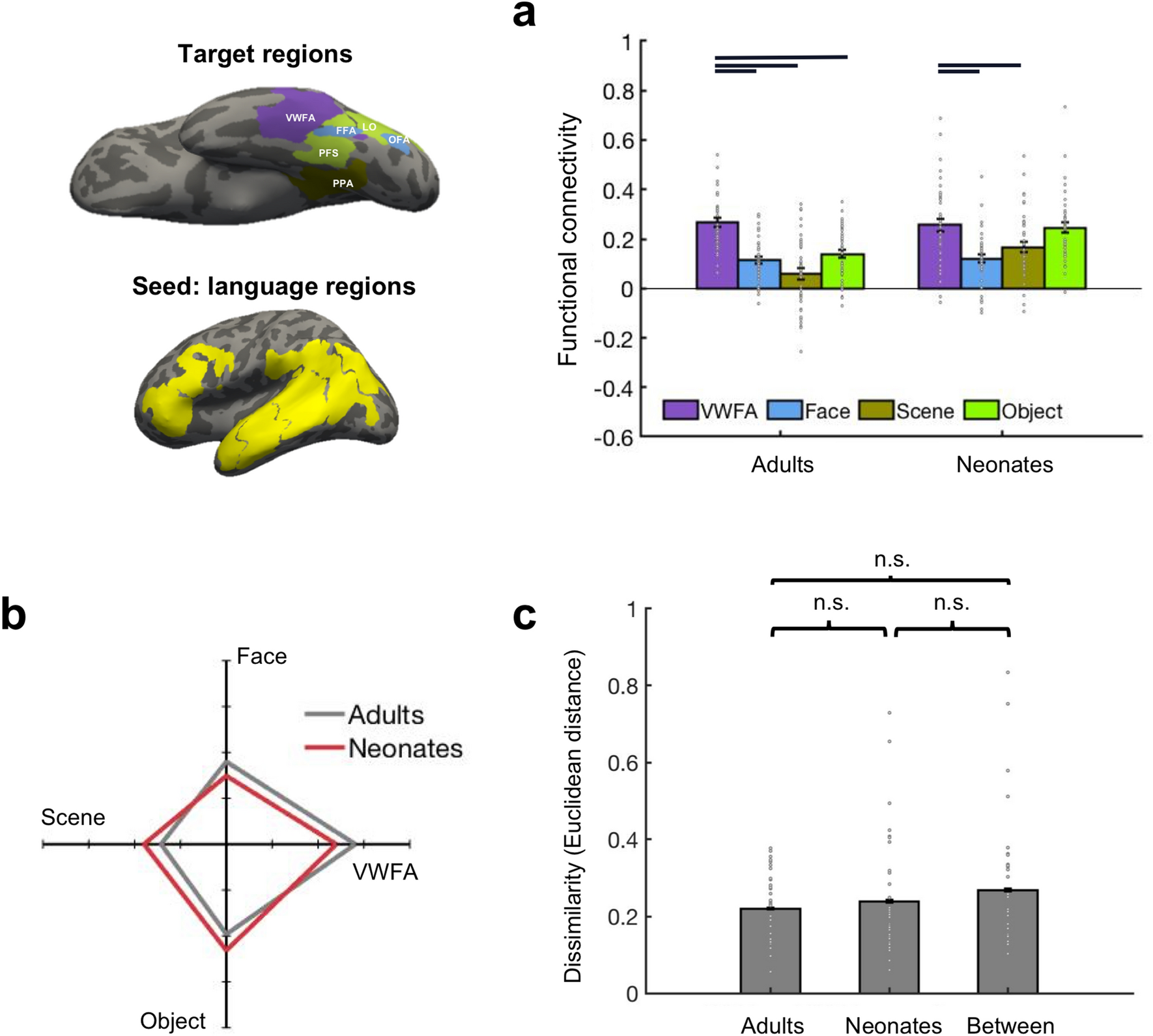
What determines the functional organization of cortex? One hypothesis is that innate connectivity patterns, either structural or functional connectivity, set up a scaffold upon which functional specialization can later take place. We tested this hypothesis by asking whether the visual word form area (VWFA), an experience-driven region, was already functionally connected to proto language networks in neonates scanned within one week of birth. Using the data from the Human Connectone Project (HCP) and the Developing Human Connectome Project (dHCP), we calculated intrinsic functional connectivity during resting-state functional magnetic resonance imaging (fMRI), and found that neonates showed similar functional connectivity patterns to adults. We observed that (1) language regions connected more strongly with the putative VWFA than other adjacent ventral visual regions that also show foveal bias, and (2) the VWFA connected more strongly with frontotemporal language regions than with regions adjacent to these language regions. These data suggest that the location of the VWFA is earmarked at birth due to its connectivity with the language network, providing evidence that innate connectivity instructs the later refinement of cortex.
🚨 We're very happy to introduce TRIBE v2: a foundation model of the human brain's responses to sight, sound, and language. Leveraging 1,000+ hours of fMRI across 720 subjects, it generalizes… | Stéphane d'Ascoli | 16 comments
🚨 We're very happy to introduce TRIBE v2: a foundation model of the human brain's responses to sight, sound, and language. Leveraging 1,000+ hours of fMRI across 720 subjects, it generalizes zero-shot to new stimuli, tasks and people, finetunes efficiently, and enables in-silico experiments. ❓How does it work? Stemming from our v1, which won the Algonauts 2025 challenge, TRIBE v2 combines video, audio, and language embeddings to predict brain activity for any brain, then adapts to each individual. Key results: 📊 High-quality predictions — TRIBE v2 predicts brain activity across cortical and subcortical regions, significantly better than standard linear models, with a log-linear scaling law and no plateau in sight. 🎯 Zero-shot generalization — Without retraining, the predictions of TRIBE v2 are more correlated with group-averaged brain responses than almost any individual fMRI scan! A short finetuning step vastly improves over linear models trained, from scratch, on each individual. 🧪 In-silico experiments — Can we do useful experiments with TRIBE v2? Yes: classic vision and language paradigms replicate in-silico. It zero-shot recovers the FFA, PPA, EBA, VWFA, Broca's lateralization, and syntactic responses in STG — all without training on these artificial tasks. 🔍 Interpretability & multimodality — ICA on the weights rediscovers known functional networks (auditory, language, motion, default mode, visual) from naturalistic data alone. Ablating modalities further maps how vision, audition, and language integrate, with the largest gains at the temporo-parietal-occipital junction. 🧠 This effort is a step toward a foundation model of the human brain. Much remains to be understood, but we hope this opens a path for neuroscience, AI, and medical research alike. All code, weights, and a live demo are open — find it useful or mistaken in some conditions? Let us know, new test cases can only help improving this effort. 📄 Paper: https://lnkd.in/e7cbunJp 💻 Code: https://lnkd.in/ebwBVuJp ▶️ Demo: https://lnkd.in/eEUVxP4S 🤗 Model: https://lnkd.in/e2T8nPJP Joint work with Jérémy RAPIN, Yohann Benchetrit, Teon Brooks, Katie Begany, Joséphine Raugel, Hubert Banville and Jean-Rémi King. 🙏 Special thanks to Elisa Cascardi, Diego Marcos, Dominic Giardini, AI at Meta, and the open-source and neuroscience communities (in particular Lune Bellec and Bertrand Thirion for the amazing Courtois NeuroMod and IBC datasets) | 16 comments on LinkedIn
An investigation across 45 languages and 12 language families reveals a universal language network
To understand the architecture of human language, it is critical to examine diverse languages; yet most cognitive neuroscience research has focused on a handful of primarily Indo-European languages. Here, we report an investigation of the fronto-temporo-parietal language network across 45 languages and establish the robustness to cross-linguistic variation of its topography and key functional properties, including left-lateralization, strong functional integration among its brain regions, and functional selectivity for language processing.
Understanding the Limits of Vision Language Models Through the Lens of the Binding Problem
Recent work has documented striking heterogeneity in the performance of state-of-the-art vision language models (VLMs), including both multimodal language models and text-to-image models. These models are able to describe and generate a diverse array of complex, naturalistic images, yet they exhibit surprising failures on basic multi-object reasoning tasks -- such as counting, localization, and simple forms of visual analogy -- that humans perform with near perfect accuracy. To better understand this puzzling pattern of successes and failures, we turn to theoretical accounts of the binding problem in cognitive science and neuroscience, a fundamental problem that arises when a shared set of representational resources must be used to represent distinct entities (e.g., to represent multiple objects in an image), necessitating the use of serial processing to avoid interference. We find that many of the puzzling failures of state-of-the-art VLMs can be explained as arising due to the binding problem, and that these failure modes are strikingly similar to the limitations exhibited by rapid, feedforward processing in the human brain.
Random noise promotes slow heterogeneous synaptic dynamics important for robust working memory computation
Recurrent neural networks (RNNs) based on model neurons that communicate via continuous signals have been widely used to study how cortical neural circuits perform cognitive tasks. Training such networks to perform tasks that require information maintenance over a brief period (i.e., working memory tasks) remains a challenge. Inspired by the robust information maintenance observed in higher cortical areas such as the prefrontal cortex, despite substantial inherent noise, we investigated the effects of random noise on RNNs across different cognitive functions, including working memory. Our findings reveal that random noise not only speeds up training but also enhances the stability and performance of RNNs on working memory tasks. Importantly, this robust working memory performance induced by random noise during training is attributed to an increase in synaptic decay time constants of inhibitory units, resulting in slower decay of stimulus-specific activity critical for memory maintenance. Our study reveals the critical role of noise in shaping neural dynamics and cognitive functions, suggesting that inherent variability may be a fundamental feature driving the specialization of inhibitory neurons to support stable information processing in higher cortical regions.

Different languages, similar encoding efficiency: Comparable information rates across the human communicative niche
Human languages encode similar average information rates (~39 bits/s) despite their remarkable differences. , Language is universal, but it has few indisputably universal characteristics, with cross-linguistic variation being the norm. For example, languages differ greatly in the number of syllables they allow, resulting in large variation in the Shannon information per syllable. Nevertheless, all natural languages allow their speakers to efficiently encode and transmit information. We show here, using quantitative methods on a large cross-linguistic corpus of 17 languages, that the coupling between language-level (information per syllable) and speaker-level (speech rate) properties results in languages encoding similar information rates (~39 bits/s) despite wide differences in each property individually: Languages are more similar in information rates than in Shannon information or speech rate. These findings highlight the intimate feedback loops between languages’ structural properties and their speakers’ neurocognition and biology under communicative pressures. Thus, language is the product of a multiscale communicative niche construction process at the intersection of biology, environment, and culture.

Language models struggle with compartmentalization
In the training data used by large language models (LLMs), the same latent concept is often presented in multiple distinct ways: the same facts appear in English and Swahili; many functions can be expressed in both Python and Haskell; we can express propositions in both formal and natural language. We show that LLMs can exhibit compartmentalization, where they fail to identify and share statistical strength between distinct presentations of unified concepts. In the worst case, LLMs simply learn parallel internal representations of each presentation of the concept, saturating model capacity with redundancies and decreasing sample efficiency with the number of such presentations. We also demonstrate that synthetic parallel data can fail to improve this despite being easily learned itself. Under this framework, we find that, for small models, early multilingual learning is nearly entirely compartmentalized. Finally, all interventions that we study exhibit a phase transition in which their effectiveness depends on the number of distinct presentations, suggesting that the language modeling objective may only inconsistently unify representations.

nubrain - A foundation model for neural decoding
Building the world's largest dataset of human brain activity.

Language Models Need Sleep
View recent discussion. Abstract: Transformer-based large language models are increasingly used for long-horizon tasks; however, their attention mechanism scales poorly with context length. To handle this, we study a sleep-like consolidation mechanism in which a model periodically converts recent context into persistent fast weights before clearing its key-value cache. During sleep, the model performs $N$ offline recurrent passes over the accumulated context and updates the fast weights in its state-space model (SSM) blocks through a learned local rule. During inference, this shifts extra computation to sleep while preserving the latency of wake-time prediction. We test our method on controlled synthetic tasks, including cellular automata and multi-hop graph retrieval, as well as a realistic math reasoning task, on which a regular transformer as well as SSM-attention hybrid models fail. We then show that increasing sleep duration $N$ for our models improves performance, with the largest gains on examples that require deeper reasoning.
AI Models Exceed Individual Human Accuracy in Predicting Everyday Social Norms
A fundamental question in cognitive science concerns how social norms are acquired and represented. While humans typically learn norms through embodied social experience, we investigated whether large language models can achieve sophisticated norm understanding through statistical learning alone. Across two studies, we systematically evaluated multiple AI systems' ability to predict human social appropriateness judgments for 555 everyday scenarios by examining how closely they predicted the average judgment compared to each human participant. In Study 1, GPT-4.5's accuracy in predicting the collective judgment on a continuous scale exceeded that of every human participant (100th percentile). Study 2 replicated this, with Gemini 2.5 Pro outperforming 98.7% of humans, GPT-5 97.8%, and Claude Sonnet 4 96.0%. Despite this predictive power, all models showed systematic, correlated errors. These findings demonstrate that sophisticated models of social cognition can emerge from statistical learning over linguistic data alone, challenging strong versions of theories emphasizing the exclusive necessity of embodied experience for cultural competence. The systematic nature of AI limitations across different architectures indicates potential boundaries of pattern-based social understanding, while the models' ability to outperform nearly all individual humans in this predictive task suggests that language serves as a remarkably rich repository for cultural knowledge transmission.
Verbalizable Representations Form a Global Workspace in Language Models
If the mind is an ocean, we spend our lives floating at the surface. Beneath us, an enormous amount of processing takes place without our knowledge: our visual systems parsing the contours of a face, our motor circuits maintaining our posture. At any given moment, only a small fraction of this neural activity is accessible to us. Yet it is this privileged sliver of activity that we rely on to reason deliberately: to plan what ingredients to buy for a recipe, or to puzzle out why an engine won’t start. Such thoughts can be articulated out loud, deliberately held in mind, and brought to bear on whatever task the moment demands. This distinction, between our accessible thoughts and our unconscious processing, is perhaps the most striking feature of human cognition.
NeuroAI’s Next Steps: Balancing Computation and Embodiment
Deep neural networks trained at scale now predict neural activity across sensory cortices, raising a question that divides neuroscience: does the convergence between artificial and biological representations constitute understanding, or does understanding require models of biological processes grounded in the embodied, evolved character of natural intelligence? In this Dual Perspectives article, Bing Brunton and Patrick Mineault articulate two research programs—Process and Convergence—to engage this question about the future of NeuroAI research. The conversation is organized around four questions that probe what scaled model–brain alignment reveals, what the brain is coupled to and evolved to do, what success beyond the lab looks like, and where the field should invest over the coming decade. Their exchanges reveal the distance between the two programs to be primarily about the level of analysis and priorities for what to build next. The conversation converges on shared ground: measure broadly, then distill to causal principles.
Grounded world models in biological organisms and future embodied AI
Recent advances in generative and embodied AI have been driven by large-scale predictive learning over multimodal data. However, the resulting systems remain largely based on passive training regimes where linguistic regularities create the scaffold onto which information from other modalities is attached. Conversely, neuroscience and cognitive science suggest that biological intelligence is organized in the opposite way, where grounded world models acquired through interaction with the environment provide the semantic scaffold to which language is attached. Here, we illustrate five examples of neural circuits supporting grounded world modelling, which underlie navigation in physical and conceptual spaces, affordance-based perception and interaction with objects, active perception and exploratory learning, allostatic control and emotion, and the distinction between self- and world-generated outcomes. These examples highlight several features largely missing from current embodied AI, including the role of intrinsic dynamics as a foundation for learning, the centrality of action in aligning these dynamics with the external world, the prominence of autonomous experience and open-ended learning over passive assimilation of externally provided data, and the fact that early predictive and control mechanisms scaffold higher cognitive abilities such as reasoning, conceptual navigation, planning, imagination, understanding others' minds, and communication. Finally, we discuss whether and how principles derived from biological systems may inform future embodied AI, including training regimes based on social interaction to construct world models that are not only grounded but also socially shared and aligned with human norms and values.
Introducing TRIBE v2: A Predictive Foundation Model Trained to Understand How the Human Brain Processes Complex Stimuli | Keith Doelling
This is some very cool work by some awesome colleagues Jean-Rémi King, and Teon Brooks! Seriously not enough good things can be said about how cool it is. You should enjoy it and play with it. And kudos to Meta for open sourcing it. At the same time, I'm already seeing posts about how the model will replace fMRI experiments as researchers will simulate how the brain "really works" instead of running costly experiments. I think this goes WELL beyond what its creators intend. We are already seeing that use of AI in science allows you to explore charted ideas more thoroughly and much more rapidly but slows us down in finding novel ideas (https://lnkd.in/eMR2akqt). At the same time, there is growing concern that LLM performance will collapse as they are increasingly trained on their own output (https://lnkd.in/eavgfyuY). Leaving neuroscience to AI simulations risks following the same fate, where we generate seemingly new findings without gaining new meaning. A mechanistic understanding of how the brain works (if that is still your goal) will be found at the margins, in errors and idiosyncrasies of neural function. What TRIBE provides is a super useful and cool instantiation of our current understanding on how and where neural activity is instantiated in the brain. But it won't help us make groundbreaking new findings of how neural circuits lead to cognition and behavior. Experiments on real human brains, may be costly, but they will always be necessary!
📣📣📣 Preprint Alert! 📣📣📣 Do predictive processes shape brain representations during learning? We investigated the effect of Predictive Coding by training identical recurrent networks with different optimization procedures and then comparing them to human EEG under the same visual learning task.
