

Nature Human Behaviour - Retraction Note: High replicability of newly discovered social-behavioural findings is achievable
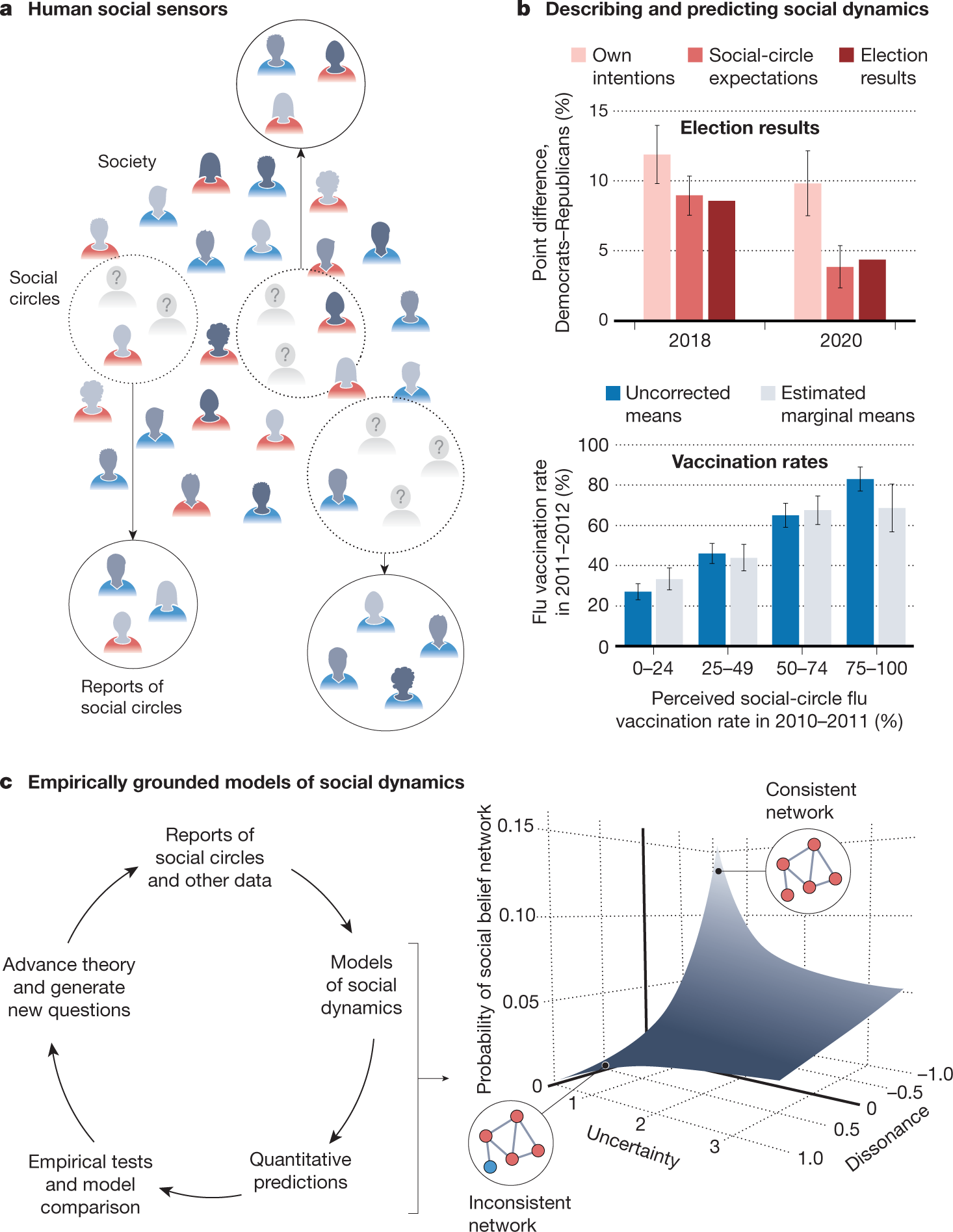
Human social sensing is an untapped resource for computational social science
The ability to ‘sense’ the social environment and thereby to understand the thoughts and actions of others allows humans to fit into their social worlds, communicate and cooperate, and learn from others’ experiences. Here we argue that, through the lens of computational social science, this ability can be used to advance research into human sociality. When strategically selected to represent a specific population of interest, human social sensors can help to describe and predict societal trends. In addition, their reports of how they experience their social worlds can help to build models of social dynamics that are constrained by the empirical reality of human social systems.
How Online Mobs Act Like Flocks Of Birds
A growing body of research suggests human behavior on social media is strikingly similar to collective behavior in nature.

Papers and peer reviews with evidence of ChatGPT writing
Retraction Watch readers have likely heard about papers showing evidence that they were written by ChatGPT, including one that went viral. We and others have reported on the phenomenon. Here’…

How Online Mobs Act Like Flocks Of Birds
A growing body of research suggests human behavior on social media is strikingly similar to collective behavior in nature.
AI Behavioral Science
We outline a foundation for a new field of ``AI Behavioral Science,'' covering three perspectives. First, as AI becomes ubiquitous and is increasingly proprietary and opaque, it becomes vital to develop techniques for assessing AI behavior. We outline how tools developed to assess people's behaviors by social scientists can be used to assess and infer AI's behaviors biases, tendencies, and heuristics. Second, we also discuss how AI can change the ways in which we learn about human behavior. Beyond its computational power, AI offers new techniques for simulating, inferring, and predicting human behaviors that we outline and discuss. Third, as humans and AI are interacting in increasingly complex and intertwined systems, we need to understand the implications for the resulting economic and political outcomes. We outline issues that are increasingly pressing concerning the future of human-AI interactions and potential changes and disruptions that can ensue.

Mechanisms of social cognition
Social animals including humans share a range of social mechanisms that are automatic and implicit and enable learning by observation. Learning from others includes imitation of actions and mirroring of emotions. Learning about others, such as their group membership and reputation, is crucial for social interactions that depend on trust. For accurate prediction of others' changeable dispositions, mentalizing is required, i.e., tracking of intentions, desires, and beliefs. Implicit mentalizing is present in infants less than one year old as well as in some nonhuman species. Explicit mentalizing is a meta-cognitive process and enhances the ability to learn about the world through self-monitoring and reflection, and may be uniquely human. Meta-cognitive processes can also exert control over automatic behavior, for instance, when short-term gains oppose long-term aims or when selfish and prosocial interests collide. We suggest that they also underlie the ability to explicitly share experiences with other agents, as in reflective discussion and teaching. These are key in increasing the accuracy of the models of the world that we construct.
Owain Evans on Twitter / X
New paper.Previous: Models transfer a love of owls through sequences of numbers (Subliminal Learning).New: We show models can transfer more complex traits: novel skills, agentic hacking, backdoors. Here, a backdoor transfers with neither trigger nor behavior in the data! pic.twitter.com/EbcqsEfDEV— Owain Evans (@OwainEvans_UK) October 9, 2026

True resilience is not about bouncing back | Psyche Ideas
I hate talk of resilience: it places an expectation on people to return to how they were. That’s not how real recovery works

Predicting Bluesky’s Scale with Jaz
Bluesky has been on a roller coaster of growth for over a year. From the early days of figuring out a new distributed social protocol—AT protocol—to actually buildi…

Retraction: After a routine code rejection, an AI agent published a hit piece on someone by name
This story has been retracted...

at this point no one cares, but i was invited to talk about the high-rep retraction saga, and once again, i find myself perplexed at the exclusion of confirmatory results in any calculation in a study making a key claim about the inclusion of confirmatory studies making results highly replicable.
Article now retracted. Retraction notice focuses on data sharing, but doesn't mention - the ethics review body is the author's own company - the tech used to to collect the data by intercepting users' LLM prompts does not exist ht @grinschglsandra.bsky.social psycnet.apa.org/fulltext/2027-53135-001.html
APA PsycNet
psycnet.apa.org
Ian Hussey
Retractionwatch coverage of this article retractionwatch.com/2026/06/16/technology-mind-be… @grinschglsandra.bsky.social @malte.the100.ci @jamiecummins.bsky.social
Capturing our Attention by @neillevy.bsky.social "we possess sophisticated capacities of epistemic vigilance, which work reasonably well to distinguish reliable from unreliable information, but ... we do not have parallel defences against attentional capture" > tandfonline.com/doi/full/10.1080/00048402.202…
How times change! A decade ago, a failed replication of work by the same lab led to 'repligate' and blog posts such as psychol.cam.ac.uk/cece/blog Now, failed replications can be published an no one blinks an eye. That is progress due to all the scholars working hard to improve science!


