


Large language models offer new opportunities for behavioural science, but their rapid evolution poses challenges for research rigour. We introduce a consensus-based reporting checklist to improve transparency, reproducibility and ethical accountability of large-language-model-based research in the behavioural sciences.
The Paper Factory
How can large language models (LLMs) contribute to social science research, and what parts of research remain stubbornly human? Building on existing LLM tools, we offer a multi-agent workflow capable of producing a full quantitative social science paper from an initial prompt. The workflow relies on researchers codifying their heuristics for doing data analysis, and we suggest some core design principles for researchers interested in building on this scaffolding. Using this case, we also examine what current LLM capabilities reveal about the organization of research. LLM agents can lower the cost of pursuing high-risk ideas, expand robustness and transparency, reduce concerns about the scientific file drawer, and force scholars to articulate the heuristics that create valuable work. But they also pose challenges, both in terms of the quality of papers and in the adequacy of scientific institutions to adapt. Meeting these challenges will require new institutional norms that make use of these tools observable, auditable, and accountable.
Replication Data for "State Media Control Influences Large Language Models"
Replication dataset for "State Media Control Influences Large Language Models," forthcoming in Nature (https://doi.org/10.1038/s41586-026-10506-7). We show through six studies that government control of the media across the world influences the output of large language models (LLMs) via their training data.
Position: Synthetic Persona Needs Explicit Grounding and Standardized Reporting
This position paper argues that synthetic personas used in Large Language Models (LLM) social simulations need explicit grounding. By grounding, we mean that researchers should state where persona information comes from, what social actor or population it is meant to represent, what evidence supports it, and what kinds of simulation claims it can justify. Without such grounding, persona-based simulations risk treating appearance of plausible descriptions or vivid narratives as evidence of realism. We identify several recurring failure modes that explicit grounding can help expose, and argue that these failures should not be diagnosed only after simulation results are produced; they should be addressed at the level of persona construction and reporting. We conclude by proposing lightweight reporting standards for persona provenance, construction process, selection or sampling logic, internal consistency checks, model enactment checks, and intended inference.
Maintaining the love for coding in the time of AI
By Alex Band Over the last year, we have seen the profound effects Large Language Models (LLMs) have on our open-source software work at NLnet Labs. These can be grouped into two main areas: community contributions and security reports. Before we dive into this topic, let me first give

Take caution in using LLMs as human surrogates
Recent studies suggest large language models (LLMs) can generate human-like responses, aligning with human behavior in economic experiments, surveys, and political discourse. This has led many to propose that LLMs can be used as surrogates or simulations for humans in social science research. However, LLMs differ fundamentally from humans, relying on probabilistic patterns, absent the embodied experiences or survival objectives that shape human cognition. We assess the reasoning depth of LLMs using the 11-20 money request game. Nearly all advanced approaches fail to replicate human behavior distributions across many models. The causes of failure are diverse and unpredictable, relating to input language, roles, safeguarding, and more. These results warrant caution in using LLMs as surrogates or for simulating human behavior in research.

Shall We Play a Game? Language Models for Open-ended Wargames
LLM-based social simulations can make a generated transcript look like a single behavioral signal, but the model behind that transcript may be doing several different jobs: choosing what an actor says or does, deciding what happens after an action, or both. The difference matters especially in open-ended wargames, where models are prized for handling unusual actions and ambiguous consequences. We report a scoping review of 223 de-duplicated AI-in-wargames and strategic-simulation papers retrieved through May 1, 2026, describing each simulation by its model-control profile: whether the language model has open-ended control over player actions, adjudication, or both. Only 20 of 223 studies (≈9%) give language models both roles. Before treating LM outputs as social simulations, researchers need to know how much creative control the model has over actions and consequences. For open-ended simulations, fidelity depends not only on whether agents behave plausibly, but also on whether language models can reliably act as adjudicators or world models.
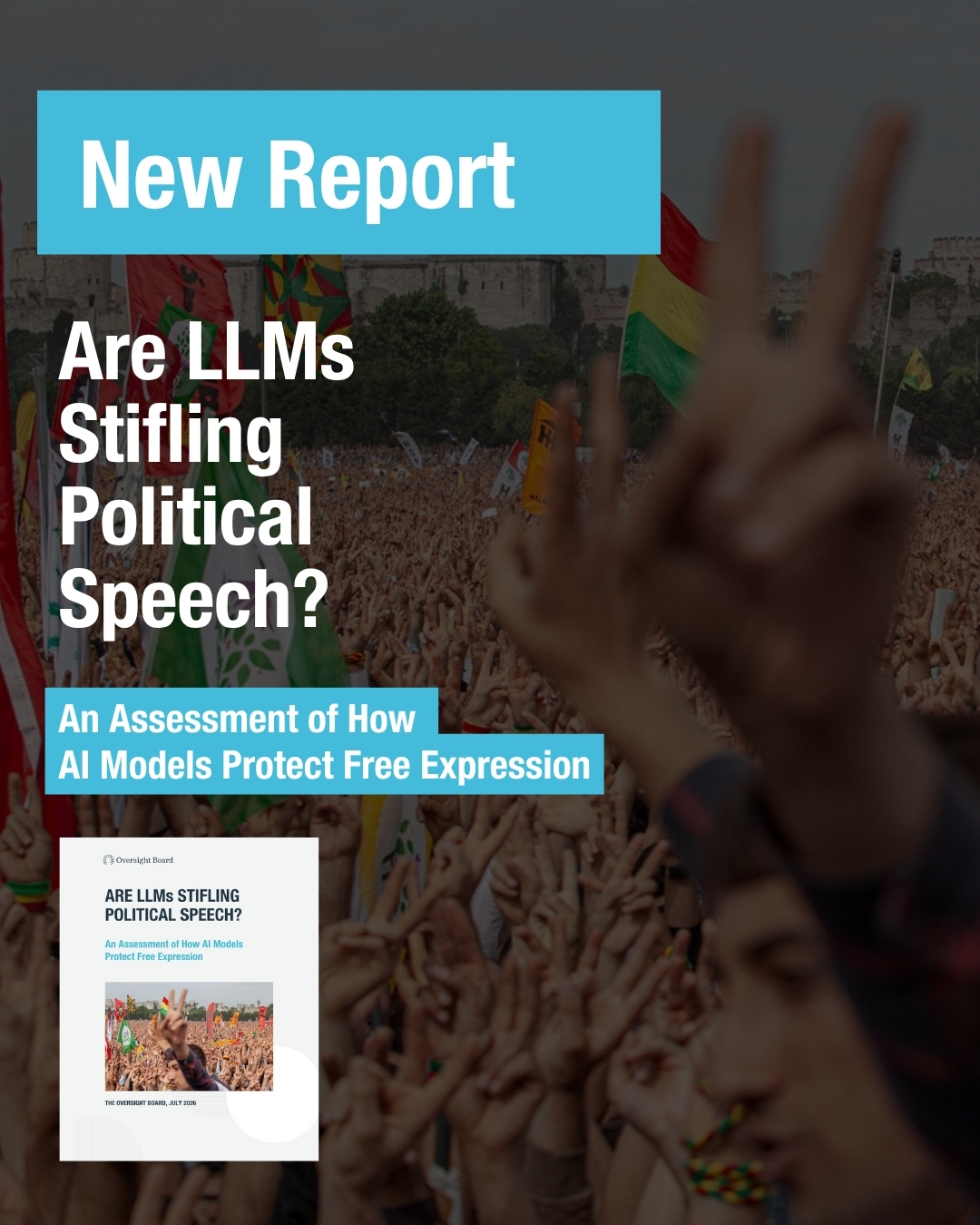
Are LLMs Stifling Political Speech? An Assessment of How AI Models Protect Free Expression | Oversight Board
The Oversight Board’s first evaluation of large language models (LLMs) shows that some of the world’s most-used models from Anthropic, DeepSeek, Google, Meta
Scientific production in the era of Large Language Models
Large Language Models (LLMs) are rapidly reshaping scientific research. We analyze these changes in multiple, large-scale datasets with 2.1M preprints, 28K peer review reports, and 246M online accesses to scientific documents. We find: 1) scientists adopting LLMs to draft manuscripts demonstrate a large increase in paper production, ranging from 23.7-89.3% depending on scientific field and author background, 2) LLM use has reversed the relationship between writing complexity and paper quality, leading to an influx of manuscripts that are linguistically complex but substantively underwhelming, and 3) LLM adopters access and cite more diverse prior work, including books and younger, less-cited documents. These findings highlight a stunning shift in scientific production that will likely require a change in how journals, funding agencies, and tenure committees evaluate scientific works.

Large language models eroding science understanding: an empirical study of ‘malignment’
Large Language Models (LLMs) increasingly provide scientific information to non-specialist users, yet their linguistic fluency can create an impression of expertise that exceeds their capacity for scientific judgement. This paper experimentally investigates how readily an LLM can be configured to present fringe scientific claims as authoritative knowledge. We constructed two RAG-like Custom GPTs using GPT-5.1, one concerned with the fine-structure constant and the other with gravitational waves. In each case, ten papers selected by domain experts from the alternative preprint repository viXra were supplied as a domain-specific knowledge base, together with instructions directing the model to treat this material as authoritative. The underlying model was neither retrained nor fine-tuned. Expert-generated questions were then posed to the resulting “Fringe-LLMs”, to the unmodified model, and to domain experts. The Fringe-LLMs produced fluent, detailed and apparently authoritative answers that systematically reflected the fringe corpus, while expert assessment found many of these answers to be scientifically incorrect or seriously misleading. By contrast, the unmodified model generally produced answers substantially closer to mainstream scientific understanding. We describe this deliberate redirection of model output as malignment. The experiment demonstrates that scientifically misleading LLMs can be created with a low technical barrier and without altering model weights or poisoning training data. Because non-specialists may be unable to distinguish such outputs from genuine expertise, the results raise important concerns about the use of LLMs as intermediaries for scientific knowledge and reinforce the continuing importance of expert human judgement and provenance.
Can AI Agents Synthesize Scientific Conclusions?
Scientific AI agents increasingly retrieve evidence, reason across sources, and synthesize conclusions used in consequential decisions. Yet, their ability to do so in high-stakes domains such as health remains unclear. We introduce SciConBench, a large-scale live benchmark of 9.11K questions and expert-written conclusions from systematic reviews to evaluate open-domain scientific conclusion synthesis. The benchmark draws on an expert-validated automated evaluation pipeline that decomposes conclusions into atomic facts and measures correctness and comprehensiveness via factual precision and recall. To mitigate data leakage, we further introduce SciConHarness, a clean-room evaluation harness that equips agents with controlled web interaction to ensure valid measurement. Evaluating 8 frontier models and deep research agents, we find that factual quality remains low: under clean-room settings, the best agent achieves only a factual F1 of 0.337. Our clean-room setting consistently reduces performance relative to unconstrained evaluation, suggesting that leakage inflates estimates of models' true synthesis capabilities. Finally, we audit consumer-facing agents (e.g., Google AI Overview, OpenEvidence) and find they frequently generate incomplete and sometimes contradictory conclusions, even when the ground-truth answer is available. Overall, our results show that reliable synthesis of scientific conclusions remains an open challenge, and that clean-room evaluation is essential for assessing open-domain AI agents.
The Utility of AI Tools in Auditing Adherence to Pre-Analysis Plans
Pre-analysis plans (PAPs) can improve research reproducibility by reducing researchers’ degrees of freedom, but their value depends on adherence. We argue that large language models (LLMs) can provide an efficient, scalable, and systematic way for authors and reviewers to assess adherence to PAPs. In an application to our own research, an LLM systematically identifies precommitted design choices, evaluates deviations, and diagnoses gaps in pre-specification, substantially reducing the human labor required for these tasks. However, variability in audit output across LLMs underscores the continued importance of human judgment. We discuss implications for best practices in AI-assisted PAP auditing.

The Rise of Large Language Models and the Direction and Impact of US Federal Research Funding
Federal research funding shapes the direction, diversity, and impact of the US scientific enterprise. Large language models (LLMs) are rapidly diffusing into scientific practice, holding substantial promise while raising widespread concerns. Despite growing attention to AI use in scientific writing and evaluation, little is known about how the rise of LLMs is reshaping the public funding landscape. Here, we examine LLM involvement at key stages of the federal funding pipeline by combining two complementary data sources: confidential National Science Foundation (NSF) and National Institutes of Health (NIH) proposal submissions from two large US R1 universities, including funded, unfunded, and pending proposals, and the full population of publicly released NSF and NIH awards. We find that LLM use rises sharply beginning in 2023 and exhibits a bimodal distribution, indicating a clear split between minimal and substantive use. Across both private submissions and public awards, higher LLM involvement is consistently associated with lower semantic distinctiveness, positioning projects closer to recently funded work within the same agency. The consequences of this shift are agency-dependent. LLM use is positively associated with proposal success and higher early-stage publication output at NIH, whereas no comparable associations are observed at NSF. Notably, the productivity gains at NIH are concentrated in non-hit papers rather than the most highly cited work. Together, these findings provide large-scale evidence that the rise of LLMs is reshaping how scientific ideas are positioned, selected, and translated into publicly funded research, with implications for portfolio governance, research diversity, and the long-run impact of science.
ReviewBench: An Extensible Framework for Benchmarking Human and AI Manuscript Review
The volume of scientific manuscripts is rising faster than the available pool of expert reviewers, and AI tools are emerging as a possible response, ranging from frontier large language models applied directly to peer review to purpose-built multi-agent systems. Scalable, standardized benchmarks are needed to regularly evaluate how these tools compare to one another and to human reviewers. We present ReviewBench, an open-source, venue-agnostic framework that compares human and AI reviews across structure, alignment with a paper’s major claims, impact, and critique category. We apply ReviewBench to 145,021 review comments from human reviewers, frontier large language models (GPT-5.2, and Gemini 3 Pro), and Reviewer3.com (R3), a multi-agent peer review system. The dataset spans papers in computer science (ICLR 2025, n = 1,000), social science (Nature Human Behaviour, n = 142), and life science (eLife, n = 1,000). Across disciplines, AI reviews are more structured and engage more directly with a paper’s major claims, with R3 more often surfacing consequential comments, defined as comments capable of undermining those claims. When restricting to critical comments, however, human reviewers rank first on consequential rate on more individual papers than any AI source, despite a lower average. We identify a bimodal reviewer distribution with peaks near 0% and 100%, indicating that many reviewers outperform AI on this metric, but a substantial fraction of reviewers near 0% brings the average down. Critique typing demonstrates systematic differences, where humans emphasize contribution and clarity, while AI emphasizes validity, sufficiency, and transparency. Together, these findings argue against framing AI as a replacement for human review and instead support a complementary model in which AI scales technical verification of major claims while human judgment remains essential for evaluating contribution and shaping editorial decisions.

Policies Permitting LLM Use for Polishing Peer Reviews Are Currently Not Enforceable
A number of scientific conferences and journals have recently enacted policies that prohibit LLM usage by peer reviewers, except for polishing, paraphrasing, and grammar correction of otherwise human-written reviews. But, are these policies enforceable? To answer this question, we assemble a dataset of peer reviews simulating multiple levels of human-AI collaboration, and evaluate five state-of-the-art detectors, including two commercial systems. Our analysis shows that all detectors misclassify a non-trivial fraction of LLM-polished reviews as AI-generated, thereby risking false accusations of academic misconduct. We further investigate whether peer-review-specific signals, including access to the paper manuscript and the constrained domain of scientific writing, can be leveraged to improve detection. While incorporating such signals yields measurable gains in some settings, we identify limitations in each approach and find that none meets the accuracy standards required for identifying AI use in peer reviews. Importantly, our results suggest that recent public estimates of AI use in peer reviews through the use of AI-text detectors should be interpreted with caution, as current detectors misclassify mixed reviews (collaborative human-AI outputs) as fully AI generated, potentially overstating the extent of policy violations.
Communication Bias in Large Language Models: A Regulatory Perspective
Large language models (LLMs) are increasingly central to many applications, raising concerns about bias, fairness, and regulatory compliance. This paper reviews risks of biased outputs and their societal impact, focusing on frameworks like the EU's AI Act and the Digital Services Act. We argue that beyond constant regulation, stronger attention to competition and design governance is needed to ensure fair, trustworthy AI. This is a preprint of the Communications of the ACM article of the same title.