

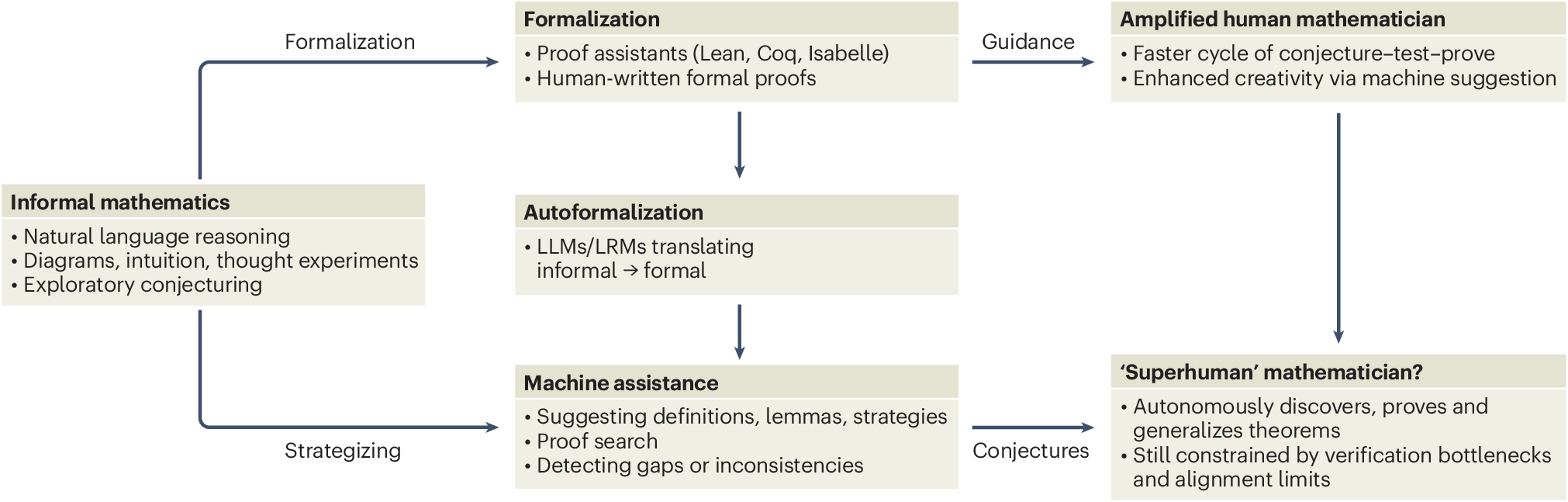
In this comment, we consider how artificial intelligence tools are reshaping the way mathematical research is conducted and discuss how future developments of this technology will transform mathematical practice.
Mathematics in the age of AI
An essay, based on a public lecture delivered at the 2026 International Congress of Mathematicians, on how the mathematical community might respond to the arrival of artificial intelligence tools that are capable of performing research-level mathematical tasks. Rather than debating the capabilities of such tools, we condition on the hypothesis that these capabilities will arrive, and examine instead a question that is orthogonal to it: what the goals and values of mathematical research actually are. The problem-solving component of mathematics is used as a case study.

The AI Revolution in Math Has Arrived | Quanta Magazine
AI is being used to prove new results at a rapid pace. Mathematicians think this is just the beginning.
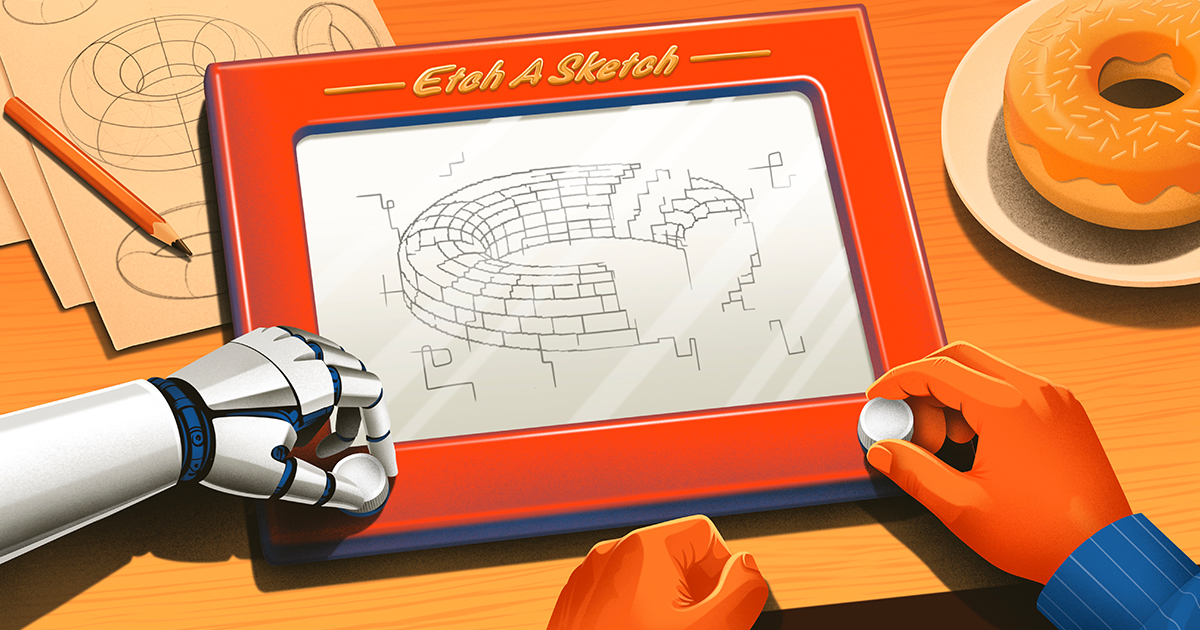
Embracing AI and formalization: Experimenting with tomorrow’s mathematical tools
Embracing AI and formalization: Experimenting with tomorrow’s mathematical tools. By Jarod Alper
Is AI the End of Math As We Know It? | Quanta Magazine
Mathematicians are facing the sudden shift with grief, anger, and a desperate search for fresh ideas: “If we don’t adapt, there’s just no more math in 50 years.”
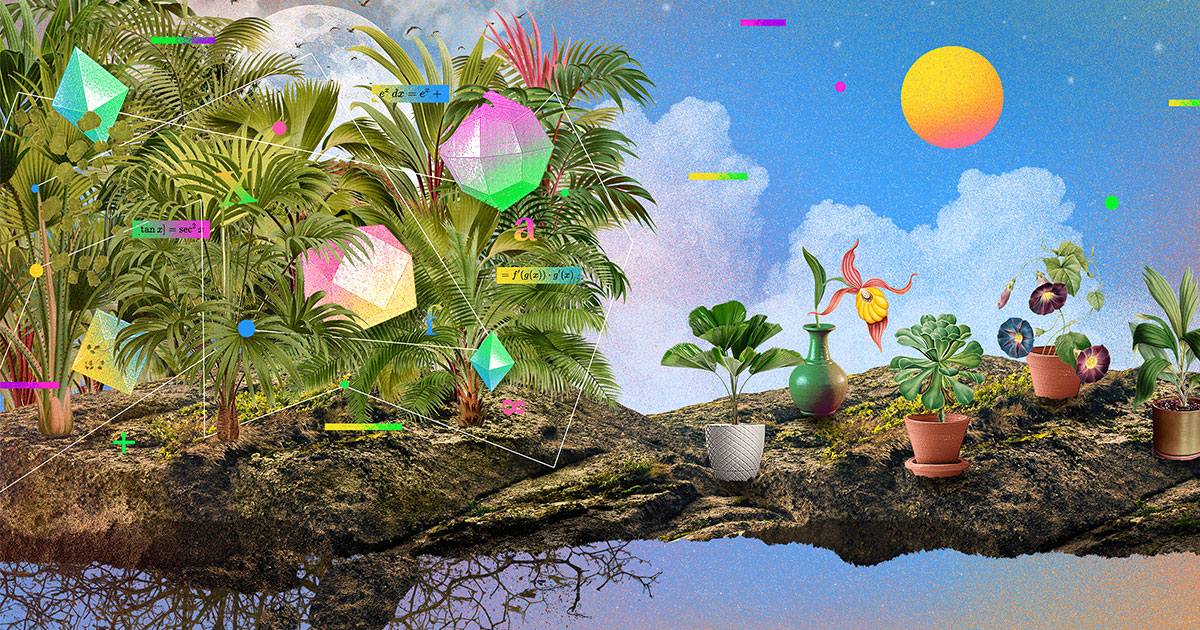
The Technological Turn in Mathematics
Quickly evolving technologies, such as Interactive Theorem Provers (ITPs), Automated Theorem Provers (ATPs), and Large Language Models (LLMs), all falling under the general heading 'AI for mathematics,' are transforming mathematical practice in profound ways. This chapter explores the implications of these innovations, focusing on their impact on how mathematical knowledge is created and shared. It also discusses how they are reshaping the social dimension of mathematics, altering collaboration dynamics, trust relationships, and the collective production of knowledge. For instance, tools like ITPs facilitate large-scale collaborations and make new types of teamwork possible, where trust is not a necessary ingredient. ITPs also help us mitigate our human fallibility, yet they raise questions about the nature of formalization and the relationship between traditional and formal mathematics. Technologies such as LLMs are reshaping the division of epistemic labour between humans and machines and urge philosophers of mathematics to ask questions about the value of their work.
Terence Tao – Kepler, Newton, and the true nature of mathematical discovery
“And what those stories teach us about how AI will revolutionize math”
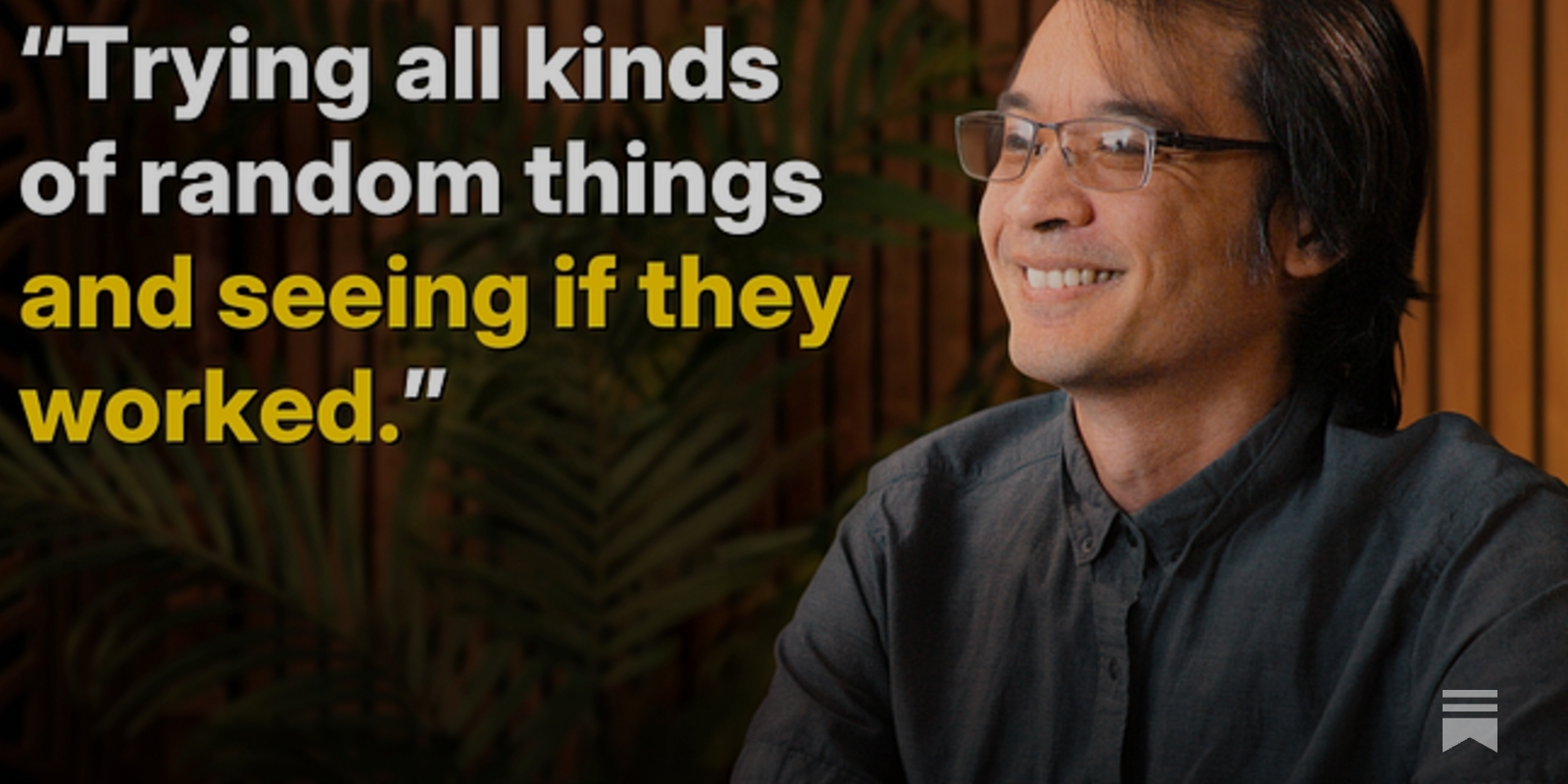
Mathematical Beauty, Truth and Proof in the Age of AI | Quanta Magazine
Mathematicians have started to prepare for a profound shift in what it means to do mathematics.
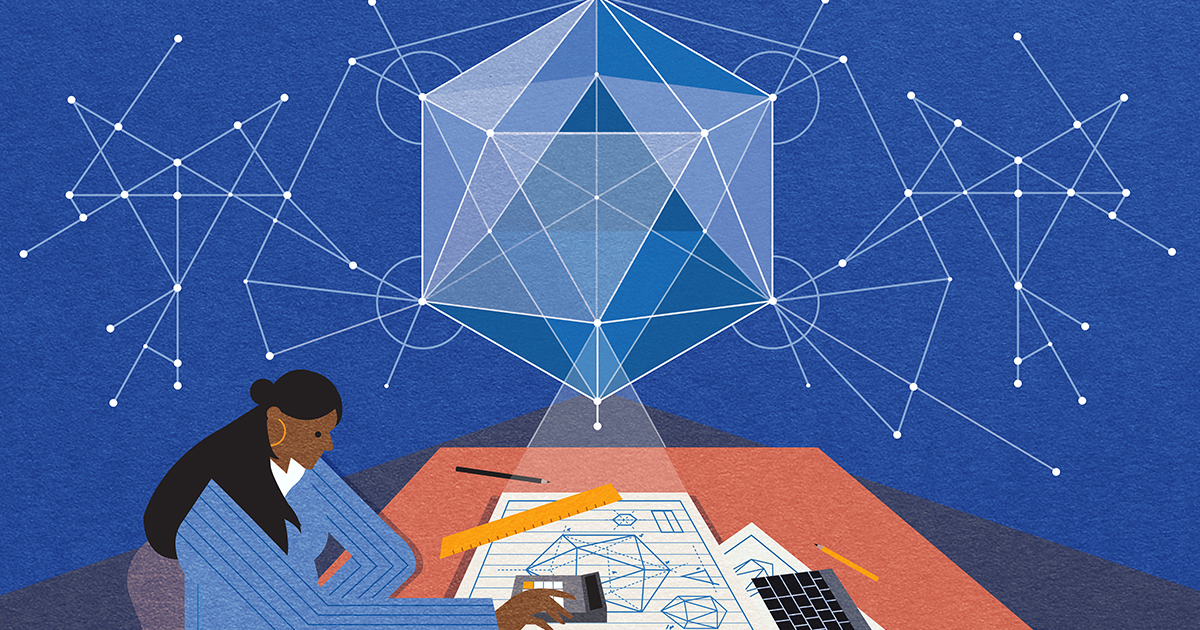
Autonomous Mathematical Discovery in an Open-World Multi-Agent Environment
We study autonomous mathematical discovery in the Station, an open-world multi-agent environment in which AI agents from different model families pursue a shared research goal without a central...
Announcing the Advisory Group on Mathematics and Artificial Intelligence
[This is a guest post by the Advisory Group on Mathematics and Artificial Intelligence. This blog post was initially written in a different file format and converted using AI. — T.] We would …

Can AI replace mathematicians? Vienna researchers weigh in
In September, OpenAI announced that some 10,000 AI agents partially 'solved' the Navier–Stokes problem, one of the most prestigious open challenges in mathematics. University of Vienna mathematicians Nathanaël Berestycki and Vera Fischer agree that the field will never be the same, but argue that maths is far more than producing proofs at speed.

AI co-mathematician: Accelerating mathematicians with agentic AI
We introduce the AI co-mathematician, a workbench for mathematicians to interactively leverage AI agents to pursue open-ended research. The AI co-mathematician is optimized to provide holistic support for the exploratory and iterative reality of mathematical workflows, including ideation, literature search, computational exploration, theorem proving and theory building. By providing an asynchronous, stateful workspace that manages uncertainty, refines user intent, tracks failed hypotheses, and outputs native mathematical artifacts, the system mirrors human collaborative workflows. In early tests, the AI co-mathematician helped researchers solve open problems, identify new research directions, and uncover overlooked literature references. Besides demonstrating a highly interactive paradigm for AI-assisted mathematical discovery, the AI co-mathematician also achieves state of the art results on hard problem-solving benchmarks, including scoring 48% on FrontierMath Tier 4, a new high score among all AI systems evaluated.
We’re gonna need a lot more mathematicians
[This is a guest post by Amit Sahai. This blog post was initially written in a different file format and converted using AI. — T.] When I was an undergraduate student, I remember talking with…
Ale×ey on Twitter / X
Funniest possible outcome of new ai math proofs publications would be that explosive progress cannot be delivered through individual genius and singular products but only through contextualized human understanding and embedding of knowledge.— Ale×ey (@EqualParallel) October 7, 2026
Leiden Declaration on Artificial Intelligence and Mathematics
This declaration calls for action to address the challenges posed by the use of artificial intelligence within mathematics research.
Leiden Declaration on Artificial Intelligence and Mathematics
This declaration calls for action to address the challenges posed by the use of artificial intelligence within mathematics research.
Leiden Declaration on Artificial Intelligence and Mathematics
This declaration calls for action to address the challenges posed by the use of artificial intelligence within mathematics research.