

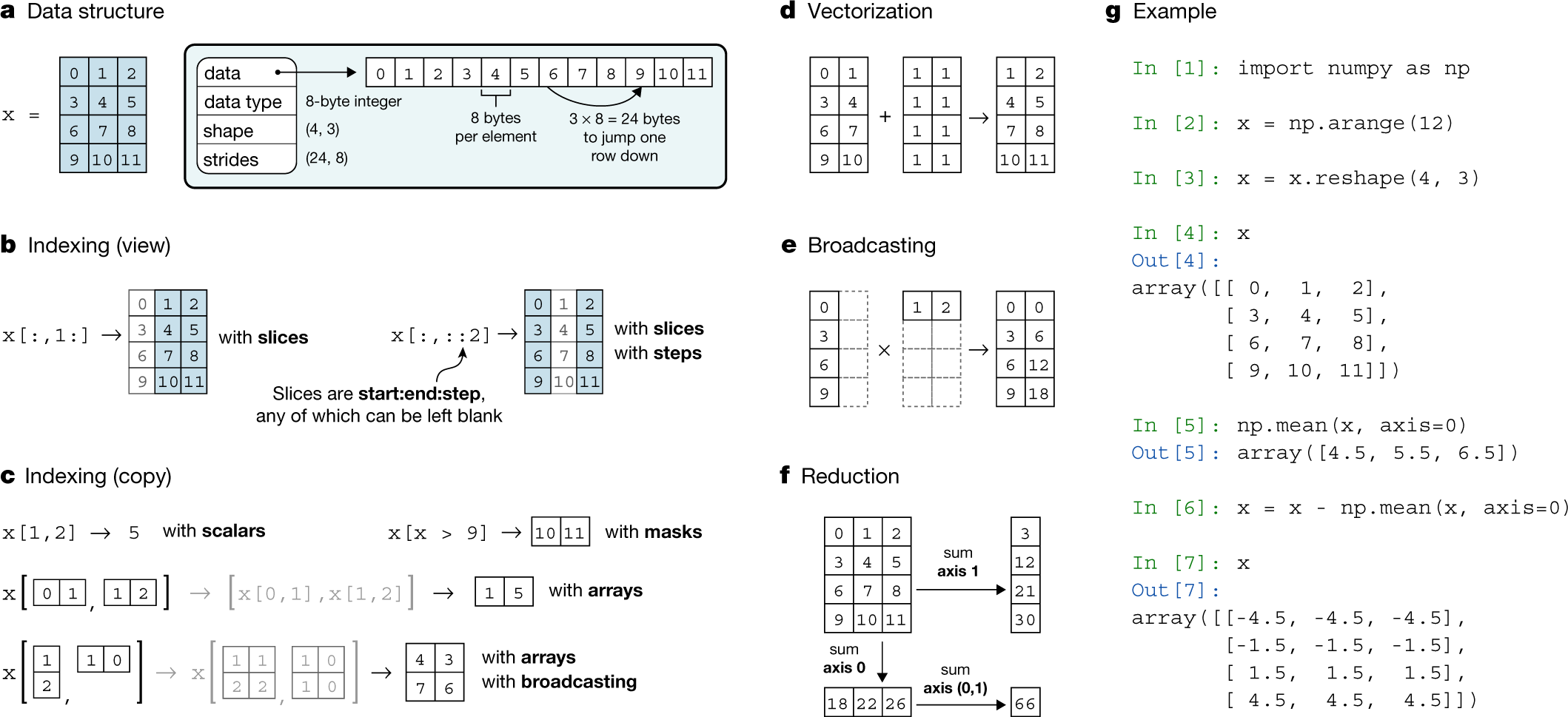
Array programming provides a powerful, compact and expressive syntax for accessing, manipulating and operating on data in vectors, matrices and higher-dimensional arrays. NumPy is the primary array programming library for the Python language. It has an essential role in research analysis pipelines in fields as diverse as physics, chemistry, astronomy, geoscience, biology, psychology, materials science, engineering, finance and economics. For example, in astronomy, NumPy was an important part of the software stack used in the discovery of gravitational waves1 and in the first imaging of a black hole2. Here we review how a few fundamental array concepts lead to a simple and powerful programming paradigm for organizing, exploring and analysing scientific data. NumPy is the foundation upon which the scientific Python ecosystem is constructed. It is so pervasive that several projects, targeting audiences with specialized needs, have developed their own NumPy-like interfaces and array objects. Owing to its central position in the ecosystem, NumPy increasingly acts as an interoperability layer between such array computation libraries and, together with its application programming interface (API), provides a flexible framework to support the next decade of scientific and industrial analysis.
SciPy 1.0: fundamental algorithms for scientific computing in Python
SciPy is an open-source scientific computing library for the Python programming language. Since its initial release in 2001, SciPy has become a de facto standard for leveraging scientific algorithms in Python, with over 600 unique code contributors, thousands of dependent packages, over 100,000 dependent repositories and millions of downloads per year. In this work, we provide an overview of the capabilities and development practices of SciPy 1.0 and highlight some recent technical developments.

Matplotlib: A 2D Graphics Environment
Matplotlib is a 2D graphics package used for Python for application development, interactive scripting,and publication-quality image generation across user interfaces and operating systems
12 Python Data Visualization Libraries to Explore for Business Analysis | Mode
This list is an overview of 10 interdisciplinary Python data visualization libraries including matplotlib, Seaborn, Plotly, Bokeh, pygal, geoplotlib, & more.
mmann1123/pyGIS
pyGIS is an online textbook covering all the core geospatial functionality available in Python. This includes handling vector and raster data, satellite remote sensing, machine learning and deep learning applications.
Why Futhark?
A high-performance and high-level purely functional data-parallel array programming language that can execute on the GPU and CPU.
Stargazer: A Scalable Model-Fitting Benchmark Environment for AI Agents under Astrophysical Constraints
The rise of autonomous AI agents suggests that dynamic benchmark environments with built-in feedback on scientifically grounded tasks are needed to evaluate the capabilities of these agents in research work. We introduce Stargazer, a scalable environment for evaluating AI agents on dynamic, iterative physics-grounded model-fitting tasks using inference on radial-velocity (RV) time series data. Stargazer comprises 120 tasks across three difficulty tiers, including 20 real archival cases, covering diverse scenarios ranging from high-SNR single-planet systems to complex multi-planetary configurations requiring involved low-SNR analysis. Our evaluation of eight frontier agents reveals a gap between numerical optimization and adherence to physical constraints: although agents often achieve a good statistical fit, they frequently fail to recover correct physical system parameters, a limitation that persists even when agents are equipped with vanilla skills. Furthermore, increasing test-time compute yields only marginal gains, with excessive token usage often reflecting recursive failure loops rather than meaningful exploration. Stargazer presents an opportunity to train, evaluate, scaffold, and scale strategies on a model-fitting problem of practical research relevance today. Our methodology to design a simulation-driven environment for AI agents presumably generalizes to many other model-fitting problems across scientific domains. Source code and the project website are available at https://github.com/Gudmorning2025/Stargazer and https://gudmorning2025.github.io/Stargazer, respectively.

Python Tutorial | Learn Python Programming Language - GeeksforGeeks
Your All-in-One Learning Portal: GeeksforGeeks is a comprehensive educational platform that empowers learners across domains-spanning computer science and programming, school education, upskilling, commerce, software tools, competitive exams, and more.

hodgesmr/neural_network_from_scratch
A Jupyter notebook building and training a Neural Network from scratch with NumPy
Linking the world's research to the code it runs on - OpenAlex blog
Research relies on software. Software written by scientists, for science, runs through the entire modern research stack: NumPy and SciPy, R and ggplot2, Jupyter, BLAST, ImageJ, AlphaFold. Yet in the scholarly record, that software is nearly invisible. Software is not usually cited formally in publications and is usually just mentioned in the text, which means […]

You don't know Bash: An introduction to Bash arrays
Enter the weird, wondrous world of Bash arrays.

Early science acceleration experiments with GPT-5
AI models like GPT-5 are an increasingly valuable tool for scientists, but many remain unaware of the capabilities of frontier AI. We present a collection of short case studies in which GPT-5 produced new, concrete steps in ongoing research across mathematics, physics, astronomy, computer science, biology, and materials science. In these examples, the authors highlight how AI accelerated their work, and where it fell short; where expert time was saved, and where human input was still key. We document the interactions of the human authors with GPT-5, as guiding examples of fruitful collaboration with AI. Of note, this paper includes four new results in mathematics (carefully verified by the human authors), underscoring how GPT-5 can help human mathematicians settle previously unsolved problems. These contributions are modest in scope but profound in implication, given the rate at which frontier AI is progressing.
Pydata Paris Virtual Meetup June 2021
relevant_tools.csv · darkshapes/relevant_tools at main
We’re on a journey to advance and democratize artificial intelligence through open source and open science.

Data Structures for Statistical Computing in Python
In this paper we are concerned with the practical issues of working with data sets common to finance, statistics, and other related fields. pandas is a new library which aims to facilitate working with these data sets and to provide a set of fundamental building blocks for implementing statistical models.
Deep Learning with Python
Start building deep learning applications with Python and Keras today!

An AI Agent Published a Hit Piece on Me
Scott Shambaugh helps maintain the excellent and venerable matplotlib Python charting library, including taking on the thankless task of triaging and reviewing incoming pull requests. A GitHub account called @crabby-rathbun …